
Quick Answer
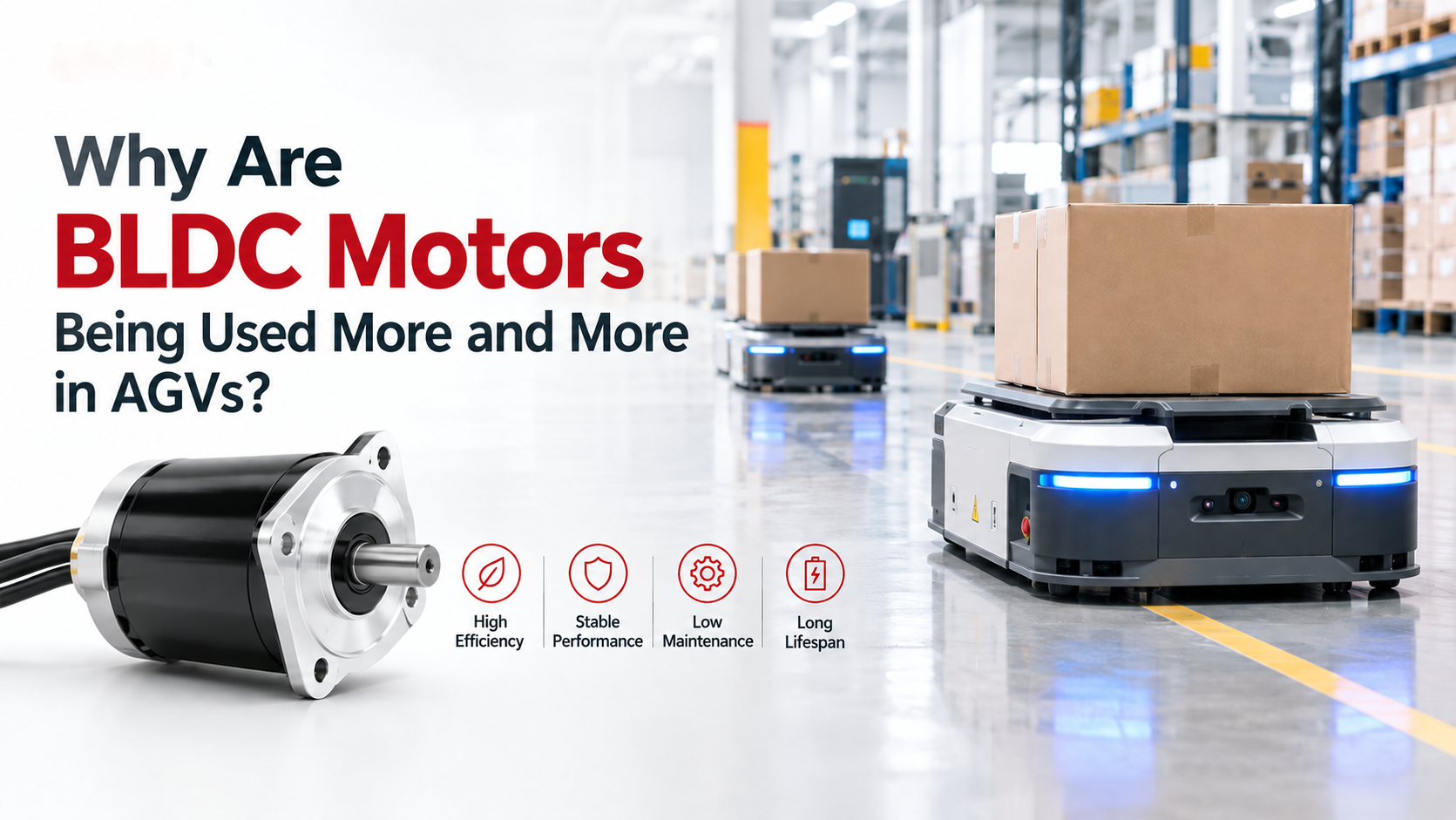
BLDC motors are increasingly used in AGVs because they provide high efficiency, compact size, precise speed control, low maintenance, and long operating life, making them well suited for battery-powered mobile equipment that must repeatedly start, stop, accelerate, decelerate, and change direction.
Compared with brushed DC motors, a BLDC motor uses electronic commutation rather than mechanical brushes and a commutator, which eliminates brush wear and reduces routine maintenance. For AGV manufacturers, BLDC motors can also be combined with gearboxes, Hall sensors, encoders, and integrated drivers, providing greater flexibility when designing different drive systems.
United Motion Inc. offers BLDC motors in 28–110 mm frame sizes, with options for gearboxes and feedback devices, supporting applications that require compact dimensions, controlled speed, and reliable continuous operation.
Why Are BLDC Motors a Good Choice for AGVs?
AGVs operate differently from many conventional industrial machines. Instead of running at one fixed speed under a relatively stable load, an AGV may spend its working day repeatedly accelerating, stopping, reversing, turning, carrying different payloads, and traveling over different floor conditions.
This places greater demands on the drive motor.
A suitable AGV motor needs to provide not only sufficient power, but also efficient operation, good low-speed control, reliable starting, compact dimensions, and the ability to work with a motor controller and feedback system.
This is where BLDC motor technology becomes particularly attractive.
1. High Efficiency Helps Extend AGV Battery Operating Time
Battery capacity is one of the most important limitations of an AGV.
The drive motor consumes a significant portion of the electrical energy used by the vehicle, particularly when the AGV is carrying a heavy payload or repeatedly accelerating.
BLDC motors are generally more efficient than comparable brushed DC motors because they eliminate mechanical brush losses and use electronic commutation to control the motor.
The U.S. Department of Energy has emphasized the importance of motor-system efficiency and variable-speed control in reducing energy consumption in electric motor applications. U.S. Department of Energy, motor-system guidance, 2018–2026.
For an AGV fleet operating many hours every day, improving average drive-system efficiency can reduce battery consumption and help increase operating time between charging cycles.
Engineering takeaway: For battery-powered AGVs, motor efficiency should be evaluated together with the controller, gearbox, wheel, and actual operating duty cycle.
2. Compact BLDC Motors Save Valuable Space
AGVs are often designed to operate in narrow warehouse aisles, production lines, storage areas, and automated material-handling systems, so the available space for the drive system can be limited.
BLDC motors offer a high power-to-size ratio, allowing engineers to obtain the required motor output without using an unnecessarily large motor.
United Motion Inc.’s BLDC motor range covers 28–110 mm frame diameters, providing different size options for compact mobile equipment and larger AGV drive systems.
Depending on the application, the motor can also be combined with a gearbox to create a compact BLDC gear motor suitable for wheel-drive applications.
3. Precise Speed Control Improves AGV Movement
An AGV does not simply need to move; it needs to move predictably.
During normal operation, the vehicle may need to travel quickly between workstations and then slow down smoothly when approaching a pallet, conveyor, charging station, or docking position.
A BLDC motor works with an electronic controller, which allows the system to regulate motor speed and acceleration much more precisely than a simple fixed-speed motor.
Depending on the control requirements, the motor can use:
- Hall sensors
- Encoders
- Sensorless control
- External motor drivers
- Integrated drivers
United Motion Inc. provides BLDC motor configurations with Hall sensors, encoders, gearboxes, and driver integration, allowing the motor configuration to be matched to the AGV’s control requirements.
4. Low Maintenance Is Important for AGV Fleets
One of the biggest advantages of BLDC motors is the absence of mechanical brushes.
In a brushed DC motor, the brushes and commutator gradually wear during operation and may eventually require maintenance or replacement.
A BLDC motor eliminates these components and performs commutation electronically.
| Feature | BLDC Motor | Brushed DC Motor |
| Mechanical brushes | No | Yes |
| Brush wear | No | Yes |
| Maintenance | Low | Higher |
| Electronic speed control | Excellent | Available |
| Long continuous operation | Well suited | More maintenance required |
| AGV suitability | Excellent | Application dependent |
This advantage becomes especially important when an AGV fleet contains dozens or hundreds of vehicles because reducing individual maintenance requirements can significantly reduce total fleet downtime.
5. BLDC Motors Can Provide the Torque AGVs Need Through Gear Reduction
An AGV wheel normally requires relatively high torque at a comparatively low rotational speed.
A BLDC motor can therefore be paired with a gearbox to reduce motor speed and increase output torque.
This combination is commonly used in:
- AGV wheel drives
- Autonomous mobile robots
- Warehouse robots
- Material-handling equipment
- Conveyor drive systems
- Compact lifting mechanisms
The gearbox ratio should be selected according to the vehicle weight, wheel diameter, required travel speed, acceleration, and floor conditions.
A common mistake is selecting the motor only according to its wattage while ignoring the required wheel torque and gearbox ratio. A motor with adequate rated power may still fail to provide sufficient starting or climbing performance if the drivetrain is incorrectly matched.
6. Hall Sensors and Encoders Provide Different Control Advantages
Not every AGV requires the same feedback system.
A simple AGV with relatively basic speed requirements may use Hall sensors or even sensorless control, while an AGV requiring more accurate positioning and speed regulation may benefit from an encoder.
| Requirement | Suitable Configuration |
| Basic motor control | Sensorless BLDC |
| Reliable starting | Hall sensor BLDC |
| Stable low-speed control | Hall sensor or encoder |
| Accurate speed feedback | Encoder |
| Precise positioning | Encoder + closed-loop controller |
| Advanced motion control | Encoder + suitable driver |
For AGV applications, engineers should consider the feedback device during the initial motor-selection process rather than treating it as an optional component added later.
How to Select a BLDC Motor for an AGV?
Step 1: Determine the Vehicle Weight
Consider both the AGV’s own weight and its maximum payload.
Step 2: Determine the Required Travel Speed
The motor speed and gearbox ratio should be selected according to the required wheel speed and vehicle travel speed.
Step 3: Check Starting and Acceleration Requirements
The motor must provide sufficient torque when the AGV starts from rest, accelerates, turns, or travels up an incline.
Step 4: Select the Gearbox
A gearbox can increase output torque while reducing wheel speed, allowing the motor to operate within a suitable speed range.
Step 5: Select Feedback
Choose Hall sensors, an encoder, or sensorless control according to the required speed and positioning accuracy.
Step 6: Check Thermal Performance
Do not evaluate the motor only under no-load conditions. Continuous operation, repeated acceleration, payload variation, ambient temperature, and installation conditions all affect motor temperature.
Common BLDC Motor Problems in AGVs
| Problem | Possible Cause | Recommended Solution |
| Motor overheats | Excessive continuous load | Check continuous torque and thermal conditions |
| AGV struggles to start | Insufficient starting torque | Recheck motor and gearbox selection |
| Poor low-speed movement | Inappropriate feedback/control | Consider Hall sensors or encoder feedback |
| Short battery runtime | Low drive-system efficiency | Evaluate motor, driver, and gearbox together |
| Excessive vibration | Mechanical or commutation issues | Check mounting, gearbox, wheel, and motor control |
| Controller frequently trips | Current or voltage mismatch | Match motor and driver specifications |
| Positioning is inaccurate | Insufficient feedback resolution | Use an appropriate encoder system |
NIST research on autonomous mobile robots identifies factors such as uneven floors, wheel slippage, vibration, dynamic loads, and docking performance as important considerations when evaluating mobile robotic systems. National Institute of Standards and Technology (NIST), 2024–2026.
Common Mistakes When Choosing an AGV BLDC Motor
Choosing Only by Motor Wattage
A motor’s rated power does not tell the complete story. Engineers should also consider torque, speed, peak load, duty cycle, gearbox ratio, feedback, and thermal performance.
Ignoring Peak Loads
An AGV may operate normally most of the time but require significantly higher torque during starting, acceleration, turning, or climbing.
Selecting the Motor Before the Gearbox
The motor and gearbox should be considered as one drivetrain because the gearbox directly affects wheel speed and output torque.
Using the Same Motor for Every AGV
Different AGVs may have different payloads, wheel sizes, speeds, duty cycles, and control requirements. A customized BLDC motor solution can often provide better system performance than simply using one standard motor across an entire product range.
Conclusion
The growing use of BLDC motors in AGVs is driven by several complementary advantages rather than a single specification. High efficiency helps battery-powered vehicles operate longer, compact construction simplifies mechanical integration, electronic commutation enables accurate speed control, and the absence of mechanical brushes reduces maintenance.
When combined with gearboxes, Hall sensors, encoders, and BLDC motor drivers, these advantages make BLDC technology suitable for a wide range of AGV and autonomous mobile robot applications.
For AGV manufacturers and system integrators, the most important consideration is not simply choosing a motor with the correct wattage. The motor, gearbox, feedback system, controller, wheel, payload, and operating environment should be evaluated as one complete motion-control system.
United Motion Inc. provides customizable BLDC motors, gear motors, encoder solutions, and integrated motion-control options for OEM applications requiring application-specific voltage, speed, torque, dimensions, and feedback configurations.
FAQ
1. Why are BLDC motors increasingly used in AGVs?
BLDC motors offer high efficiency, compact size, precise electronic speed control, low maintenance, and long operating life, making them well suited for battery-powered AGVs.
2. Are BLDC motors better than brushed DC motors for AGVs?
For many AGV applications, BLDC motors are preferred because they eliminate brush wear and provide more flexible electronic speed and torque control.
3. Do AGV BLDC motors need Hall sensors?
Not necessarily. Sensorless BLDC motors can be used in some applications, while Hall sensors or encoders are preferable when reliable low-speed operation or more accurate control is required.
4. Should an AGV use a BLDC motor with a gearbox?
Many AGV drive systems use a gearbox because the vehicle typically requires high wheel torque at relatively low wheel speed.
5. What voltage can be used for an AGV BLDC motor?
The appropriate voltage depends on the AGV battery and electrical architecture. 24 V and 48 V BLDC motor systems are common choices for compact and mobile equipment, although other voltage configurations are also possible.
6. Can BLDC motors be customized for AGVs?
Yes. United Motion Inc. can provide customized BLDC motor solutions involving dimensions, voltage, speed, torque, winding, Hall sensors, encoders, gearboxes, and driver integration.
Related blog: BLDC Motor Applications in Robotics and AGV Systems