
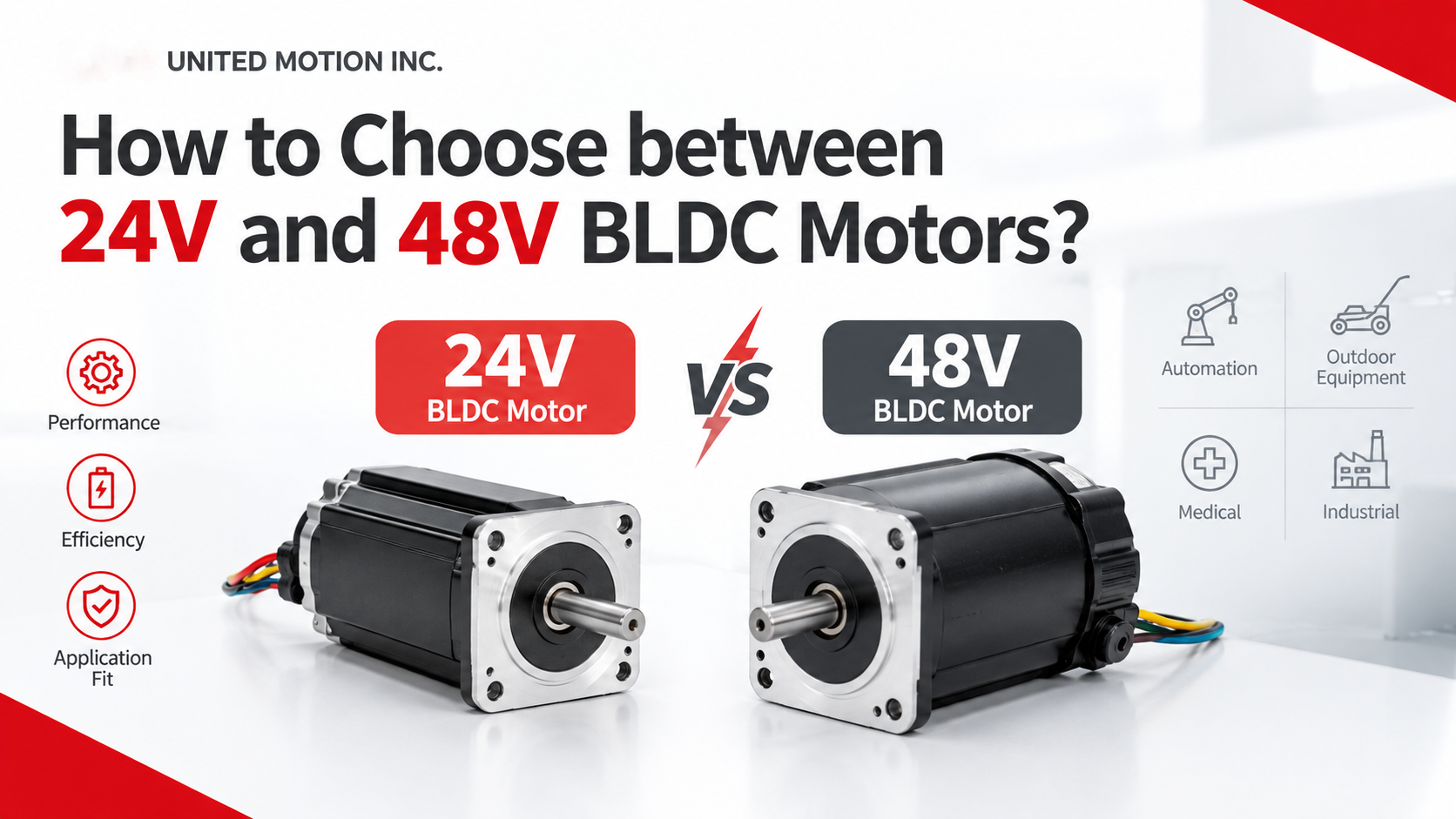
Choosing between a 24V BLDC motor and a 48V BLDC motor is not simply a matter of selecting the higher voltage. For an engineer, the correct choice depends on required mechanical power, continuous and peak torque, operating speed, controller compatibility, battery architecture, cable length, thermal conditions, duty cycle, and the available installation space.
In general, 24V BLDC motors are well suited to compact, low-to-medium-power motion systems, while 48V BLDC motors become increasingly attractive as system power and continuous current increase. However, the motor, controller, power supply, wiring, and protection devices must be designed as one electrical system.
Quick Answer: 24V or 48V BLDC Motor?
Choose 24V when the application has moderate power requirements, a 24V battery or DC supply is already available, compact control electronics are preferred, and current levels remain practical for the wiring and controller.
Choose 48V when the application requires higher power, longer cable runs, higher continuous output, or lower system current at the same power level.
The basic relationship is:
P = V × I
Therefore, for approximately the same electrical input power, doubling the voltage from 24V to 48V theoretically reduces current by about half.
For example, a 1,000 W electrical load requires approximately:
| System Voltage | Approximate Current at 1,000 W |
| 24V | 41.7 A |
| 48V | 20.8 A |
Actual motor and controller current will vary with efficiency, operating point, power factor-equivalent effects in the drive system, and transient requirements.
The lower current of a 48V system can reduce resistive cable losses because copper loss is proportional to I²R. The U.S. Department of Energy has also emphasized that motor-system efficiency must be evaluated at the system level, including the motor, drive, operating conditions, and application rather than by considering the motor alone.
What Is the Difference Between a 24V and 48V BLDC Motor?
A BLDC motor uses permanent magnets in the rotor and electronic commutation instead of mechanical brushes and a commutator. A suitable motor controller switches the three-phase windings according to rotor position.
United Motion Inc. offers BLDC motors from 28 mm to 110 mm frame diameters, with options including Hall sensors, encoder integration, gearbox integration, and driver integration. This means voltage should be treated as only one parameter within the complete motor selection process.
The fundamental difference between 24V and 48V versions is their electrical operating point.
A 48V BLDC motor is not automatically capable of producing twice the torque of a 24V motor. Torque is primarily determined by motor electromagnetic design and current, while voltage influences the motor’s available speed range and the electrical power that can be delivered at a given current.
This distinction is important when comparing BLDC motor specifications.
24V vs 48V BLDC Motor Comparison
| Factor | 24V BLDC Motor | 48V BLDC Motor |
| Typical system power | Low to medium | Medium to higher |
| Current for same power | Higher | Approximately half |
| Cable loss at same power | Higher | Lower |
| Cable size | May need larger conductors | Can often use smaller conductors |
| Battery architecture | Simple for many systems | Suitable for higher-voltage battery packs |
| Controller selection | 24V-rated controller | 48V-rated controller |
| Low-voltage integration | Very convenient | More demanding |
| High-power scalability | Current can become significant | Generally more practical |
| Safety considerations | Lower electrical voltage | Requires greater attention to insulation and protection |
| Typical applications | Robotics, automation, compact equipment | E-bikes, mobility, industrial equipment, higher-power machinery |
These are engineering tendencies rather than rigid application rules. A properly designed 24V system can outperform a poorly designed 48V system.
When Should You Choose a 24V BLDC Motor?
1. The Required Power Is Relatively Moderate
If your application operates at several hundred watts and the current remains within a practical range for the controller, connectors, wiring, and battery, 24V can be an effective solution.
For example, a 500 W electrical load theoretically requires approximately 20.8 A at 24V, before accounting for system losses.
24V is often convenient for compact automation equipment, pumps, medical equipment, small robotic mechanisms, and battery-powered systems where the existing power architecture is already 24V.
2. The Existing Power Supply Is 24V
If the machine already contains a 24V DC power supply, PLC architecture, sensors, relays, or battery system, using a 24V BLDC motor can simplify integration.
Changing to 48V may require changes to the motor controller, protection devices, wiring, connectors, battery configuration, and DC/DC converters.
3. Compact Control Architecture Is Important
A 24V architecture can be convenient when the motor is integrated into a larger low-voltage control system.
United Motion Inc. supports BLDC motor customization involving voltage, winding design, shaft configuration, mounting flange, Hall sensors, encoders, gearboxes, and driver integration, allowing the motor to be matched to the application rather than forcing the machine around a standard motor.
When Should You Choose a 48V BLDC Motor?=
1. The Application Requires Higher Power
As power increases, current can quickly become a major design constraint.
Consider a 2 kW electrical load:
24V: approximately 83.3 A
48V: approximately 41.7 A
This difference affects conductor sizing, connector selection, fuse ratings, controller current capacity, battery design, and thermal management.
2. Cable Loss Is Becoming a Problem
Copper loss can be approximated by:
P_loss = I²R
If current is reduced by half while resistance remains unchanged, resistive loss theoretically falls to one-quarter.
For this reason, 48V can be advantageous for systems with relatively long cable runs or higher continuous power. However, the actual improvement depends on conductor resistance, duty cycle, connector resistance, controller efficiency, and motor operating conditions.
DOE/NREL materials on motor systems identify winding resistance losses as an important component of motor losses and emphasize proper motor-system selection and operation.
3. Battery-Powered Equipment Needs Higher Power Density
Higher-voltage architectures are increasingly useful when a battery-powered machine needs substantial mechanical output without allowing current to become excessive.
This can be relevant to:
Electric bikes
Agricultural equipment
Electric lawn equipment
Industrial automation
Mobile machinery
Robotics
Higher-power pumps
Electric mobility systems
United Motion Inc. lists electric bikes, lawn equipment, solar tracking, robotics, pumps, and industrial automation among BLDC motor application areas.
Step-by-Step: How to Select the Correct Voltage
Step 1: Calculate Required Mechanical Power
Start with:
P_mechanical = T × ω
where:
P = mechanical power in watts
T = torque in N·m
ω = angular velocity in rad/s
For RPM:
P(W) = T(N·m) × RPM / 9.55
Do not select the motor based only on voltage.
Step 2: Determine Continuous and Peak Torque
Identify both:
Continuous operating torque
Peak or acceleration torque
A motor that can produce sufficient peak torque for a few seconds may still overheat if its continuous torque requirement exceeds the thermal rating.
United Motion Inc.’s BLDC motor selection guidance specifically recommends determining continuous and peak torque before selecting the motor.
Step 3: Estimate Current
A simplified estimate is:
I ≈ P / (V × η)
where η represents the combined electrical and mechanical efficiency.
For example, assuming 90% efficiency:
| Output Power | 24V Approx. Input Current | 48V Approx. Input Current |
| 500 W | 23.1 A | 11.6 A |
| 1,000 W | 46.3 A | 23.1 A |
| 2,000 W | 92.6 A | 46.3 A |
These values are estimates; actual current depends on motor speed, torque, controller efficiency, acceleration, and operating conditions.
Step 4: Match the BLDC Motor Controller
A BLDC motor requires an electronic controller to perform phase commutation and regulate current.
The controller must match:
Motor voltage
Continuous current
Peak current
Hall sensor configuration
Encoder interface, if applicable
Speed range
Control method
Communication interface
Regenerative braking requirements
A 24V controller should not simply be connected to a 48V motor system, and vice versa.
Step 5: Check Thermal Performance
Motor temperature is often a more important reliability factor than nominal voltage.
Check:
Ambient temperature
Motor mounting conditions
Continuous torque
Continuous current
Cooling method
Duty cycle
Enclosure
Bearing temperature
Controller thermal limits
Overloading, excessive current, inadequate cooling, incorrect controller settings, and operation beyond the rated duty cycle are common causes of BLDC motor overheating.
Common 24V/48V BLDC Motor Selection Mistakes
| Problem | Likely Cause | Engineering Solution |
| Motor overheats | Excessive continuous current | Recalculate continuous torque and thermal load |
| Controller trips | Peak current too high | Check acceleration and peak torque |
| Cable becomes hot | Excessive current or undersized wiring | Reduce current or increase conductor size |
| Motor cannot reach target RPM | Incorrect winding/KV selection | Match winding and voltage to speed requirement |
| Poor low-speed operation | Incorrect commutation or feedback | Consider Hall sensors or encoder feedback |
| Battery voltage drops under load | Battery/BMS current limitation | Check battery continuous and peak current ratings |
| Unexpected motor failure | Overload or inadequate cooling | Verify duty cycle and thermal design |
24V vs 48V: Which Is More Efficient?
It is incorrect to say that a 48V BLDC motor is always more efficient than a 24V BLDC motor.
Motor efficiency depends on the motor electromagnetic design, winding resistance, operating speed, torque, controller, and operating point.
However, a 48V architecture can reduce system current for the same power, which can reduce wiring and distribution losses.
The U.S. Department of Energy’s Better Plants program recommends evaluating motor-driven equipment using a systems approach, considering how the motor, drive, controls, load, and operating conditions interact.
Therefore, the better question is not:
“Is 48V more efficient than 24V?”
It is:
“Which voltage allows the complete motor-drive system to meet its power, thermal, cost, safety, and reliability requirements most effectively?”
Practical Recommendation
For a compact machine operating from an existing 24V DC architecture, a 24V BLDC motor is often the logical starting point.
For a higher-power battery system where current is becoming difficult to manage, 48V is often the more practical architecture, particularly when cable length, connector current, battery current, and thermal losses become significant.
The final motor should still be selected according to torque, speed, power, voltage, duty cycle, feedback, gearbox ratio, environmental conditions, and controller compatibility.
United Motion Inc. provides BLDC motor solutions ranging from 28 mm to 110 mm frame sizes, with Hall sensor, encoder, gearbox, and driver integration options, supporting customized OEM requirements across industrial automation, robotics, electric mobility, solar tracking, pumps, and lawn equipment.
FAQ
Is 48V better than 24V for a BLDC motor?
Not necessarily. 48V can reduce current for the same power and therefore simplify high-power electrical distribution, while 24V may be more convenient for lower-power systems and existing 24V control architectures.
Does a 48V BLDC motor produce twice the torque of a 24V motor?
No. Voltage alone does not determine torque. Torque depends strongly on motor electromagnetic design and winding current.
Can I use a 48V controller with a 24V BLDC motor?
Only if the motor and controller are specifically designed for that operating range. Always follow the manufacturer’s rated voltage and controller specifications.
Is 24V or 48V better for electric bikes?
Both architectures are used. The correct choice depends on required power, battery capacity, controller current, target speed, motor winding, and vehicle requirements.
Does 48V reduce BLDC motor heating?
It can reduce current-related electrical losses in the overall system for a given power level, but it does not automatically make the motor cooler. Motor winding losses still depend strongly on current and resistance.
What voltage should I choose for a custom BLDC motor?
Start with the available DC power source, required mechanical power, continuous and peak torque, operating speed, controller architecture, wiring distance, duty cycle, and thermal requirements. The motor winding should then be designed around the selected operating point.