
Quick Answer
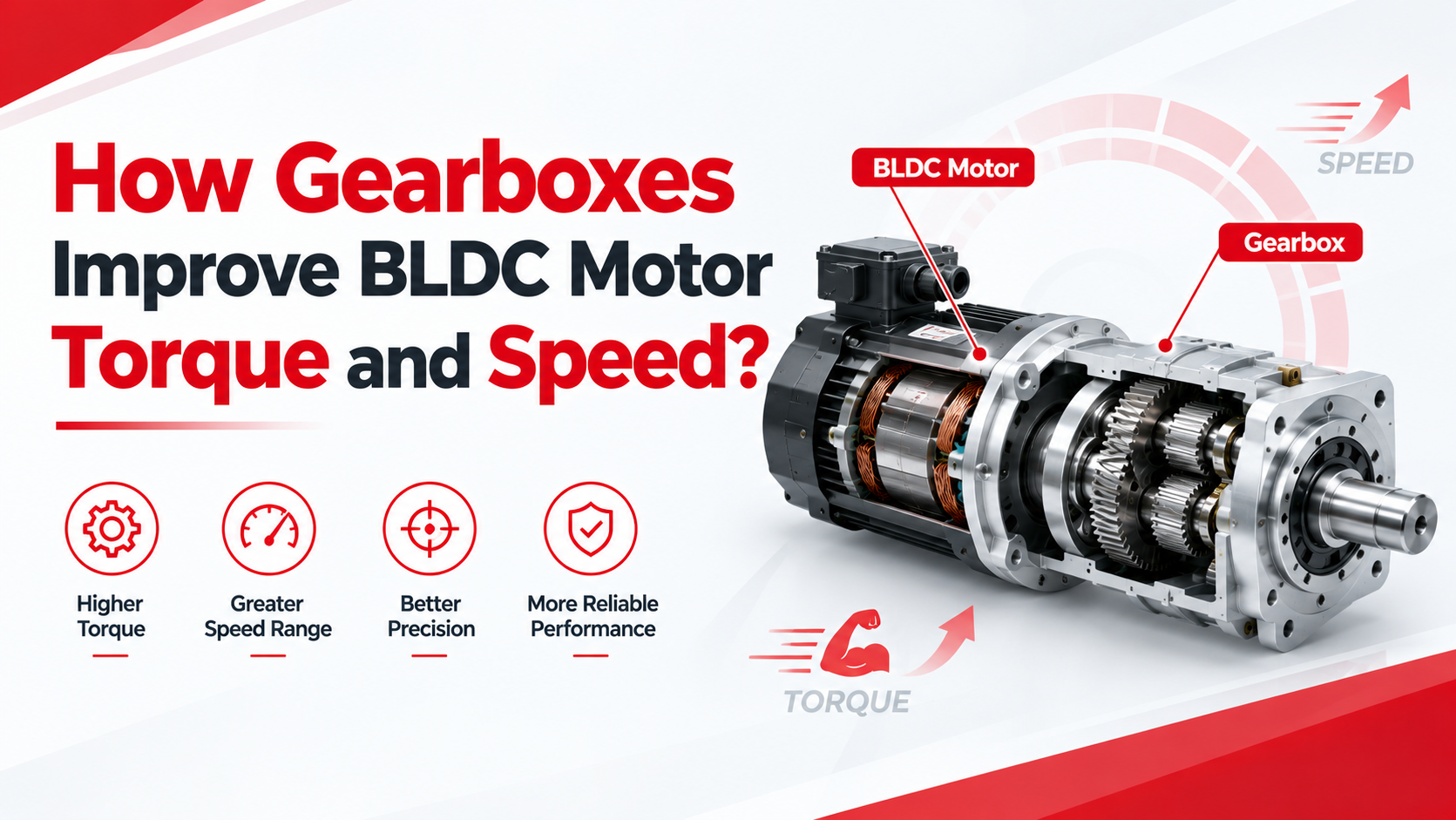
A gearbox improves the usable output of a Brushless DC (BLDC) motor by reducing rotational speed and increasing output torque, allowing a compact, high-speed motor to drive loads that require greater force, controlled movement, or lower operating speeds.
The gear ratio determines the relationship between motor speed and gearbox output speed, while gearbox efficiency determines how much of the motor’s input power is available at the output. For example, a BLDC motor running at 3,000 rpm connected to a 10:1 gearbox ideally produces an output speed of 300 rpm, with output torque increasing approximately tenfold before accounting for mechanical losses.
The key engineering principle is that a gearbox does not create additional power; it trades speed for torque while introducing some mechanical losses. Selecting the right gearbox ratio, gear type, efficiency, and rated load capacity is therefore essential for achieving reliable performance in robotics, industrial automation, pumps, medical equipment, and other OEM applications.
Why Do BLDC Motors Need Gearboxes?
BLDC motors are widely used because they offer high efficiency, good speed control, compact dimensions, and low maintenance requirements. However, the speed and torque produced directly by a motor may not match the requirements of the driven mechanism.
For example, a motor may operate efficiently at several thousand revolutions per minute, while a conveyor, actuator, or robotic joint requires much lower speed and substantially higher torque.
A gearbox bridges this difference by adapting the motor’s rotational output to the application.
Common reasons for integrating a gearbox with a BLDC motor include:
– Increasing output torque: Suitable gear reduction allows a motor to drive heavier loads.
– Reducing output speed: Gear ratios help match motor speed to the required operating speed.
– Improving load matching: The motor can operate closer to a suitable operating region while the gearbox provides the required mechanical output.
– Supporting compact designs: A relatively small motor can deliver useful torque at the output shaft.
– Improving motion control: A suitable gear ratio can support controlled positioning and low-speed movement when paired with an appropriate controller and feedback system.
How Does a Gearbox Increase BLDC Motor Torque?
A gearbox increases output torque by transmitting rotational force through gears with different tooth counts or effective diameters. In a reduction gearbox, the output shaft rotates more slowly than the motor shaft, while the available output torque increases.
The actual increase depends on both the gear ratio and the mechanical efficiency of the gearbox.
Consider a BLDC motor with a rated output torque of 0.5 N·m connected to a 10:1 reduction gearbox. Under an idealized calculation, the output torque would be 5 N·m; if the gearbox efficiency were 90%, the estimated output torque would instead be approximately 4.5 N·m.
This example illustrates why engineers should evaluate gearbox efficiency rather than assuming that the rated gear ratio translates directly into an identical torque multiplication factor.
The real output torque must also remain within the gearbox’s rated continuous and peak limits.
What affects actual output torque?
– Gear ratio
– Gearbox efficiency
– Motor torque at the operating speed
– Continuous and peak load requirements
– Starting and acceleration loads
– Gear tooth strength and bearing capacity
– Lubrication and operating temperature
Technical basis: Gear-train mechanics and gearbox performance specifications.
How Does a Gearbox Control BLDC Motor Speed?
A gearbox reduces motor speed according to its gear ratio, making it possible to use a high-speed BLDC motor in applications that require slower, more controlled movement.
For example, when a 3,000 rpm BLDC motor is paired with a 5:1 reduction gearbox, the nominal output speed is approximately 600 rpm; increasing the reduction ratio to 20:1 lowers the output speed to approximately 150 rpm, provided that the motor maintains the same input speed and the gearbox operates within its rated limits.
However, a higher reduction ratio is not automatically better, because excessive reduction may limit maximum output speed, increase gearbox size, introduce more backlash, or reduce overall transmission efficiency.
| Gear Ratio | Motor Speed | Approx. Output Speed | Typical Application |
| 3:01 | 3,000 rpm | 1,000 rpm | High-speed drives |
| 5:01 | 3,000 rpm | 600 rpm | Fans and light-duty mechanisms |
| 10:01 | 3,000 rpm | 300 rpm | Conveyors and compact actuators |
| 20:01 | 3,000 rpm | 150 rpm | Robotics and positioning systems |
| 50:01:00 | 3,000 rpm | 60 rpm | Low-speed, higher-torque drives |
These are illustrative values assuming a constant motor speed and idealized gear-ratio behavior; actual operating speed depends on load, motor characteristics, controller settings, and gearbox limitations.
Which Gearbox Is Best for a BLDC Motor?
Different gearbox designs offer different combinations of torque capacity, efficiency, size, backlash, and cost. The best choice depends on the mechanical requirements of the application rather than the motor type alone.
Planetary Gearbox
Planetary gearboxes offer high torque density and a compact coaxial design, making them suitable for robotics, AGVs, automated machinery, and applications where installation space is limited.
Spur Gearbox
Spur gearboxes use relatively simple gear geometry and can provide a cost-effective solution for compact drives, although noise, tooth loading, and backlash must be considered during selection.
Worm Gearbox
Worm gearboxes can provide substantial speed reduction in a compact arrangement, but sliding friction can produce more heat and lower efficiency than some alternative gear designs; self-locking behavior should never be assumed without verifying the specific design and operating conditions.
How to Select the Right Gear Ratio for a BLDC Motor?
Choosing the right gearbox requires engineers to evaluate the complete motor-and-load system rather than selecting a ratio based only on the desired output speed.
Step 1: Define output requirements
Identify the required output speed, continuous torque, peak torque, acceleration time, duty cycle, and available installation space.
Step 2: Check the motor operating range
Confirm that the selected BLDC motor can deliver the required torque at the intended speed without exceeding its current, voltage, or thermal limits.
Step 3: Select the gear ratio
Choose a ratio that matches the motor’s operating speed to the application’s output speed while providing sufficient torque margin.
Step 4: Check gearbox efficiency and ratings
Evaluate continuous output torque, peak load, permissible input speed, efficiency, backlash, bearing loads, and thermal limits.
Step 5: Validate the complete drive system
Test starting performance, acceleration, steady-state operation, temperature rise, vibration, noise, and performance under representative load conditions.
Technical basis: OEM drive-system sizing and validation practice.
Common BLDC Gearbox Problems and Troubleshooting
| Problem | Possible Cause | Recommended Action |
| Insufficient output torque | Incorrect ratio or inadequate motor torque | Recheck load requirements and motor operating point |
| Output speed too low | Excessive reduction or motor speed limitation | Reassess gear ratio and controller settings |
| Gearbox overheating | Excessive load, friction, or unsuitable lubrication | Check loading, lubrication, and thermal limits |
| Excessive noise | Gear wear, misalignment, or backlash | Inspect gears, mounting, and alignment |
| Motor current too high | Overload, poor acceleration settings, or transmission resistance | Measure current and inspect the mechanical load |
| Unstable positioning | Backlash or inadequate feedback/control | Evaluate gearbox precision and encoder feedback |
| Premature gear failure | Repeated shock loads or insufficient torque rating | Review peak torque, service factor, and duty cycle |
Common Engineering Mistakes
Selecting a gearbox based only on its reduction ratio. Two gearboxes with the same ratio may have very different torque ratings, efficiencies, backlash, and service lives.
Ignoring peak torque. Starting, braking, reversing, and rapid acceleration can create loads substantially higher than steady-state operating torque.
Overlooking thermal limits. A gearbox that can withstand a short peak load may not be able to sustain the same load continuously.
Ignoring motor-controller compatibility. A gearbox changes the mechanical operating point, but it does not eliminate the need to verify motor current limits, speed control, and acceleration settings.
Assuming all planetary gearboxes have the same performance. Gear stages, materials, bearing arrangements, lubrication, and manufacturing tolerances all affect the final performance.
BLDC Motor and Gearbox Solutions from UNITED MOTION INC.
UNITED MOTION INC. provides BLDC motor solutions across approximately 28–110 mm frame sizes, with customization options that include gearboxes, encoders, and integrated drivers.
For OEM customers, integrating the motor and gearbox around the actual application requirements can simplify mechanical integration and help achieve the required balance of output torque, speed, efficiency, and installation dimensions.
For example, a compact planetary gearbox may be suitable for a robotic actuator that needs high torque in a limited space, while another application may prioritize lower reduction, higher output speed, or cost-effective transmission.
When developing a custom BLDC motor solution, engineers should evaluate the motor, gearbox, encoder, and driver as one coordinated system rather than selecting each component independently.
Explore UNITED MOTION INC.’s BLDC motor solutions or contact the team through the contact page to discuss OEM motor requirements.
FAQ
1. How does a gearbox increase BLDC motor torque?
A reduction gearbox increases output torque by reducing rotational speed. The actual torque increase depends on the reduction ratio, gearbox efficiency, and the allowable torque ratings of both the motor and gearbox.
2. Does a gearbox reduce BLDC motor speed?
Yes. A reduction gearbox decreases output speed in proportion to its reduction ratio. For example, a 10:1 gearbox produces approximately 300 rpm from a motor running at 3,000 rpm.
3. Which gearbox is best for a BLDC motor?
Planetary gearboxes are often suitable for compact, high-torque applications, spur gearboxes can be appropriate for simpler cost-sensitive designs, and worm gearboxes may suit applications requiring substantial reduction in a compact arrangement.
4. Does a gearbox improve BLDC motor efficiency?
Not necessarily. A gearbox introduces mechanical losses, but it can improve system-level performance by matching motor speed and torque to the application more effectively. Total system efficiency must be evaluated across the actual operating range.
5. How do I calculate the required BLDC motor gearbox ratio?
Start with the required output speed and the motor’s intended operating speed, then select a ratio that provides the desired reduction. Verify that the resulting output torque, gearbox efficiency, peak-load capacity, and thermal performance meet the application requirements.
6. Can UNITED MOTION INC. provide customized BLDC motors with gearboxes?
UNITED MOTION INC. offers BLDC motor solutions with customization options such as gearboxes, encoders, and integrated drivers. Final availability and configuration should be confirmed against the project’s torque, speed, voltage, dimensions, and control requirements.