
Quick Answer
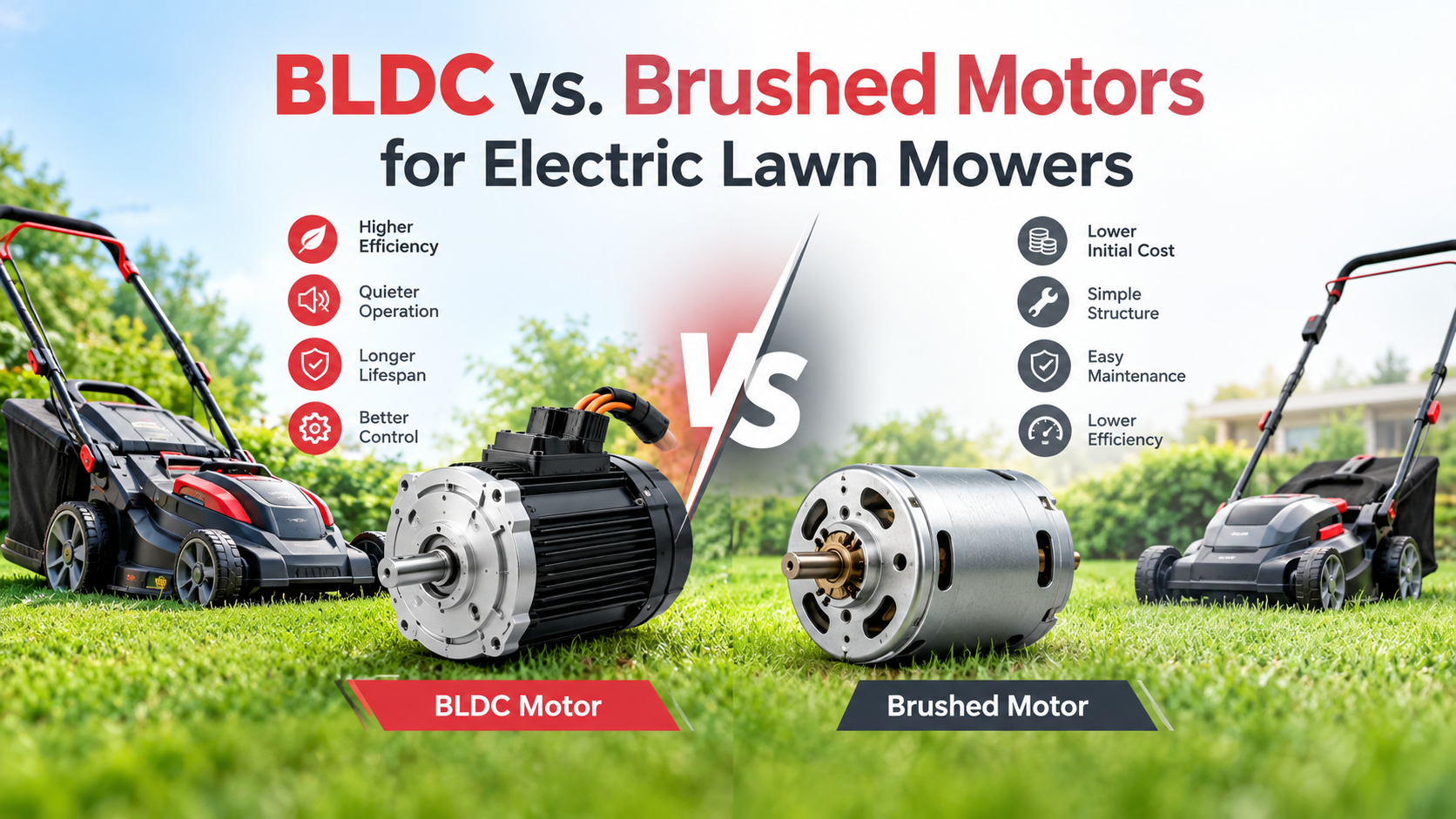
When comparing BLDC vs. brushed motors for electric lawn mowers, BLDC motors generally offer better energy efficiency, longer service life, lower maintenance requirements, and more flexible speed and torque control, making them particularly suitable for modern cordless lawn mowers and commercial electric lawn equipment.
Brushed DC motors remain attractive for cost-sensitive applications because they have a simpler construction, lower initial motor cost, and do not require an electronic commutation controller. However, brush and commutator friction creates additional heat and wear, which can increase maintenance requirements and reduce long-term operating efficiency.
For OEM lawn mower manufacturers, the best choice depends on cutting load, battery capacity, operating time, grass conditi ons, motor cooling, and total cost of ownership. In applications involving wet or thick grass, frequent load changes, and extended operating cycles, a properly designed BLDC motor with an optimized controller can provide significant performance advantages.
How Do BLDC and Brushed Motors Work?
Before selecting a motor for an electric lawn mower, it is important to understand how these two motor technologies generate torque and control rotation.
Brushed DC Motors
A brushed DC motor uses carbon brushes and a mechanical commutator to transfer electrical current to the rotating armature. As the rotor turns, the commutator continuously changes the current direction in the windings, maintaining the electromagnetic force required for rotation.
Its main advantages include simple electrical connections, relatively low initial cost, and straightforward speed control.
However, physical contact between the brushes and commutator creates friction, electrical arcing, and gradual component wear. Over time, brush replacement and commutator maintenance may become necessary.
BLDC Motors
A Brushless DC (BLDC) motor replaces mechanical commutation with electronic commutation. Permanent magnets are installed on the rotor, while the windings are positioned on the stator, and an electronic motor controller energizes the stator phases according to rotor position.
This configuration eliminates brush friction and allows engineers to optimize motor speed, torque, and current according to changing cutting conditions.
For electric lawn mowers, BLDC motors can also work with Hall sensors, sensorless control, or Field-Oriented Control (FOC), depending on the required performance and system cost.
BLDC vs. Brushed Motors: Key Performance Comparison
The differences between these motor technologies become more significant when the mower operates under changing grass density, cutting resistance, and battery conditions.
| Performance Factor | BLDC Motor | Brushed DC Motor |
|---|---|---|
| Energy efficiency | Generally higher | Generally lower |
| Starting torque | Excellent with proper control | Naturally strong |
| Torque control | Electronic and programmable | Simpler control |
| Battery runtime | Generally longer | Generally shorter |
| Maintenance | Low | Brush replacement required |
| Service life | Generally longer | Limited by brush and commutator wear |
| Heat generation | No brush friction; thermal design still critical | Additional brush friction and rotor heating |
| Operating noise | Lower potential | Brush friction and electrical noise |
| Speed regulation | Flexible electronic control | Relatively simple |
| Initial motor cost | Generally higher | Generally lower |
| Controller requirement | Required | Not required for basic operation |
| OEM customization | Highly flexible | More limited in some configurations |
These are general engineering comparisons rather than guaranteed performance ratings. Actual results depend on motor design, controller quality, cooling, operating load, and manufacturing materials.
Why Are BLDC Motors Better for Modern Electric Lawn Mowers?
Higher Efficiency and Longer Battery Runtime
Battery runtime is one of the most important considerations for cordless lawn mower manufacturers because the motor must deliver sufficient cutting power without consuming excessive battery energy.
In a brushed motor, friction between the brushes and commutator creates mechanical losses, while electrical contact resistance contributes to additional heat generation.
A BLDC motor eliminates these brush-related losses and can achieve better overall efficiency when its winding design, magnetic circuit, and controller are properly matched.
For battery-powered lawn equipment, this means more of the available battery energy can be converted into useful mechanical output, potentially allowing longer mowing time or a smaller battery for the same operating requirement.
The U.S. Department of Energy’s December 2013 report on high-efficiency electric motors discusses the efficiency and energy-saving potential of permanent-magnet motor technologies, including brushless permanent-magnet designs.
Better Torque Performance Under Heavy Cutting Loads
An electric lawn mower does not operate under a constant mechanical load. When the blade encounters thick grass, wet grass, or dense vegetation, cutting resistance increases and the motor must respond quickly to prevent excessive speed reduction or stalling.
A BLDC motor paired with an appropriately configured controller can regulate phase current and adjust its output according to the changing load.
This is particularly valuable for applications requiring high starting torque, stable blade speed, and reliable operation under demanding grass conditions.
For OEM designers, the important specification is not simply rated motor power, but the combination of continuous torque, peak torque, speed regulation, thermal capacity, and controller current limits.
Lower Maintenance and Longer Service Life
Brush wear is a natural limitation of brushed DC motors because the brushes continuously contact the commutator during operation.
In commercial lawn mower applications, where equipment may operate for extended periods and maintenance downtime affects productivity, this can become an important operating cost.
BLDC motors eliminate this particular wear mechanism, although bearings, insulation, magnets, connectors, and electronic components still require appropriate protection and maintenance.
Consequently, BLDC technology can reduce routine motor maintenance and improve equipment availability.
Better Noise and Vibration Control
Noise is another important consideration for residential and commercial electric lawn equipment.
Brushed motors produce electrical and mechanical noise through brush contact, commutator switching, and friction.
BLDC motors can reduce these sources of noise, while sinusoidal commutation and FOC can further reduce torque ripple and electromagnetic vibration compared with conventional six-step commutation.
However, the complete mower noise level also depends on blade aerodynamics, airflow, bearings, housing resonance, and cutting conditions.
Engineering reference: Monolithic Power Systems, June 2022, technical comparison of commutation methods and motor noise.
How Motor Control Affects Lawn Mower Performance?
The motor controller is just as important as the motor itself when developing a high-performance electric lawn mower.
Two common BLDC control methods are six-step commutation and Field-Oriented Control (FOC).
| Control Method | Main Characteristics | Typical Application |
|---|---|---|
| Six-step commutation | Simple control structure and relatively low cost | Cost-sensitive lawn equipment |
| FOC | Smoother current control, lower torque ripple, improved low-speed control | Premium and performance-oriented lawn equipment |
Six-step control is often sufficient for applications where cost and basic speed regulation are the main priorities.
FOC provides more precise control of motor current and electromagnetic torque, making it useful when the mower requires smoother operation, reduced vibration, and better response to changing cutting resistance.
For OEM manufacturers, selecting the correct control strategy should involve evaluating motor efficiency, cutting performance, controller cost, temperature rise, and acoustic requirements together.
Practical Engineering Example: Improving Lawn Mower Motor Performance
In one UNITED MOTION INC. lawn mower application evaluation, an optimized motor configuration demonstrated measurable improvements in output performance.
| Performance Indicator | Initial Configuration | Optimized Configuration |
|---|---|---|
| Measured output power | 40 W | 77 W |
| Output power improvement | — | +92.5% |
| Torque improvement | — | +110% |
These are application-specific engineering results rather than universal performance figures for all BLDC motors.
The evaluation highlights an important design consideration: increasing motor power alone is not enough. Engineers must also consider torque characteristics, operating speed, magnetic design, controller matching, and thermal performance to achieve reliable cutting performance.
For electric lawn mower manufacturers, this is particularly important when equipment needs to handle wet grass, thick vegetation, and changing cutting resistance without frequent speed fluctuations.
Common Electric Lawn Mower Motor Problems and Troubleshooting
Even a well-designed BLDC motor can experience performance problems if the controller, battery, cooling system, or mechanical load is not properly matched.
| Problem | Possible Cause | Recommended Engineering Check |
|---|---|---|
| Motor stops in thick grass | Insufficient peak torque or current limit | Check peak current and torque capability |
| Short battery runtime | Excessive motor current or poor efficiency | Evaluate load profile and system efficiency |
| Motor overheats | Excessive continuous load or insufficient cooling | Check winding temperature and thermal design |
| Blade speed fluctuates | Poor load regulation or controller tuning | Evaluate current control and speed feedback |
| Excessive vibration | Blade imbalance or motor torque ripple | Check blade balance and motor control |
| Motor fails to start | Battery voltage drop or controller protection | Check battery, wiring, and fault codes |
| Excessive operating noise | Bearing issues, blade airflow, or vibration | Inspect mechanical assembly and motor operation |
A common mistake is selecting a motor based only on rated wattage while ignoring peak cutting loads and thermal limits. A motor that performs well under no-load conditions may still overheat or lose speed when cutting dense grass continuously.
How to Choose the Right Motor for an Electric Lawn Mower?
OEM engineers should evaluate the following factors before selecting a BLDC or brushed motor.
Step 1: Define the cutting requirements
Determine mower cutting width, blade diameter, grass density, expected cutting speed, and operating environment.
Step 2: Determine torque and power requirements
Evaluate continuous power, peak torque, starting performance, and overload capability rather than relying exclusively on rated power.
Step 3: Match the battery and controller
Check operating voltage, maximum current, battery discharge capability, controller current limits, and protection functions.
Step 4: Evaluate thermal performance
Consider winding temperature, cooling airflow, housing material, operating duty cycle, and ambient temperature.
Step 5: Validate the complete system
Conduct load testing under realistic cutting conditions, including wet and thick grass, to verify torque, speed stability, battery runtime, temperature rise, and vibration.
Why Choose UNITED MOTION INC. for BLDC Lawn Mower Motors?
UNITED MOTION INC. provides BLDC motor solutions for OEM applications, with motor frame sizes ranging from approximately Φ28 mm to Φ110 mm and customization options designed to meet different industrial and equipment requirements.
For electric lawn mower applications, motor configurations can be developed around specific requirements, including:
- Customized voltage, speed, and torque
- High-torque motor configurations
- Motor dimensions and mounting requirements
- Hall sensor and encoder integration
- Integrated motor drivers
- Gearbox configurations where required
- Application-specific performance optimization
As an experienced BLDC motor manufacturer and supplier, UNITED MOTION INC. supports OEM customers in developing motor solutions for electric lawn equipment, robotics, industrial automation, and other motion control applications.
Looking for a suitable BLDC motor for your electric lawn mower project? Contact UNITED MOTION INC. to discuss your voltage, torque, speed, and application requirements.
FAQ
1. Is a BLDC motor better than a brushed motor for an electric lawn mower?
Generally, yes. BLDC motors offer better efficiency potential, reduced maintenance, longer service life, and more flexible electronic control, making them suitable for modern cordless lawn mowers.
2. Do BLDC lawn mower motors provide more torque?
BLDC motors can deliver excellent torque density and electronically controlled output, but actual torque depends on motor geometry, magnet strength, winding design, current limits, and cooling.
3. Do brushless lawn mowers have longer battery runtime?
Generally, a properly optimized BLDC motor system can use battery energy more efficiently than a comparable brushed motor system, potentially extending operating time under equivalent cutting conditions.
4. Why does a BLDC lawn mower motor stop in thick grass?
Possible causes include insufficient peak torque, excessive cutting resistance, battery voltage drop, controller current limitations, or thermal protection activation.
5. What is the difference between six-step control and FOC?
Six-step control uses relatively simple electronic commutation, while FOC provides more precise control of stator current and electromagnetic torque, potentially reducing torque ripple, vibration, and noise.
6. Can a BLDC motor be customized for an electric lawn mower?
Yes. OEM manufacturers can customize motor voltage, speed, torque, dimensions, cooling configuration, Hall sensors, encoders, and integrated drivers according to the mower’s cutting and operating requirements.