
Quick Answer
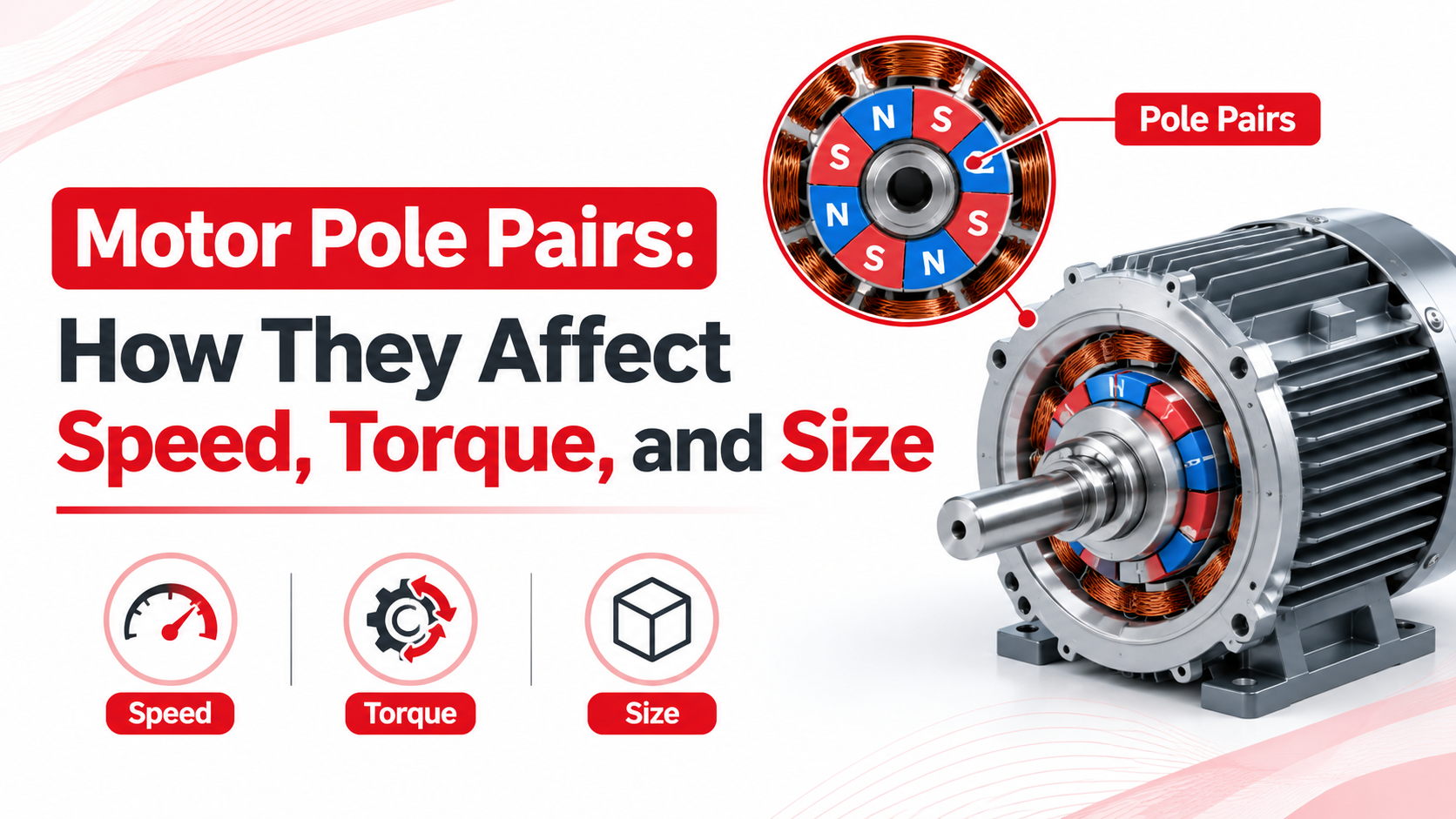
Motor pole pairs determine the relationship between electrical frequency and mechanical rotational speed, making them an important parameter in BLDC and PMSM motor design. A motor with more pole pairs generally runs at a lower mechanical speed at the same electrical frequency, while a motor with fewer pole pairs can achieve higher rotational speeds under the same frequency conditions.
However, pole pairs do not independently determine motor torque or physical size. Torque capability also depends on stator current, magnetic flux, winding configuration, rotor geometry, cooling capacity, and electromagnetic loading.
For motor manufacturers and OEM engineers, selecting the correct pole-pair configuration requires balancing speed, torque, efficiency, motor dimensions, operating temperature, and application requirements rather than simply choosing a motor with more or fewer poles.
What Are Motor Pole Pairs?
In an electric motor, the rotor contains alternating north and south magnetic poles that interact with the rotating magnetic field generated by the stator windings.
A pole pair consists of one north pole and one south pole. Therefore, a motor with 2 pole pairs has 4 magnetic poles, while a motor with 4 pole pairs has 8 magnetic poles.
Pole count and pole-pair count are closely related, but they should not be confused when evaluating motor specifications.
| Number of Poles | Number of Pole Pairs |
|---|---|
| 2 poles | 1 |
| 4 poles | 2 |
| 6 poles | 3 |
| 8 poles | 4 |
| 10 poles | 5 |
| 12 poles | 6 |
| 14 poles | 7 |
| 16 poles | 8 |
In BLDC and PMSM motors, the number of pole pairs determines how many electrical cycles correspond to one mechanical revolution.
How Do Pole Pairs Affect Motor Speed?
The relationship between pole pairs and motor speed is one of the most important considerations in motor selection.
At the same electrical frequency, a motor with fewer pole pairs rotates faster mechanically, while a motor with more pole pairs rotates more slowly.
For example, consider two motors operating at an electrical frequency of 200 Hz:
| Motor Configuration | Pole Pairs | Synchronous Speed |
|---|---|---|
| Motor A | 2 | 6,000 rpm |
| Motor B | 4 | 3,000 rpm |
| Motor C | 5 | 2,400 rpm |
| Motor D | 8 | 1,500 rpm |
These figures represent ideal synchronous speeds, not guaranteed operating speeds under every load condition.
In practical BLDC and PMSM applications, the motor controller determines the electrical frequency, while voltage limitations, current limits, back EMF, load conditions, and control strategy affect the achievable operating speed.
Why does this matter?
– High-speed applications often benefit from fewer pole pairs.
– Low-speed direct-drive applications may benefit from more pole pairs.
– Applications requiring a wide speed range need careful coordination between motor design and driver capability.
For example, high-speed pumps and compact power tools may prioritize a motor configuration that supports higher rotational speed, whereas AGV drive systems and direct-drive actuators may require a different balance between speed and torque.
How Do Pole Pairs Affect Motor Torque?
More pole pairs do not automatically mean higher torque.
Although increasing pole-pair count can change the electromagnetic torque characteristics, the actual output torque depends on several interacting design factors, including:
– Permanent magnet strength
– Rotor diameter
– Active stack length
– Stator winding configuration
– Phase current
– Magnetic flux density
– Cooling capability
A motor with more pole pairs may achieve favorable torque characteristics within a particular design envelope, especially when the rotor and stator geometry are optimized for low-speed operation.
However, increasing pole-pair count can also increase electrical frequency at the same mechanical speed, which may increase iron losses and place greater demands on the motor controller.
Practical engineering insight: When an OEM application requires higher output torque, engineers should evaluate magnetic loading, motor dimensions, winding design, and gearbox requirements rather than assuming that increasing pole pairs alone will solve the problem.
Direct Drive vs. Gear Motor
| Parameter | Multi-Pole Direct-Drive Motor | Motor with Gearbox |
|---|---|---|
| Output speed | Depends on motor design | Reduced by gear ratio |
| Output torque | Depends on electromagnetic design | Increased through reduction |
| Mechanical structure | Can be simpler | Includes additional transmission components |
| Control requirements | Depends on motor configuration | Requires consideration of motor and gearbox |
| Application | Direct-drive systems | AGVs, actuators, industrial equipment |
For applications requiring low output speed and high torque, a properly selected gearbox can sometimes provide a more practical solution than substantially increasing the motor’s pole-pair count.
How Do Pole Pairs Affect Motor Size?
Pole-pair count also influences the electromagnetic and mechanical layout of a motor, although there is no universal rule that more pole pairs always produce a larger or smaller motor.
A motor with more magnetic poles may require different magnet segmentation, winding arrangements, slot/pole combinations, and rotor geometry.
These design changes can affect:
– Rotor manufacturing complexity
– Magnet arrangement
– Stator winding space
– Magnetic flux distribution
– Cooling requirements
– Manufacturing cost
For compact BLDC motors, engineers must balance pole-pair count with motor diameter, stack length, rated voltage, speed, and torque requirements.
For example, a compact motor with a high pole-pair count may be suitable for a low-speed application, but it may not be the most appropriate solution for a high-speed application where electrical frequency and iron losses become important considerations.
How to Select the Right Pole-Pair Configuration?
For OEM motor development, engineers should follow a structured selection process.
Step 1: Define Required Speed and Torque
Identify the continuous operating speed, maximum speed, starting torque, peak torque, and duty cycle.
A motor designed for continuous operation at 3,000 rpm may require a different pole configuration from one intended for low-speed, high-torque operation.
Step 2: Determine the Motor Voltage and Driver Capability
Check the available DC bus voltage, maximum phase current, electrical frequency capability, and control method.
The selected motor must operate within the electrical limits of its driver.
Step 3: Evaluate Rotor and Stator Geometry
Compare pole-pair count with rotor diameter, stator slot count, magnet thickness, winding arrangement, and active stack length.
The slot/pole combination should also be evaluated for cogging torque, torque ripple, and winding manufacturability.
Step 4: Evaluate Thermal and Efficiency Performance
Check copper losses, iron losses, magnet temperature, and cooling conditions across the expected operating range.
A configuration that performs well at rated speed may not provide the same efficiency under continuous low-speed or high-load operation.
Step 5: Validate the Prototype
Test the motor under realistic application conditions, including speed, torque, temperature rise, vibration, noise, and efficiency.
Common Engineering Mistakes
Mistake 1: Assuming more pole pairs always mean more torque.
Torque depends on the complete electromagnetic design, not pole-pair count alone.
Mistake 2: Ignoring electrical frequency.
A high-pole-pair motor operating at high mechanical speed may require a controller capable of handling a relatively high electrical frequency.
Mistake 3: Selecting a motor based only on rated RPM.
Starting torque, acceleration, peak load, continuous duty, and thermal performance must also be considered.
Mistake 4: Ignoring gearbox requirements.
For low-speed, high-torque applications, a gearbox may provide a more efficient and practical system-level solution than redesigning the motor around a higher pole-pair count.
Choosing the Right BLDC Motor for OEM Applications
For industrial OEM projects, pole-pair selection should be part of a complete motor customization process.
UNITED MOTION INC. provides BLDC motor solutions covering approximately Φ28 mm to Φ110 mm, with configurable options including gearboxes, encoders, and integrated drivers.
Depending on the application, motor configurations can be developed around different requirements for:
– Rated voltage and operating speed
– Continuous and peak torque
– Motor diameter and length
– Pole and slot combinations
– Gearbox ratio
– Encoder feedback
– Integrated driver configuration
For example, an AGV drive system may prioritize low-speed torque and reliable feedback, while a pump application may require stable continuous operation and an appropriate high-speed operating range.
Working with an experienced BLDC motor manufacturer helps OEM engineers coordinate electromagnetic design, mechanical dimensions, feedback systems, and control requirements from the beginning of the project.
UNITED MOTION INC. supports customized motor configurations for industrial automation and motion control applications.
FAQ
1. What are motor pole pairs?
A motor pole pair consists of one north magnetic pole and one south magnetic pole. The number of pole pairs determines the relationship between electrical frequency and mechanical rotational speed.
2. Do more pole pairs increase motor torque?
Not necessarily. More pole pairs can influence electromagnetic torque characteristics, but actual torque also depends on magnetic flux, phase current, rotor diameter, stack length, and winding design.
3. Do fewer pole pairs make a motor faster?
Yes, at the same electrical frequency, a motor with fewer pole pairs has a higher synchronous mechanical speed.
4. Are high-pole-count motors better for low-speed applications?
They can be suitable for low-speed applications because they operate at a lower mechanical speed for a given electrical frequency, but the final design must also consider torque, efficiency, controller capability, and thermal performance.
5. How do pole pairs affect BLDC motor selection?
Pole-pair count affects the relationship between electrical frequency and mechanical speed, which influences motor controller selection, operating range, and electromagnetic design.
6. Can pole-pair count be customized for OEM motors?
Yes. Pole-pair configuration can be considered during custom motor development together with rotor geometry, stator winding, voltage, speed, torque, gearbox, encoder, and integrated driver requirements.