
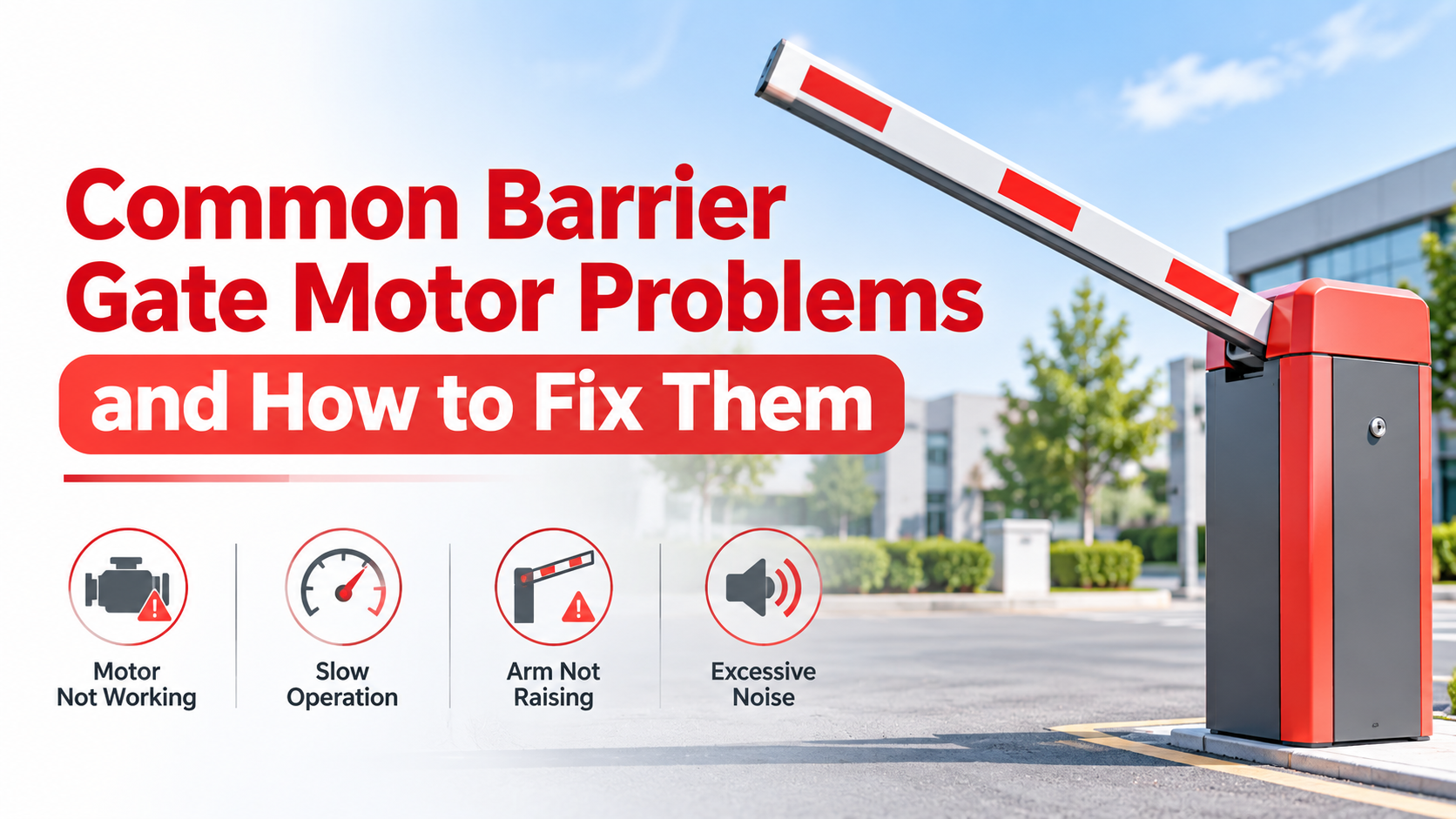
Quick Answer
Barrier gate motor problems commonly include failure to start, slow opening and closing, overheating, unusual noise, excessive vibration, inconsistent operation, and unexpected stopping. These issues can result from insufficient power supply, motor wear, gearbox damage, incorrect limit switch settings, controller faults, mechanical resistance, or inadequate maintenance.
The most effective troubleshooting approach is to inspect the power supply first, check the motor controller and electrical connections, examine the gearbox and transmission mechanism, and then evaluate the motor’s operating current, temperature, and mechanical load.
For automatic barrier gate manufacturers and system integrators, selecting the correct barrier gate motor is equally important because motor torque, output speed, gearbox ratio, duty cycle, and control compatibility directly affect operating reliability and service life.
How Does a Barrier Gate Motor Work?
An automatic barrier gate uses an electric motor and mechanical transmission system to raise and lower a gate arm, controlling vehicle access in parking facilities, residential communities, commercial buildings, industrial sites, and toll stations.
A typical automatic barrier gate system consists of:
– Electric motor
– Gearbox or reduction mechanism
– Motor controller
– Gate arm and balancing spring
– Limit switches or position sensors
– Control board
– Power supply
– Safety detection devices
The motor generates rotational force, while the gearbox reduces motor speed and increases output torque to drive the gate arm.
Depending on the application, manufacturers may use DC gear motors, BLDC motors, or AC motors, with different configurations selected according to operating frequency, gate weight, opening speed, and control requirements.
Common Barrier Gate Motor Problems and How to Fix Them
Barrier Gate Motor Fails to Start
Possible causes:
– Unstable or insufficient power supply
– Loose electrical connections
– Damaged motor windings
– Faulty motor controller
– Activated thermal protection
– Mechanical obstruction
How to fix it:
1. Check whether the input voltage matches the motor’s rated voltage.
2. Inspect power cables, connectors, and terminal connections.
3. Check controller fault indicators and protection status.
4. Disconnect power and inspect the mechanical transmission for obstruction.
5. Test motor winding continuity and insulation according to the manufacturer’s specifications.
If the power supply and controller operate normally but the motor still fails to start, the motor assembly or gearbox may require further inspection.
Barrier Gate Opens or Closes Slowly
Possible causes:
– Insufficient motor torque
– Incorrect gearbox ratio
– Excessive mechanical friction
– Incorrect spring balancing
– Low supply voltage
– Excessive gate arm load
How to fix it:
Check the actual operating speed and compare it with the motor’s rated speed. Inspect the gearbox, bearings, connecting components, and gate arm for excessive friction.
If the gate operates slowly even when mechanical resistance is normal, engineers should evaluate whether the motor’s output torque and gearbox reduction ratio match the application requirements.
For example, a barrier gate requiring faster opening may need a different motor speed and transmission configuration, while a heavier gate arm may require greater output torque.
Barrier Gate Motor Overheats
Possible causes:
– Excessive operating frequency
– Overloaded motor
– Continuous operation beyond the rated duty cycle
– Poor heat dissipation
– Excessive gearbox friction
– Incorrect motor voltage
How to fix it:
1. Measure motor operating current.
2. Compare the measured current with the rated current.
3. Check the operating frequency and duty cycle.
4. Inspect the gearbox and mechanical transmission.
5. Verify the motor’s cooling conditions.
Barrier gates installed in high-traffic parking facilities may operate much more frequently than residential systems, making duty-cycle selection particularly important.
A motor designed for intermittent operation may experience excessive temperature rise when used in a high-frequency application.
Unusual Noise and Excessive Vibration
Possible causes:
– Worn gearbox gears
– Bearing damage
– Loose mounting bolts
– Shaft misalignment
– Insufficient lubrication
– Damaged transmission components
How to fix it:
Inspect the motor mounting structure, shaft alignment, bearings, gearbox, and transmission connections.
If the noise changes significantly with operating speed or load, engineers should determine whether the source is electromagnetic, mechanical, or related to the gearbox.
For gear motors, incorrect gear engagement or excessive backlash can also contribute to noise and vibration.
Barrier Gate Stops Unexpectedly
Possible causes:
– Incorrect limit switch settings
– Position sensor malfunction
– Controller protection activation
– Unstable power supply
– Excessive mechanical resistance
– Overcurrent protection
How to fix it:
Check the opening and closing limit positions, sensor signals, controller parameters, and motor operating current.
For systems using encoders, verify whether position feedback is accurate and whether the controller receives consistent speed and position signals.
If unexpected stopping occurs at the same physical position repeatedly, inspect the gate arm, transmission mechanism, and limit detection system for localized interference.
Barrier Gate Opens or Closes Inconsistently
Possible causes:
– Unstable power supply
– Intermittent electrical connections
– Inconsistent sensor signals
– Incorrect controller settings
– Changing mechanical resistance
How to fix it:
Inspect the power supply under operating load rather than checking voltage only when the motor is idle. Verify controller settings, sensor feedback, and the mechanical condition of the gate arm.
For applications requiring precise and repeatable movement, an encoder-based feedback system may help improve position monitoring and motion control.
Barrier Gate Motor Troubleshooting Comparison Table
The following table summarizes common symptoms and recommended inspection priorities.
| Common Problem | Main Cause | Recommended Solution |
|---|---|---|
| Motor does not start | Power or controller fault | Check voltage and wiring |
| Slow operation | Insufficient torque or incorrect gear ratio | Verify motor and gearbox selection |
| Motor overheating | Overload or excessive duty cycle | Check current and thermal conditions |
| Unusual noise | Gear or bearing wear | Inspect gearbox and bearings |
| Excessive vibration | Misalignment or imbalance | Check shaft and mounting |
| Incorrect stopping position | Limit switch or encoder fault | Recalibrate position feedback |
| Intermittent operation | Unstable power or signal | Inspect wiring and controller |
How to Choose the Right Motor for a Barrier Gate?
Preventing motor problems begins with selecting the correct motor configuration for the actual application.
Motor Torque
The motor must provide sufficient starting and running torque to overcome the combined resistance of the barrier arm, transmission mechanism, and external operating conditions.
Engineers should evaluate both continuous torque and peak torque rather than selecting a motor based only on rated power.
Motor Speed and Gearbox Ratio
The gearbox converts motor speed into the output speed and torque required by the barrier mechanism.
An unsuitable reduction ratio may cause slow operation, insufficient output torque, or unnecessary mechanical stress.
Duty Cycle and Thermal Performance
Commercial parking systems may operate much more frequently than residential systems, making duty cycle, heat dissipation, and winding temperature important motor selection criteria.
Motor Control and Feedback
BLDC motors with integrated drivers or encoder feedback can support more precise speed regulation, starting behavior, and position control when properly matched with the barrier gate controller.
Why BLDC Motors Are Worth Considering for Barrier Gate Systems?
Traditional brushed DC motors are used in many barrier gate systems because of their straightforward control and cost-effective design. However, BLDC motors offer several advantages for applications requiring frequent operation and reduced maintenance.
| Comparison | Brushed DC Motor | BLDC Motor |
|---|---|---|
| Brush maintenance | Required | Not required |
| Mechanical commutation | Brushes and commutator | Electronic commutation |
| Maintenance requirements | Generally higher | Generally lower |
| Speed control | Relatively simple | Requires electronic controller |
| Operating noise | Brush noise may occur | No brush friction |
| Control options | Basic to advanced | Advanced electronic control |
| Suitable applications | Standard barrier gates | Frequent-cycle and advanced control systems |
A BLDC motor can be particularly attractive for barrier gate applications requiring frequent opening and closing, long service intervals, and stable speed control.
However, the final selection should also consider controller compatibility, gearbox design, starting torque, thermal performance, and total system cost.
Common Mistakes When Troubleshooting Barrier Gate Motors
Mistake 1: Replacing the motor immediately.
The actual problem may come from the controller, power supply, gearbox, or mechanical transmission.
Mistake 2: Ignoring the gearbox.
Even a properly selected motor cannot provide reliable system performance if the gearbox has excessive wear or an unsuitable reduction ratio.
Mistake 3: Selecting motors based only on rated power.
Starting torque, output speed, peak load, and duty cycle are equally important.
Mistake 4: Ignoring position feedback.
Incorrect limit switch settings or encoder signals can cause mechanical impact and unreliable stopping behavior.
Mistake 5: Ignoring operating frequency.
A motor designed for occasional operation may overheat in a high-frequency commercial parking environment.
Custom Motor Solutions for Barrier Gate Manufacturers
For barrier gate OEMs, motor selection should be based on the complete operating requirements rather than simply replacing an existing motor with another model of similar power.
UNITED MOTION INC. provides customized motor solutions, including BLDC motors, PMDC motors, gear motors, integrated drivers, and encoder configurations, supporting different voltage, speed, torque, and mechanical installation requirements.
With BLDC motor frame sizes covering approximately 28–110 mm, motor configurations can be evaluated according to the available installation space, required output performance, and control architecture.
For barrier gate manufacturers developing new products or upgrading existing drive systems, important customization considerations include:
– Rated voltage and operating current
– Starting and continuous torque
– Motor speed and gearbox ratio
– Encoder and position feedback
– Integrated driver requirements
– Mounting dimensions and shaft configuration
– Operating frequency and thermal performance
Selecting the right motor and transmission combination can help OEM manufacturers improve operating consistency, reduce maintenance requirements, and develop more reliable automatic access-control equipment.
Contact UNITED MOTION INC. to discuss custom motor requirements for barrier gate and automatic access-control applications.
Frequently Asked Questions
1. Why does my barrier gate motor fail to start?
Common causes include an unstable power supply, loose wiring, controller faults, motor overload, or damaged motor windings. Check the electrical system and mechanical transmission before replacing the motor.
2. Why does my automatic barrier gate open slowly?
Slow operation may result from insufficient motor torque, an incorrect gearbox ratio, mechanical resistance, or unsuitable controller speed settings.
3. Why does a barrier gate motor overheat?
Excessive operating frequency, continuous overload, insufficient cooling, high ambient temperature, and mechanical resistance can all contribute to overheating.
4. How long should a barrier gate motor last?
Motor service life depends on operating frequency, load conditions, motor quality, gearbox design, thermal management, and maintenance. There is no universal service-life value applicable to every barrier gate system.
5. Are BLDC motors suitable for automatic barrier gates?
Yes. BLDC motors can be suitable for automatic barrier gates requiring frequent operation, electronic speed control, reduced brush maintenance, and optional encoder feedback, provided that the motor and controller are correctly matched.
6. How do I choose the right barrier gate motor?
Evaluate the barrier arm load, required opening time, starting torque, output speed, gearbox ratio, operating frequency, voltage, mounting dimensions, and control requirements before selecting a motor.