
Quick Answer
Choosing between an integrated and an external BLDC motor controller is an important decision in OEM motor development because the controller configuration directly affects installation space, wiring complexity, thermal management, electromagnetic compatibility, maintenance accessibility, and overall system integration.
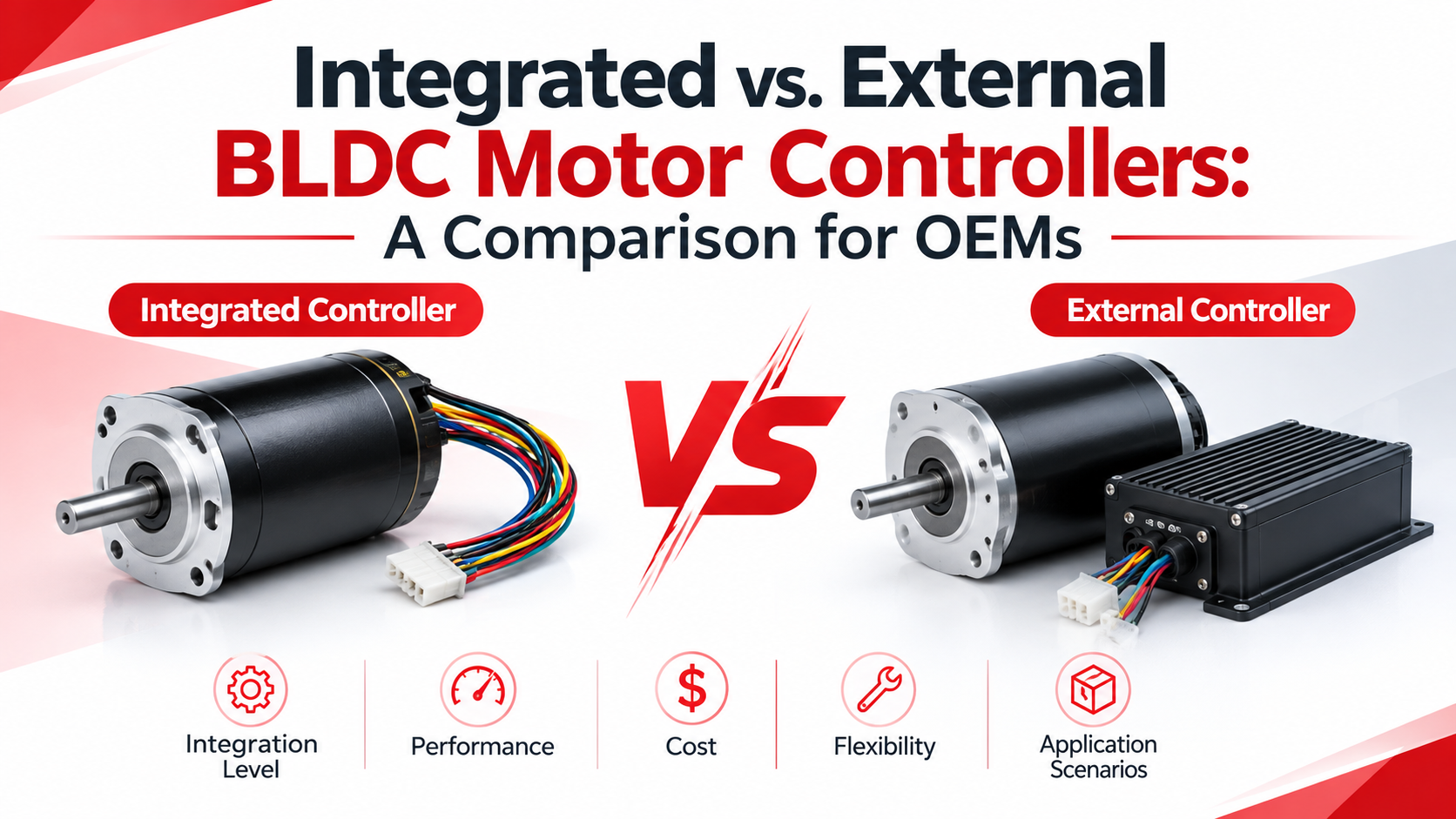
An integrated BLDC motor controller combines the motor and electronic drive within one assembly, making it suitable for compact equipment that requires simplified wiring, reduced installation space, and a more integrated motion control solution.
An external BLDC motor controller is installed separately from the motor, providing greater flexibility in controller placement, heat dissipation, maintenance, and parameter adjustment, which can be particularly beneficial for high-power applications or systems operating in demanding thermal environments.
There is no universally better configuration. OEM engineers should select the appropriate solution according to motor power, operating voltage, continuous current, peak current, installation environment, control requirements, and expected maintenance conditions.
Engineering takeaway: Integrated controllers prioritize compactness and system integration, while external controllers prioritize configuration flexibility, serviceability, and independent thermal management.
What Is an Integrated BLDC Motor Controller?
An integrated BLDC motor controller is an electronic drive system built directly into or attached to the motor assembly.
Instead of connecting the motor to a separately installed driver, the controller is incorporated into the motor structure, creating a more compact electromechanical solution.
A typical integrated BLDC motor system includes:
– BLDC motor stator and rotor
– Electronic control board
– Power switching components
– Motor control circuitry
– Hall sensor interface or encoder feedback
– Communication and control connections
– Thermal management components
The controller regulates motor operation by controlling the current supplied to the stator windings according to the required speed, torque, and operating conditions.
Depending on the design, integrated controllers can support different control methods, including six-step commutation and Field-Oriented Control (FOC).
Key Advantages
1. Reduced installation space
Combining the motor and controller eliminates the need for a separate driver enclosure, which can simplify mechanical packaging in compact equipment.
2. Simplified wiring
An integrated configuration can reduce the length and complexity of motor-to-controller power connections, helping OEM engineers simplify equipment assembly.
3. Easier system integration
The motor and controller can be developed and tested as a coordinated unit, reducing compatibility issues during equipment integration.
4. Compact motion control architecture
This configuration is particularly useful for applications where installation space, cable routing, and equipment appearance are important design considerations.
What Is an External BLDC Motor Controller?
An external BLDC motor controller is a separate electronic drive installed independently from the motor.
The motor and controller are connected through power cables, sensor wiring, and control interfaces, allowing engineers to position the driver according to the equipment’s electrical and mechanical layout.
A typical external BLDC drive system includes:
– BLDC motor
– Separate motor driver
– DC power supply
– Hall sensor or encoder feedback
– Motor phase connections
– Speed and direction control interface
– Communication interface, depending on the controller
Unlike an integrated configuration, the external driver can be installed in a control cabinet, equipment enclosure, or another location with suitable ventilation and protection.
Key Advantages
1. Flexible installation
The controller can be positioned independently from the motor, which is beneficial when the motor is installed in a location with limited space or high ambient temperature.
2. Independent thermal management
The driver can use a dedicated heatsink, ventilation system, or cooling arrangement without relying entirely on the motor housing.
3. Easier maintenance
If the controller experiences an electrical failure, technicians can inspect or replace the driver without necessarily replacing the motor assembly.
4. Greater system configuration flexibility
OEM engineers can select controller specifications according to the motor’s voltage, current, speed, communication, and feedback requirements.
Integrated vs. External BLDC Motor Controllers: Key Differences
The following table summarizes the major engineering differences that OEMs should consider during motor selection and system development.
| Comparison Factor | Integrated Controller | External Controller |
|---|---|---|
| Installation | Compact, fewer connections | Requires separate mounting |
| Wiring | Simplified external wiring | More motor-driver connections |
| Space requirements | Generally smaller system footprint | Requires additional installation space |
| Thermal management | Heat from motor and electronics must be managed together | More flexible controller placement |
| Maintenance | May require servicing the integrated assembly | Controller can be replaced separately |
| Customization | Depends on integrated electronics | Greater flexibility in controller selection |
| Control functions | Depends on integrated driver specification | Broad range of configurable options |
| Cable management | Generally simpler | More wiring considerations |
| System integration | Convenient for compact equipment | Suitable for distributed systems |
| OEM flexibility | Best for standardized compact designs | Best for more complex configurations |
The actual differences depend on controller design, rated power, cooling method, protection functions, and communication requirements.
How to Choose the Right Controller for Your OEM Application?
Consider Installation Space
If the equipment has limited internal space, an integrated BLDC motor controller can reduce the number of separate components and simplify mechanical installation.
For compact automation equipment, medical devices, and small robotic systems, reducing wiring and mounting requirements can also shorten assembly time.
However, engineers should reserve sufficient clearance around the integrated electronics for heat dissipation and service access.
Evaluate Thermal Management
Thermal performance is one of the most important considerations when selecting a BLDC motor controller.
An integrated controller is exposed to the motor’s operating temperature, which means heat generated by the stator, rotor-related losses, and surrounding equipment can influence electronic component temperatures.
An external controller provides more flexibility because it can be installed in a cooler or better-ventilated location.
For applications involving continuous operation, high ambient temperatures, or frequent acceleration, engineers should evaluate both motor temperature and controller temperature under actual load conditions.
Match Power and Speed Requirements
Controller selection should be based on the motor’s rated voltage, continuous current, peak current, speed range, and duty cycle.
For example, a motor operating at 24 VDC and 5 A requires a controller capable of handling its continuous operating current, while also providing sufficient peak-current capacity during startup and acceleration.
A common mistake is selecting a controller based only on its nominal voltage or advertised power rating without checking startup current, overload duration, and thermal limitations.
Determine Control and Feedback Requirements
Different OEM applications require different control capabilities.
Basic applications may only require speed adjustment and forward/reverse operation, while more advanced systems may need:
- Hall sensor feedback
- Encoder feedback
- Closed-loop speed control
- Position control
- Programmable acceleration
- Communication interfaces
- Multi-motor synchronization
An external controller may provide more flexibility for complex control architectures, although integrated solutions can also support advanced functions when specifically designed for the application.
Advantages and Limitations of Each Configuration
Integrated BLDC Controller
Advantages
- Compact motor-drive assembly
- Reduced external wiring
- Simplified equipment installation
- Fewer separate mounting components
- Convenient for standardized OEM products
Limitations
- More demanding thermal integration
- Potentially more difficult electronic servicing
- Less freedom to reposition the controller
- Customization depends on the integrated driver design
External BLDC Controller
Advantages
- Flexible controller positioning
- Independent thermal management
- Easier controller replacement
- Greater flexibility in control configuration
- Suitable for centralized electrical systems
Limitations
- More wiring and connectors
- Additional installation space
- More complicated cable routing
- Greater attention required for electrical interference and connection reliability
Common BLDC Controller Problems and Troubleshooting
| Problem | Possible Cause | Recommended Check |
|---|---|---|
| Motor fails to start | Incorrect wiring or insufficient power supply | Check supply voltage and phase connections |
| Motor starts but stops | Overcurrent or thermal protection | Check startup load and controller temperature |
| Unstable speed | Incorrect feedback signals or control settings | Inspect Hall or encoder signals |
| Excessive controller heating | Insufficient cooling or excessive current | Check mounting, ventilation, and operating load |
| Motor vibration | Incorrect commutation or phase sequence | Verify motor-controller compatibility |
| Poor low-speed performance | Inadequate feedback or unsuitable control mode | Evaluate closed-loop control requirements |
| Communication failure | Incorrect wiring or interface configuration | Check communication settings and connections |
| Frequent protection shutdown | Overload or incorrect controller sizing | Review continuous and peak-current requirements |
Troubleshooting should begin with the power supply, motor wiring, feedback signals, and mechanical load before replacing the motor or controller.
Common OEM Selection Mistakes
Mistake 1: Choosing an integrated controller only to save space.
A compact assembly is not necessarily the best solution if the equipment operates in a high-temperature environment or requires frequent maintenance.
Mistake 2: Ignoring peak current requirements.
Startup, acceleration, and sudden load changes can require substantially more current than steady-state operation, so the controller must be selected according to the actual duty cycle.
Mistake 3: Treating the motor and controller as independent components.
Motor inductance, back EMF, feedback configuration, voltage, and current characteristics must be compatible with the selected driver.
Mistake 4: Overlooking future customization.
OEM equipment may require different voltage, speed, torque, mounting dimensions, or communication functions during product development, making early consideration of customization important.
Custom BLDC Motor and Controller Solutions from UNITED MOTION INC.
UNITED MOTION INC. provides BLDC motor solutions covering approximately Φ28–Φ110 mm, supporting different industrial and OEM application requirements.
Depending on the motor platform and project specifications, available configurations can include:
- Integrated motor drivers
- External controller matching
- Gearbox integration
- Encoder feedback
- Hall sensor feedback
- Customized voltage and speed
- Application-specific torque requirements
For OEM manufacturers, choosing the correct controller is only one part of the complete motion-control system. Motor dimensions, output torque, operating speed, mechanical transmission, feedback signals, and installation conditions should all be evaluated together.
As a BLDC motor manufacturer and supplier, UNITED MOTION INC. works with OEM customers to develop motor configurations according to their equipment requirements, helping simplify motor selection and system integration.
Whether your project requires a compact integrated BLDC motor or a motor paired with an independently installed driver, the engineering objective is to achieve reliable operation, appropriate thermal performance, and consistent control under actual working conditions.
Contact UNITED MOTION INC. to discuss your custom BLDC motor and controller requirements.
FAQ
1. What is the main difference between integrated and external BLDC motor controllers?
An integrated controller is mounted directly onto or incorporated into the motor assembly, while an external controller is installed separately and connected through electrical and feedback cables.
2. Are integrated BLDC motor controllers better for OEM applications?
They can be a better choice for compact equipment requiring simplified wiring and installation, but thermal conditions, maintenance access, and control requirements must also be considered.
3. Are external BLDC motor controllers better for high-power applications?
External controllers often provide greater flexibility in thermal management and component selection, making them suitable for many higher-power systems. However, the actual power capability depends on the motor and controller specifications.
4. Can an integrated BLDC motor controller support encoder feedback?
Yes, provided the integrated driver is designed to support the selected encoder type and its corresponding feedback interface.
5. Can an external BLDC controller work with different BLDC motors?
Not necessarily. Voltage, current, back EMF, winding characteristics, Hall sensor configuration, and control compatibility must be checked before connecting a different motor.
6. How do I choose the right BLDC motor controller?
Start by defining the motor voltage, continuous and peak current, speed range, torque requirements, duty cycle, thermal environment, feedback requirements, and installation constraints.
7. Can UNITED MOTION INC. provide customized BLDC motor and controller solutions?
UNITED MOTION INC. supports OEM motor configurations with options such as integrated drivers, external controller matching, gearboxes, encoders, and application-specific electrical and mechanical specifications.