
Quick Answer
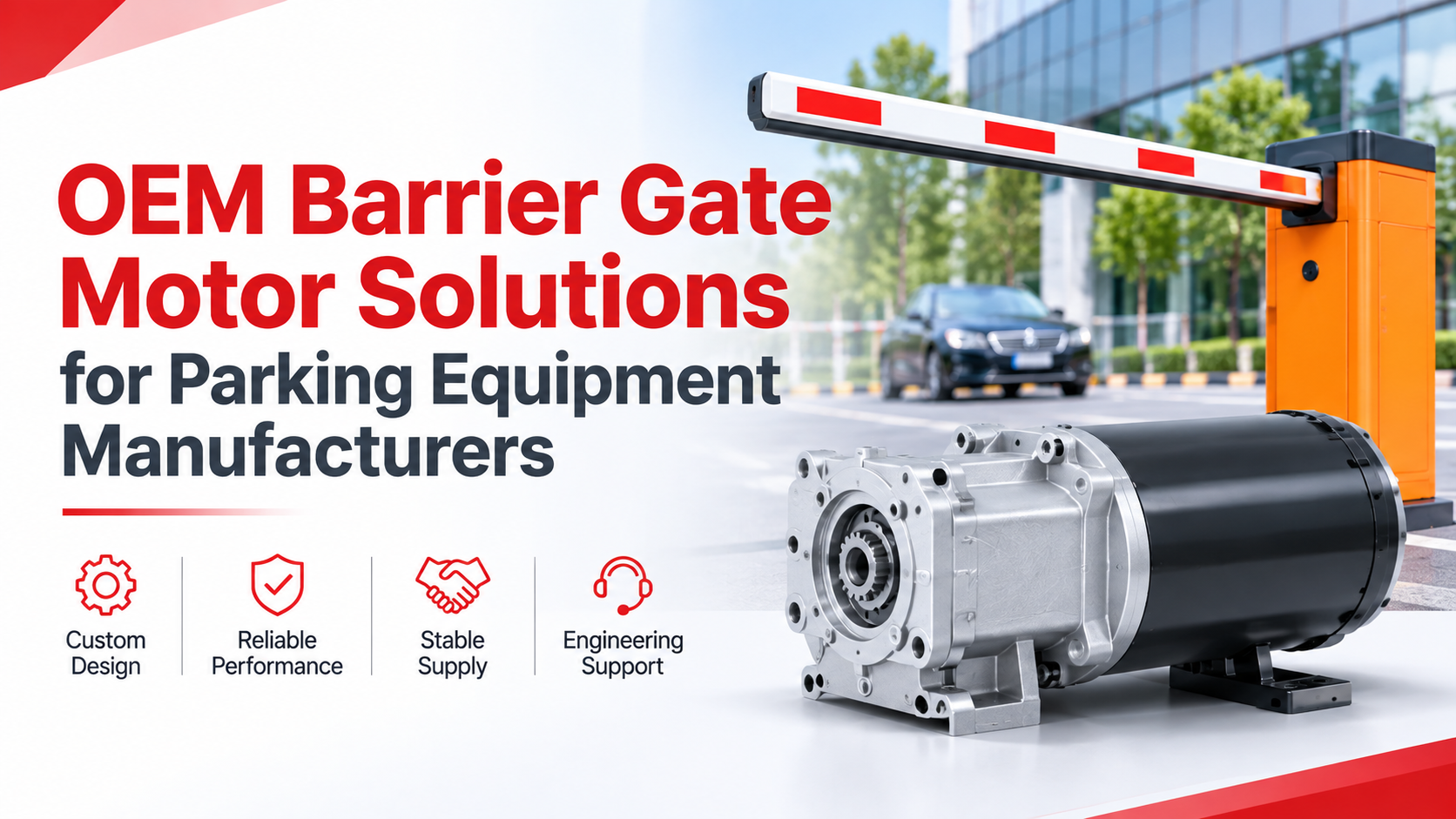
An automatic barrier gate motor is a critical component of a parking barrier system because it determines the opening and closing speed, lifting torque, operating stability, noise level, and service life of the equipment. For parking equipment manufacturers, selecting the right OEM barrier gate motor requires more than matching rated power; engineers must consider boom length, boom weight, counterbalance mechanism, gearbox ratio, operating frequency, acceleration, braking performance, and environmental conditions.
UNITED MOTION INC. provides customized motor and motion control solutions for OEM applications, including DC motors, BLDC motors, gear motors, and integrated motor configurations. By optimizing motor specifications and gearbox configurations according to the mechanical structure and operating requirements of each barrier gate, manufacturers can develop more reliable and application-specific parking equipment.
Why Motor Selection Matters in Automatic Barrier Gates?
Automatic barrier gates are widely used in parking facilities, commercial buildings, residential communities, industrial entrances, and access control systems. Although the equipment may appear mechanically simple, its motor system must repeatedly accelerate, lift, stop, and lower a barrier arm while maintaining consistent positioning and reliable operation.
The motor directly affects several important performance characteristics:
- Opening and closing speed: Determines vehicle throughput and waiting time.
- Output torque: Provides sufficient force to lift the barrier arm and overcome mechanical resistance.
- Operating stability: Helps prevent sudden acceleration, vibration, and inconsistent movement.
- Noise level: Influences the user experience in residential and commercial environments.
- Service life: Depends on electrical loading, mechanical stress, thermal management, and operating frequency.
For parking equipment manufacturers, an appropriately engineered motor system can improve overall equipment reliability while reducing maintenance requirements and unnecessary energy consumption.
How to Choose the Right OEM Barrier Gate Motor?
Motor selection should begin with the mechanical and operating requirements of the complete barrier gate rather than the motor’s rated wattage alone.
Evaluate Barrier Arm Length and Weight
Barrier arm length and weight are two primary factors affecting the required lifting torque. A longer or heavier boom generally creates a greater load on the drive mechanism, particularly when the system accelerates from a stationary position.
Engineers should evaluate:
- Barrier arm length and total weight
- Center of gravity and rotational inertia
- Counterbalance spring configuration
- Mechanical friction
- Required opening angle
- Starting and stopping conditions
A barrier gate with a short, lightweight arm may use a different motor and gearbox configuration from a heavy-duty parking barrier designed for wider entrances.
Determine Required Motor Speed and Gear Ratio
Most barrier gate applications require relatively controlled output movement rather than high rotational speed. Therefore, a gearbox is commonly used to convert the motor’s speed into the required output speed and torque.
The gearbox ratio should be selected according to the desired opening time, output torque, mechanical efficiency, and available installation space.
| Design Parameter | Main Engineering Consideration |
|---|---|
| Motor speed | Determines available input speed |
| Gear ratio | Controls output speed and torque |
| Output torque | Must meet the barrier’s lifting requirements |
| Gearbox efficiency | Influences actual available output torque |
| Gearbox backlash | Affects positioning and movement consistency |
| Mechanical strength | Determines load-bearing capability |
| Noise | Important for residential and commercial applications |
An excessively high gear ratio may increase opening time, while an insufficient reduction ratio may leave the motor unable to provide adequate output torque.
DC Gear Motor vs. BLDC Motor for Barrier Gate Applications
The choice between a brushed DC gear motor and a brushless DC motor depends on operating frequency, maintenance expectations, control requirements, and equipment positioning.
| Comparison | DC Gear Motor | BLDC Gear Motor |
|---|---|---|
| Motor structure | Brushed | Brushless |
| Speed control | Relatively straightforward | Requires an electronic driver |
| Maintenance | Brush inspection and replacement may be required | No brush replacement required |
| Operating noise | Depends on motor and gearbox design | Depends on motor, driver, and gearbox design |
| Speed regulation | Application dependent | Supports electronic speed regulation |
| Control integration | Relatively simple | Supports advanced electronic control |
| Typical considerations | Cost and simple control | Service life and control flexibility |
When Should Manufacturers Choose a DC Gear Motor?
A DC gear motor can be suitable for conventional barrier gates where straightforward speed control, compact dimensions, and cost-effective integration are important.
When Should Manufacturers Choose a BLDC Gear Motor?
A BLDC gear motor is worth considering for applications requiring frequent operation, reduced brush maintenance, electronic speed regulation, and more flexible integration with modern control systems.
For manufacturers developing intelligent parking barriers, BLDC motors can provide additional flexibility when combined with suitable drivers, sensors, and control electronics.
Key Motor Design Considerations for Parking Barrier Systems
Starting Torque and Acceleration
The motor must generate sufficient starting torque to overcome static friction and accelerate the barrier mechanism from rest. If the motor is undersized, the barrier may start slowly, fail to reach its target speed, or experience excessive current during acceleration.
A suitable motor selection should consider both continuous operating requirements and transient starting loads.
Thermal Performance
Barrier gate motors operate intermittently, but high operating frequency can produce significant heat accumulation, particularly when the equipment is installed outdoors or inside an enclosure with limited ventilation.
Engineers should evaluate winding temperature, ambient temperature, duty cycle, current loading, and heat dissipation when selecting the motor.
Braking and Positioning
Reliable stopping is essential because a barrier arm must reach its fully open and fully closed positions without excessive impact.
Depending on the system architecture, positioning and stopping can be achieved through limit switches, Hall sensors, encoders, electronic control, or a combination of mechanical and electrical braking methods.
Environmental Protection
Outdoor parking equipment may encounter rain, dust, humidity, temperature fluctuations, and corrosion.
The motor housing, connectors, shaft seals, and electrical interfaces should therefore be selected according to the actual installation environment and required ingress protection level.
Common Barrier Gate Motor Problems and Troubleshooting
| Problem | Possible Cause | Recommended Engineering Check |
|---|---|---|
| Barrier arm cannot lift | Insufficient output torque or mechanical obstruction | Check boom load, gearbox ratio, and mechanical resistance |
| Slow opening speed | Incorrect gear ratio or insufficient motor speed | Verify motor speed and transmission configuration |
| Motor overheats | Excessive current, frequent operation, or poor heat dissipation | Check duty cycle, current, and temperature rise |
| Excessive operating noise | Gearbox wear, poor alignment, or mechanical vibration | Inspect gears, bearings, and mounting structure |
| Unstable opening and closing | Inconsistent control signals or speed regulation | Check driver, sensors, and feedback signals |
| Barrier arm stops inaccurately | Incorrect limit switch or encoder configuration | Verify position feedback and control parameters |
| Short motor service life | Excessive loading or unsuitable operating conditions | Review torque margin, thermal conditions, and duty cycle |
Troubleshooting should begin with the complete drive system rather than replacing the motor immediately, because mechanical resistance, gearbox problems, power supply instability, and control-system faults can produce similar symptoms.
OEM Customization for Different Parking Equipment Manufacturers
Standard motors do not always match the installation dimensions, output torque, speed, and control requirements of different barrier gate designs.
OEM customization allows parking equipment manufacturers to optimize the motor system according to their product architecture.
Common customization requirements include:
- Rated voltage and power
- Motor diameter and overall length
- Rated speed and torque
- Gearbox type and reduction ratio
- Output shaft dimensions
- Mounting holes and flange design
- Encoder or Hall sensor integration
- Motor driver configuration
- Connector and cable specifications
- Environmental protection requirements
For example, a manufacturer developing a compact residential parking barrier may prioritize installation space and low operating noise, whereas a commercial parking facility may place greater emphasis on frequent operation, thermal stability, and consistent opening and closing performance.
UNITED MOTION INC. OEM Motor Solutions
UNITED MOTION INC. is a U.S. subsidiary of Greensky Power Company, a professional motor and driver manufacturer with more than 15 years of industry experience.
The company provides motor and motion control solutions for OEM customers across industrial automation and other application sectors, with product capabilities covering:
BLDC Motors: Brushless motor solutions for applications requiring electronic speed control and flexible system integration.
DC Motors: Practical motor configurations for applications requiring straightforward electrical control.
Gear Motors: Integrated motor and gearbox configurations for applications requiring specific output speed and torque.
Servo Motors: Precision motion solutions for applications requiring controlled positioning and dynamic response.
Customized Motor Assemblies: Configurations tailored to voltage, torque, speed, dimensions, feedback, and installation requirements.
For parking equipment manufacturers, the motor selection process should begin with the barrier mechanism’s actual operating requirements, allowing the motor, gearbox, and driver to be evaluated as one integrated drive system.
By working with an experienced OEM motor manufacturer, equipment developers can improve compatibility between the motor assembly and the overall parking barrier design while reducing unnecessary redesign during product development.
Explore our BLDC Motor Solutions or contact UNITED MOTION INC. to discuss your custom motor requirements.
Frequently Asked Questions
1. What type of motor is best for an automatic barrier gate?
DC gear motors and BLDC gear motors are both potential solutions. The best choice depends on barrier arm weight, opening speed, operating frequency, maintenance requirements, control architecture, and budget.
2. Why does a barrier gate motor need a gearbox?
A gearbox reduces the motor’s rotational speed while increasing available output torque, allowing a relatively compact motor to drive the barrier mechanism at a controlled speed.
3. How do I calculate the required torque for a barrier gate motor?
Engineers should consider boom weight, center of gravity, rotational inertia, counterbalance spring force, mechanical friction, acceleration, and transmission efficiency. The complete mechanical load should be evaluated rather than selecting a motor based only on barrier arm weight.
4. Are BLDC motors suitable for parking barrier systems?
Yes. BLDC motors can be suitable for parking barriers requiring frequent operation, electronic speed regulation, and reduced brush-related maintenance, provided that the driver and mechanical transmission are properly matched to the application.
5. Can barrier gate motors be customized for OEM manufacturers?
Yes. Motor voltage, power, speed, torque, gearbox ratio, shaft dimensions, mounting structure, encoder, and driver configuration can be customized according to the equipment manufacturer’s requirements.
6. What causes an automatic barrier gate motor to overheat?
Common causes include excessive mechanical load, frequent operating cycles, high starting current, unsuitable motor sizing, poor ventilation, and incorrect driver settings.