
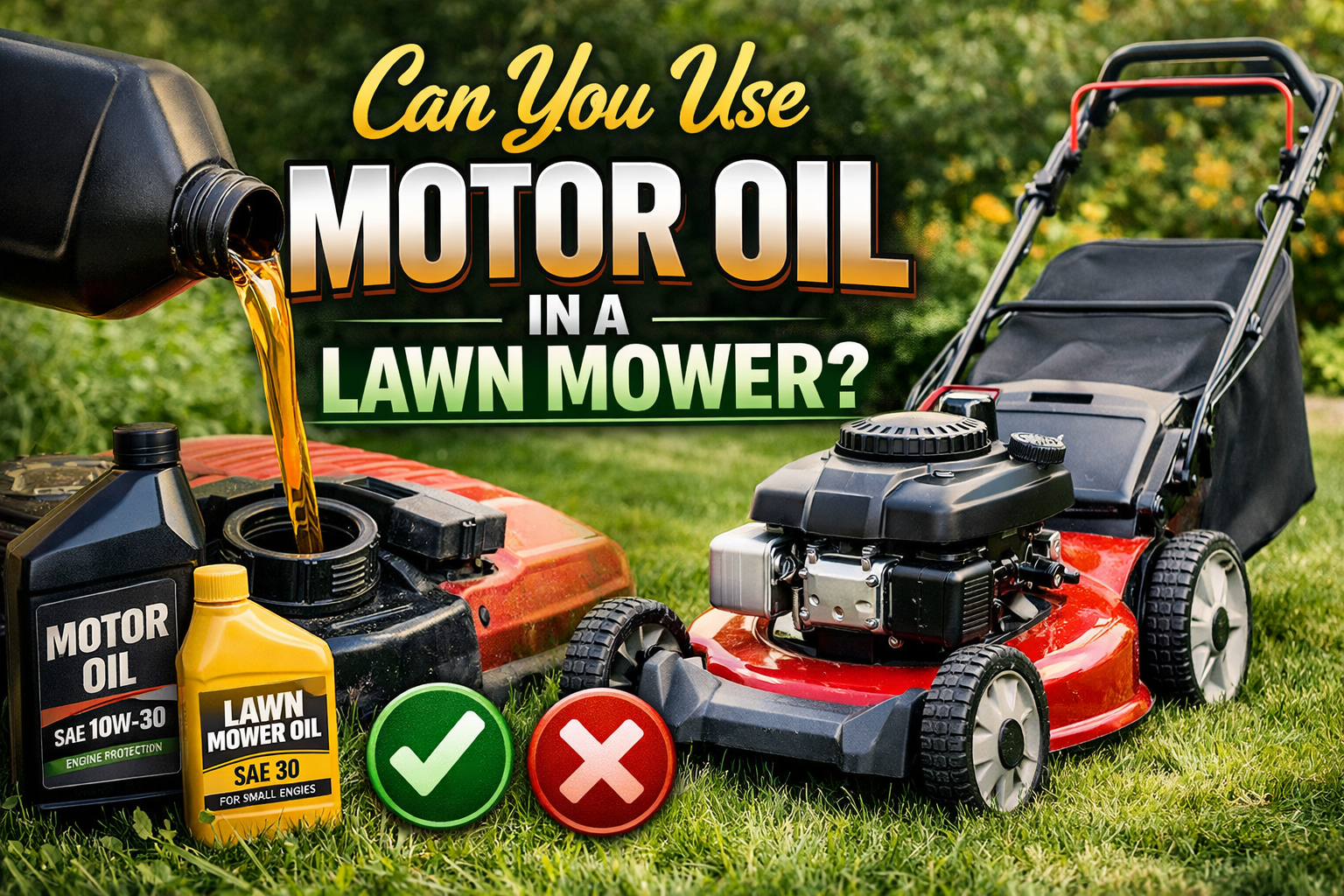
Can You Use Motor Oil in Lawn Mower?
Yes, you can use motor oil in a lawn mower if the oil meets the lawn mower engine manufacturer’s specifications.
For a typical 4-stroke gasoline lawn mower, automotive-style detergent motor oil may be suitable. However, there is no single oil that is correct for every lawn mower. The required viscosity depends on the engine model and operating temperature.
Common lawn mower oil grades include SAE 30, SAE 10W-30, and synthetic 5W-30, but you should always check the owner’s manual before adding oil. Briggs & Stratton, for example, lists different oil grades for different temperature ranges and engine applications.
The important rule is:
Do not choose lawn mower oil based only on the words “motor oil.” Choose an oil that matches the engine manufacturer’s recommended viscosity and specification.
What Type of Oil Does a Lawn Mower Need?
The correct oil depends primarily on the engine design and ambient temperature.
For many small 4-stroke gasoline engines, commonly used grades include:
SAE 30
SAE 30 is commonly recommended for small engines operating in warmer temperatures.
Briggs & Stratton currently lists SAE 30 as a common choice for warmer conditions.
SAE 10W-30
SAE 10W-30 is a multigrade oil that can provide better cold-weather starting than SAE 30.
However, the suitability of 10W-30 depends on the engine model and temperature range. Always follow the engine manufacturer’s recommendation rather than assuming that 10W-30 is universally appropriate.
Synthetic 5W-30
Synthetic 5W-30 may be suitable for many modern small engines and can provide good performance across a wider temperature range.
Briggs & Stratton currently lists synthetic SAE 5W-30 as an acceptable option for its applicable engines.
Important: Check the Owner’s Manual
Oil recommendations vary between engines.
The safest method is:
Find the engine model → check the owner’s manual → identify the recommended viscosity → use the specified oil.
Do not select oil solely because another lawn mower uses the same grade.
Can You Use Synthetic Oil in a Lawn Mower?
Yes. Synthetic oil can be used in many lawn mower engines when the viscosity and specification meet the manufacturer’s requirements.
For example, Briggs & Stratton states that synthetic oil is acceptable for its applicable small engines and notes that synthetic oil does not change the required oil-change intervals.
Potential advantages of synthetic oil include:
- Good temperature stability
- Improved cold-weather starting
- Reduced oil consumption in some applications
- Consistent lubrication over a wider temperature range
However, synthetic oil is not automatically better for every mower. The manufacturer’s specification should always take priority over whether the oil is conventional or synthetic.
Can You Use 10W-30 in a Lawn Mower?
Yes, 10W-30 can be suitable for many lawn mower engines, but you should verify it against the engine manufacturer’s recommendation.
The “10W” describes the oil’s low-temperature viscosity behavior, while “30” describes its viscosity at operating temperature.
Briggs & Stratton currently lists SAE 10W-30 for certain temperature ranges and applications, while also warning that its use in higher temperatures may increase oil consumption.
Therefore:
10W-30 is not automatically the best oil for every lawn mower.
Check the owner’s manual before using it.
Can You Use SAE 30 Motor Oil in a Lawn Mower?
Yes, SAE 30 is commonly used in small 4-stroke lawn mower engines, particularly in warmer operating conditions, when recommended by the engine manufacturer.
SAE 30 is a single-grade oil. It does not have the same low-temperature characteristics as a multigrade oil such as 10W-30.
Briggs & Stratton identifies SAE 30 as a common oil for small engines in warmer temperatures.
If you operate a mower in colder conditions, however, the manufacturer may recommend a different grade.
How Much Oil Does a Lawn Mower Need?
There is no universal lawn mower oil capacity.
Oil capacity depends on the engine model and mower design.
For example, Briggs & Stratton states that typical walk-behind mower engines may hold approximately 15 or 18 oz, while some riding mower engines may hold approximately 48 or 64 oz.
Because capacities vary, do not fill the crankcase based on a general number.
Instead:
Check the engine owner’s manual.
Add oil gradually.
Check the dipstick.
Stop at the specified oil level.
Do not overfill the crankcase.
Overfilling can cause problems just as underfilling can.
What Happens If You Use the Wrong Oil?
Using oil with the wrong viscosity or specification can reduce lubrication quality and may increase engine wear.
Possible problems include:
- Difficult starting
- Increased oil consumption
- Excessive engine noise
- Overheating
- Smoke
- Increased internal wear
The exact symptoms depend on the engine and the oil used.
A particularly important point is that oil viscosity affects how easily the engine starts and how effectively the oil circulates under different temperatures.
For this reason, the correct oil is not simply the thickest or thinnest oil available.
Can You Put Motor Oil in an Electric Lawn Mower?
No. An electric lawn mower normally does not use engine oil because it does not have an internal combustion engine.
Gasoline lawn mowers use combustion engines that require crankcase lubrication.
Electric lawn mowers use an electric motor and therefore do not require engine oil changes.
A simplified power path is:
Battery → Motor Controller → Electric Motor → Blade
This is one of the major maintenance differences between gasoline and battery-powered lawn mowers.
Electric outdoor equipment commonly uses motor technologies such as BLDC motors because they provide electronic speed control, compact construction, and relatively low routine maintenance.
What About 2-Stroke Lawn Mowers?
A 2-stroke engine requires a different lubrication system from a conventional 4-stroke lawn mower engine.
In many 2-stroke designs, oil is mixed with fuel or supplied through a dedicated oil-injection system rather than stored in a conventional crankcase sump.
Do not assume that 4-stroke lawn mower oil can be used in a 2-stroke engine.
Always follow the engine manufacturer’s fuel and oil-mixing instructions.
If you are unsure whether your mower uses a 2-stroke or 4-stroke engine, check the owner’s manual.
How Often Should You Change Lawn Mower Oil?
The correct oil-change interval depends on the engine model and operating conditions.
Briggs & Stratton currently recommends that some walk-behind mower engines have their oil changed every 50 hours or annually, whichever comes first, while also recommending an initial oil change after the first five hours for a new engine.
Heavy-duty conditions can require more frequent maintenance.
For example:
- Frequent mowing
- High ambient temperatures
- Dusty conditions
- Wet grass
- Heavy loads
- Commercial use
can increase maintenance requirements.
Always use the interval specified for your engine model.
How to Change Lawn Mower Oil?
For a typical 4-stroke gasoline lawn mower, the general process is:
1. Warm the engine
Run the engine briefly according to the manufacturer’s instructions so the oil can flow more easily.
2. Stop the engine and disconnect the spark plug
Turn the engine off and follow the manufacturer’s safety instructions before servicing.
3. Drain the old oil
Use the appropriate drain plug or oil extraction method for your mower.
4. Reinstall the drain plug
Make sure the plug is correctly installed before adding new oil.
5. Add the recommended oil
Add the specified oil gradually.
6. Check the oil level
Use the dipstick or manufacturer’s specified checking method.
7. Avoid overfilling
Do not exceed the recommended oil level.
Briggs & Stratton also recommends checking the oil level and consulting the engine and equipment manuals before performing maintenance.
Common Lawn Mower Oil Mistakes
Using the wrong viscosity
Do not assume that SAE 30, 10W-30, or 5W-30 is universally correct.
Overfilling the engine
More oil does not provide more protection. The oil level must remain within the manufacturer’s specified range.
Ignoring temperature
Oil viscosity affects starting and lubrication performance at different temperatures.
Using the wrong oil for a 2-stroke engine
Two-stroke engines have different lubrication requirements.
Skipping the owner’s manual
The engine manufacturer’s specification should always be the primary reference.
Gas Lawn Mower vs Electric Lawn Mower: Oil Requirements
| Feature | Gas Lawn Mower | Electric Lawn Mower |
| Power source | Gasoline | Battery/electricity |
| Main power unit | Combustion engine | Electric motor |
| Engine oil | Required for applicable 4-stroke engines | Not required |
| Oil changes | Yes | No engine oil change |
| Exhaust emissions during operation | Yes | None at the mower |
| Routine maintenance | More extensive | Generally simpler |
This difference is one reason electric lawn equipment has become increasingly attractive for residential and professional applications.
Electric lawn mowers use motors rather than combustion engines, so there is no crankcase oil to replace.
Frequently Asked Questions
Can I use car oil in my lawn mower?
Yes, if the oil meets the lawn mower engine manufacturer’s viscosity and specification requirements.
Is SAE 30 good for a lawn mower?
SAE 30 is commonly recommended for many small engines in warm conditions, but you should confirm the recommendation for your specific engine.
Can I use 10W-30 in a lawn mower?
Yes, 10W-30 is suitable for some lawn mower engines. Check the owner’s manual because the recommended viscosity varies by engine and temperature.
Can I use synthetic oil in a lawn mower?
Yes, many modern small engines can use synthetic oil when the recommended viscosity and specification are met.
Can I use motor oil in an electric lawn mower?
No. Electric lawn mowers do not use engine oil because they use electric motors instead of combustion engines.
How much oil does a lawn mower take?
Oil capacity varies by engine. Some walk-behind mower engines require around 15–18 oz, while larger riding mower engines may require substantially more. Always check the engine manual.
How often should I change lawn mower oil?
The interval depends on the engine. Some Briggs & Stratton walk-behind engines, for example, specify 50 hours or annually, while new engines may require an initial change after five hours.
Related blog: What motor do electric lawn mowers use?