
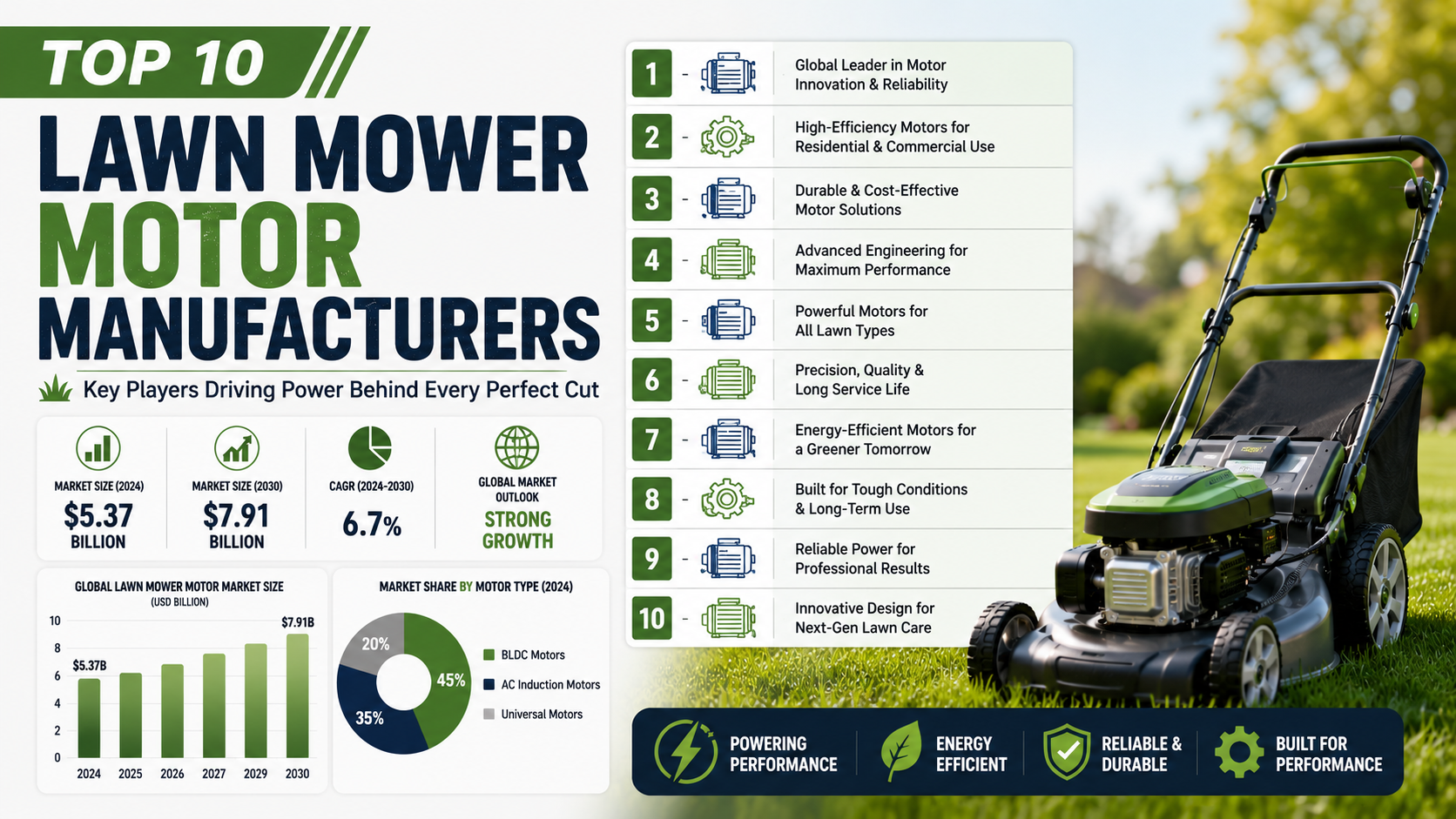
As global demand for electric landscaping equipment continues to rise, choosing the right lawn mower motor manufacturer has become a critical engineering and sourcing decision.
Modern electric lawn mower systems require:
• High torque density
• Low noise operation
• Long service life
• Waterproof performance
• Efficient thermal management
• Battery optimization
• Reliable OEM manufacturing
This article compares the top lawn mower motor manufacturers used in robotic lawn mowers, commercial electric mowers, and smart outdoor power equipment.
Quick Answer
The best lawn mower motor manufacturers in 2026 are:
- T-MOTOR
- Nidec Corporation
- Johnson Electric
- Maxon
- Bühler Motor
- Mabuchi Motor
- Allied Motion
- Regal Rexnord
- WEG
- United MOTION INC.
For robotic and battery-powered mowing applications, BLDC motor for lawn mower systems are now the dominant technology because they offer:
• 85–93% efficiency
• Longer lifespan
• Lower maintenance
• Better torque control
• Reduced energy consumption
Why Lawn Mower Motors Matter More Than Ever?
The lawn mower industry is rapidly transitioning from gasoline engines to electric drive systems.
Several trends are driving this shift:
| Industry Trend | Engineering Impact |
|---|---|
| Battery-powered equipment growth | Higher demand for efficient motors |
| Robotic lawn mowers | Need for compact high-torque motors |
| Noise regulations | Low-RPM quiet motor systems |
| Smart landscaping equipment | Sensor-compatible motor control |
| Sustainability goals | High-efficiency BLDC adoption |
Traditional brushed DC motors are increasingly being replaced by electric lawn mower motor systems based on brushless technology.
A modern brushless motor for lawn mower applications typically operates between:
| Specification | Typical Range |
|---|---|
| Voltage | 24V–72V |
| Rated Power | 200W–3000W |
| Efficiency | 85%–93% |
| Speed Range | 1500–6000 RPM |
| Protection Level | IP54–IP67 |
| Lifespan | 3000–10000 hours |
What Makes a Good Lawn Mower Motor Manufacturer?
Engineers evaluating OEM lawn mower motor manufacturer suppliers should focus on more than pricing.
The best suppliers provide:
1. High Torque Density
Grass-cutting applications require strong startup torque.
Typical requirements:
• Blade motors: 1.5–4 Nm
• Drive wheel motors: 3–15 Nm
Poor torque performance often causes:
• Stalling
• Uneven cutting
• Battery drain
• Controller overheating
2. Thermal Management
Electric mower motors operate under high-load outdoor conditions.
Key thermal considerations include:
• Copper fill ratio
• Magnet temperature resistance
• Heat dissipation structure
• Fan cooling design
• Aluminum housing conductivity
A motor winding temperature above 120°C can significantly shorten insulation life.
3. Waterproof Protection
Outdoor mowing equipment must withstand:
• Rain
• Mud
• Grass debris
• Dust
• High humidity
Recommended protection levels:
| Environment | Recommended IP Rating |
|---|---|
| Residential mowing | IP54–IP55 |
| Robotic mower | IP65 |
| Commercial mower | IP66–IP67 |
4. Motor Control Compatibility
Modern lawn mower systems require advanced electronic control.
A quality OEM lawn mower motor manufacturer should support:
• Hall sensor integration
• Sensorless FOC control
• CAN communication
• PWM speed control
• Battery management integration
Top 10 Lawn Mower Motor Manufacturers
T-MOTOR
T-MOTOR specializes in high-efficiency brushless motors.
Their technology is increasingly adapted for:
• Lightweight robotic mowers
• Autonomous outdoor equipment
• Compact electric mobility systems
Nidec Corporation
Nidec Corporation is one of the world’s largest motor manufacturers.
Strengths include:
• High-volume production
• Efficient BLDC platforms
• Automotive-grade quality control
• Advanced motor controllers
Nidec motors are widely used in premium robotic mowing systems.
Johnson Electric
Johnson Electric provides compact motion systems for outdoor power equipment.
Key benefits:
• High production scalability
• Compact brushless platforms
• Integrated electronics capability
They are frequently selected for medium-power residential mowers.
Maxon
Maxon is known for high-end precision brushless motors.
Although expensive, Maxon offers:
• Exceptional efficiency
• High precision control
• Advanced encoder systems
• Compact planetary gear solutions
Best suited for premium robotic mower platforms.
Bühler Motor
Bühler Motor focuses on reliable DC and BLDC drive systems.
Engineering advantages:
• Long operating life
• Quiet operation
• Robust thermal design
Bühler motors are common in European outdoor equipment systems.
Mabuchi Motor
Mabuchi Motor is a large-scale producer of compact DC motors.
Their strengths include:
• Cost optimization
• High-volume manufacturing
• Compact drive systems
Mabuchi products are often used in smaller residential mower systems.
Allied Motion
Allied Motion provides advanced motion solutions for intelligent outdoor machinery.
Key technologies:
• Servo integration
• Precision speed control
• High-performance motion systems
Suitable for autonomous mowing equipment.
Regal Rexnord
Regal Rexnord offers industrial-grade electric motor systems.
Advantages:
• Heavy-duty performance
• Large power range
• Durable commercial-grade construction
Ideal for commercial ride-on mower applications.
WEG
WEG is known for industrial efficiency and robust motor engineering.
WEG products emphasize:
• Energy efficiency
• Durable construction
• Global manufacturing support
UNITED MOTION INC.
UNITED MOTION INC. specializes in custom electric lawn mower motor solutions for robotic and commercial mowing equipment.
Key advantages include:
• Custom BLDC motor design
• Integrated gearbox solutions
• High-efficiency drive motors
• Compact robotic mower motors
• OEM/ODM engineering support
Typical applications:
• Robotic lawn mowers
• Ride-on electric mowers
• Smart landscaping robots
• Autonomous outdoor equipment
UNITED MOTION INC. is particularly competitive for manufacturers requiring custom torque curves, wheel-drive systems, and integrated lawn mower parts solutions.
Brushed vs Brushless Lawn Mower Motors
One of the most common engineering questions is whether to use brushed or brushless technology.
Comparison Table
| Feature | Brushed Motor | BLDC Motor |
|---|---|---|
| Efficiency | 60–75% | 85–93% |
| Maintenance | High | Low |
| Brush Wear | Yes | None |
| Noise Level | Higher | Lower |
| Lifespan | 500–2000 hrs | 3000–10000 hrs |
| Controller Complexity | Simple | Advanced |
| Battery Runtime | Shorter | Longer |
| Torque Control | Moderate | Excellent |
For modern battery-powered systems, BLDC motor for lawn mower applications are now considered the industry standard.
Common Lawn Mower Motor Problems
Troubleshooting Table
| Problem | Possible Cause | Engineering Solution |
|---|---|---|
| Motor overheating | Poor ventilation | Improve cooling airflow |
| Reduced torque | Voltage drop | Upgrade battery/current path |
| Excessive vibration | Shaft imbalance | Dynamic balancing |
| Water ingress | Insufficient sealing | Upgrade IP protection |
| Motor stalling | Undersized motor | Increase torque margin |
| Short battery runtime | Low efficiency motor | Use high-efficiency BLDC |
| Controller shutdown | Overcurrent condition | Tune acceleration profile |
How to Select the Right Lawn Mower Motor?
Step 1: Define Blade Torque Requirement
Calculate:
• Grass density
• Blade diameter
• Cutting speed
• Peak load conditions
Typical blade motor power:
| Mower Type | Motor Power |
|---|---|
| Robotic mower | 100W–500W |
| Push mower | 500W–1500W |
| Ride-on mower | 2kW–5kW |
Step 2: Match Voltage Platform
Higher voltage systems reduce current demand.
Common platforms:
• 24V robotic mowers
• 36V residential systems
• 48V–72V commercial equipment
Step 3: Evaluate Duty Cycle
Continuous-duty operation requires:
• Efficient winding design
• Quality magnets
• Proper cooling
• Temperature-resistant insulation
Step 4: Consider Gearbox Integration
Wheel-drive systems often require:
• Planetary gearboxes
• Worm gear reducers
• High reduction ratios
Typical ratios:
• 10:1 to 50:1
Engineering Mistakes When Choosing Lawn Mower Motors
Choosing Based Only on Peak Power
Peak power ratings can be misleading.
Continuous torque capability is far more important in mowing applications.
Ignoring Thermal Conditions
Outdoor environments can exceed 40°C ambient temperature.
Always verify:
• Thermal rise data
• Continuous current rating
• Magnet temperature resistance
Underestimating Waterproof Requirements
Many motor failures are caused by moisture ingress rather than electrical defects.
IP65 or higher is strongly recommended for robotic outdoor equipment.
Selecting Low-Efficiency Motors
A 10% efficiency difference can significantly affect battery runtime.
Example:
| Efficiency | Runtime Impact |
|---|---|
| 72% | Baseline |
| 90% | Up to 25% longer runtime |
Key Takeaways
• BLDC technology is now the preferred solution for modern lawn mower systems.
• High efficiency directly improves battery runtime and thermal performance.
• Waterproof protection and thermal management are critical for outdoor reliability.
• OEM customization is increasingly important for robotic mower manufacturers.
• Selecting the right lawn mower motor manufacturer requires evaluating torque, durability, efficiency, and control compatibility.
• UNITED MOTION INC. offers strong OEM engineering capability for robotic and electric lawn mower applications.
FAQ
What motor is best for an electric lawn mower?
A brushless DC motor is generally the best option because it provides higher efficiency, lower maintenance, quieter operation, and longer lifespan compared to brushed motors.
What is the typical power range for a lawn mower motor?
Residential electric lawn mower motors typically range from 500W to 1500W, while commercial ride-on mower motors may exceed 5kW.
Why are BLDC motors used in robotic lawn mowers?
BLDC motors provide precise speed control, low noise, high efficiency, and long service life, making them ideal for autonomous outdoor equipment.
What IP rating should a lawn mower motor have?
For robotic and outdoor applications, IP65 or higher is recommended to protect against water, dust, and grass debris.
How long does a brushless lawn mower motor last?
A quality brushless motor for lawn mower applications can last between 3000 and 10000 operating hours depending on load conditions and thermal management.
What should OEM buyers look for in a lawn mower motor manufacturer?
OEM buyers should evaluate:
• Torque capability
• Efficiency
• Waterproof design
• Thermal performance
• Controller compatibility
• Production scalability
• Custom engineering support
Related blog: What are the Benefits of a Brushless Motor in a Lawn Mower?