At UNITED MOTION INC., our weekly Wednesday meetings are more than routine sales updates. They are also opportunities to discuss customer needs, explore new markets, and rethink how motor technology should be matched to real-world applications.
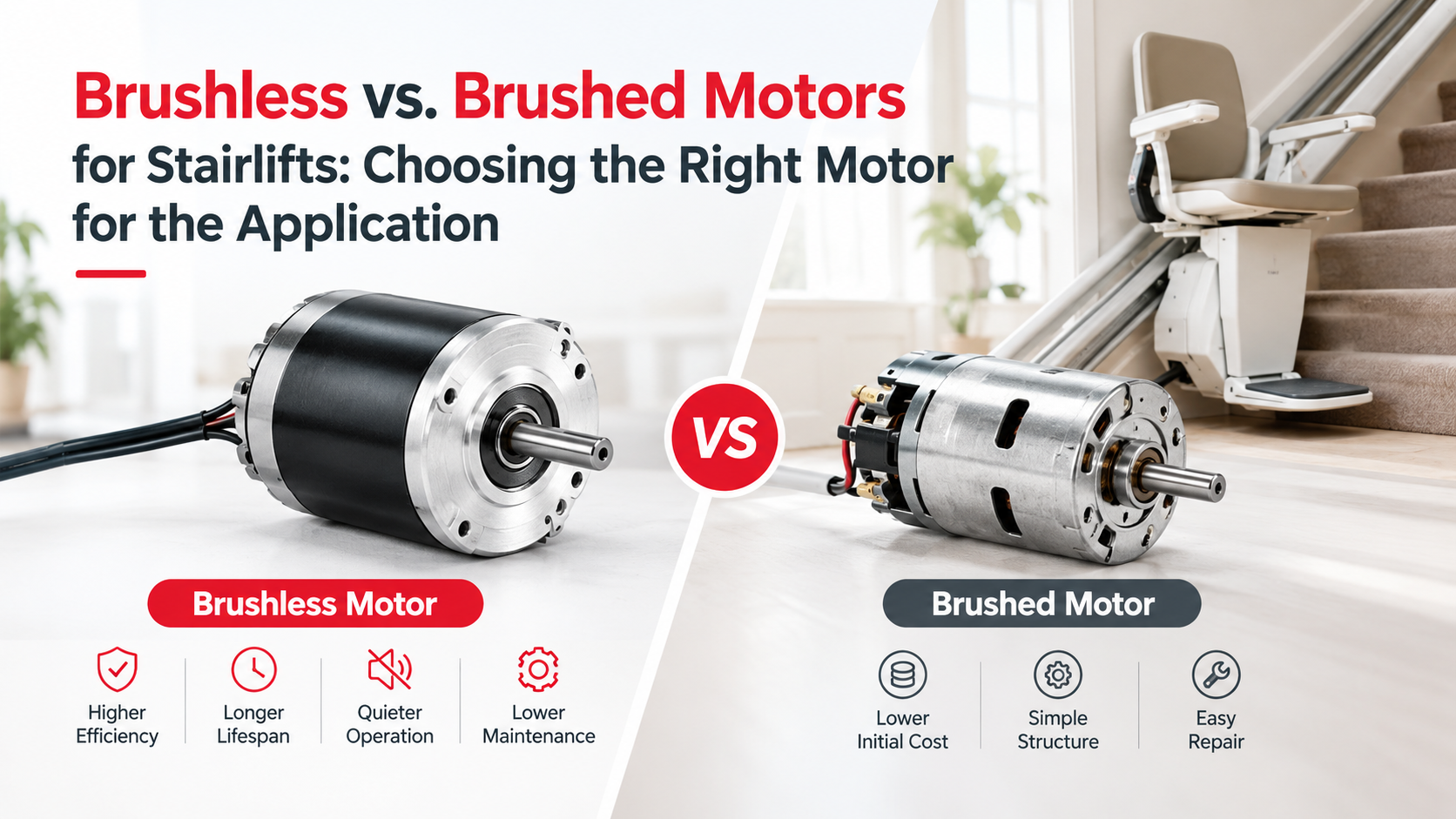
Recently, Elaine, one of our sales team members, has been researching the stairlift market and the motors used in passenger-carrying lifting equipment. UNITED MOTION INC. currently offers three motor options for this type of application: two brushless motors and one brushed DC motor.
During the meeting, Elaine raised a simple question: Should we remove the brushed motor from the product lineup?
At first, the answer seemed obvious to her. Brushless motors offer several well-known advantages, including longer service life, reduced maintenance, improved controllability, and no brush wear. The brushed motor appeared to have one major advantage: lower cost.
However, our manager, Ray, challenged that assumption.
He pointed out that not every customer is primarily focused on price. Some customers may prefer a simpler and more familiar motor-and-transmission system, particularly when an encoder or sophisticated electronic controller is not required.
Then came a more important question:
“Is a brushless motor automatically safer just because it is brushless?”
That question made Elaine look at the application from a different perspective.
For stairlifts, safety cannot be judged by the motor type alone. A passenger-carrying lifting system must consider what happens if power is lost, the controller stops working, or the drive system encounters a fault. Depending on the system design, safe operation may involve a mechanical brake, gearbox backdriving characteristics, backup battery, manual release mechanism, position feedback, and controller fault-handling strategies.
A motor itself cannot determine the complete safety performance of a stairlift.
A brushless motor can provide efficient operation, low maintenance, and precise speed or position control, but it generally depends on a controller and an appropriate commutation and feedback strategy. A brushed motor contains wear components, but its control architecture can be simpler and more familiar for certain system designs.
This discussion changed Elaine’s perspective on motor selection.
The better question is not simply “Which motor is more advanced?” It is:
“Which motor and safety architecture are the best fit for this particular application?”
For passenger-carrying equipment such as stairlifts, motor selection should be considered together with the gearbox, braking system, controller, power backup, feedback system, mechanical structure, and overall safety strategy.
At UNITED MOTION INC., we continue to see strong potential for brushless motor technology. At the same time, this discussion reminded us that newer technology is not automatically the best solution for every customer or every application.
Sometimes, a simpler motor system is exactly what a customer needs—something familiar, maintainable, and appropriate for the required control architecture.
That is why we are not in a hurry to remove our brushed motor option.
The right motor is not necessarily the newest motor. It is the motor that best fits the complete system.
For stairlift and other customized motion applications, UNITED MOTION INC. can provide both brushed and brushless motor solutions based on system requirements.
Contact us:
Phone: +1 (857) 250-1370
Email: info@unitedmotioninc.com