
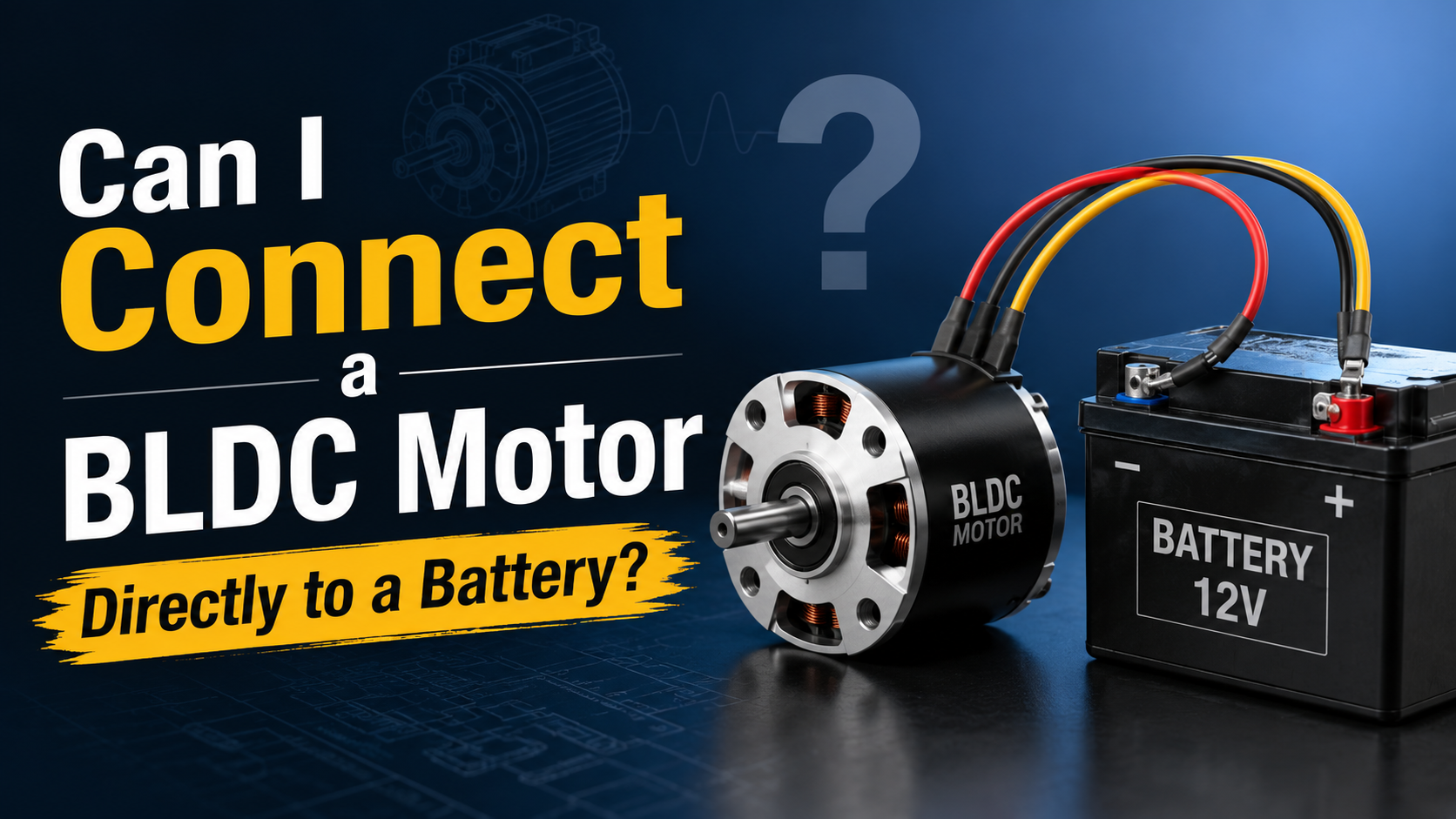
A BLDC motor cannot be connected directly to a battery for normal operation.
Unlike brushed DC motors, a BLDC motor (Brushless DC Motor) requires an electronic motor controller (ESC or BLDC driver) to perform electronic commutation. Without a controller, the motor will not rotate continuously because there are no brushes to automatically switch current between windings.
Quick Summary
✅ Battery + BLDC driver + BLDC motor = Normal operation
❌ Battery + BLDC motor only = Motor will not run properly
✅ Controller regulates current, speed, torque, and rotor position
✅ Proper wiring significantly improves efficiency and motor lifespan
Why Can’t a BLDC Motor Run Directly from a Battery?
A conventional brushed DC motor uses mechanical brushes and a commutator to switch current automatically as the rotor turns.
A BLDC motor removes these mechanical components and instead relies on electronic commutation.
The motor controller continuously:
- Detects rotor position
- Energizes the correct stator phases
- Adjusts PWM duty cycle
- Controls torque and speed
- Protects against overcurrent and overheating
Without these switching functions, the magnetic field remains fixed, preventing continuous rotation.
Engineering Insight
Applying DC voltage directly to the motor windings typically causes:
- Rotor locking
- High current draw
- Excessive winding heating
- Possible insulation damage if maintained for extended periods
How Does a BLDC Motor Actually Work?
A BLDC motor consists of:
- Permanent magnet rotor
- Three-phase stator windings
- Position feedback (Hall sensors or sensorless estimation)
- Electronic motor driver
The controller rapidly energizes the stator windings in sequence, creating a rotating magnetic field that pulls the rotor around.
Typical commutation frequency ranges from several hundred Hz to several kHz depending on motor speed.
This electronic switching replaces the mechanical commutator found in brushed motors.
According to the IEEE Industry Applications Society, electronic commutation enables:
- Higher efficiency
- Reduced maintenance
- Longer service life
- Higher operating speeds
Source: IEEE Industry Applications Society. Brushless Motor Drive Technology.
Correct Way to Connect a BLDC Motor to a Battery
The proper connection sequence is straightforward.
Step 1: Select the Correct Battery Voltage
Battery voltage should match the driver’s rated input voltage.
Common industrial ranges include:
- 12 V
- 24 V
- 36 V
- 48 V
- 72 V
Exceeding the rated voltage can permanently damage the controller.
Step 2: Install a BLDC Motor Driver
The driver acts as the “brain” of the system.
It converts DC battery power into controlled three-phase output.
Driver functions include:
- PWM speed control
- Current limiting
- Soft start
- Over-voltage protection
- Under-voltage protection
- Thermal protection
Step 3: Connect Motor Phases
Most BLDC motors have:
- U
- V
- W
These connect directly to the corresponding driver outputs.
If rotation direction is incorrect, two phase wires can usually be swapped or reversed in software.
Step 4: Connect Position Feedback
Depending on the motor:
Hall sensor motors:
- Hall power
- Ground
- Hall A
- Hall B
- Hall C
Sensorless motors:
No Hall wiring is required because the controller estimates rotor position using back EMF.
Step 5: Configure Motor Parameters
Industrial controllers typically require:
- Pole pairs
- Rated current
- Rated voltage
- Maximum speed
- Acceleration
- Deceleration
Proper parameter tuning improves startup reliability and efficiency.
What Happens If You Connect a BLDC Motor Directly to a Battery?
Several outcomes are possible.
The motor vibrates but does not rotate
Only one winding becomes energized.
The rotor aligns with the magnetic field and remains stationary.
High Current Draw
Since there is no commutation, current quickly rises toward the winding resistance limit.
Example:
24 V motor
Phase resistance = 0.6 Ω
Current:
I = 24 / 0.6 = 40 A
This is often several times the motor’s rated operating current.
Excessive Heating
Continuous DC energization converts electrical energy directly into heat.
Potential consequences include:
- Coil overheating
- Magnet demagnetization
- Insulation degradation
- Reduced motor life
BLDC Motor vs Brushed Motor Connection
| Feature | Brushed DC Motor | BLDC Motor |
| Direct battery connection | Yes | No |
| Brushes | Yes | No |
| Electronic controller required | No | Yes |
| Electronic commutation | No | Yes |
| Maintenance | Higher | Lower |
| Efficiency | 70–85% | 85–95% |
| Typical lifespan | Lower | Longer |
Common Engineering Mistakes
Using Only Battery Voltage
Many beginners assume a BLDC motor behaves like a brushed DC motor.
Without a controller, continuous rotation is impossible.
Selecting the Wrong Driver Voltage
Using a 24 V motor with a 48 V driver without proper configuration may damage both the driver and motor.
Always verify:
- Rated voltage
- Rated current
- Continuous current
- Peak current
Ignoring Battery Current Capability
Battery voltage alone is insufficient.
Industrial motors often require several times rated current during startup.
Example:
Rated current:
8 A
Starting current:
20–30 A
Battery and wiring must safely deliver this surge.
Poor Cable Connections
Loose power cables increase resistance and heat generation.
For high-current systems:
- Use appropriately sized conductors
- Minimize cable length
- Ensure secure terminal connections
BLDC Motor Troubleshooting
| Problem | Possible Cause | Recommended Solution |
| Motor does not rotate | No controller | Install a compatible BLDC driver |
| Motor vibrates | Incorrect phase sequence | Verify U-V-W wiring |
| Driver trips immediately | Overcurrent or short circuit | Check wiring and current settings |
| Motor overheats | Excessive load or incorrect parameters | Reduce load and tune driver |
| Low torque | Incorrect Hall signals or poor tuning | Verify sensor wiring and controller configuration |
| Reverse rotation | Incorrect phase order | Swap two motor phases or change software direction |
Why Industrial Systems Always Use BLDC Controllers?
Modern automation systems depend on precise motion control.
Industrial BLDC drivers provide:
- Closed-loop speed regulation
- Torque control
- Position control
- CANopen communication
- Modbus RTU
- EtherCAT compatibility
- Regenerative braking
- Safety protection
These capabilities are impossible with a direct battery connection.
For robotics, AGVs, medical devices, conveyors, and automation equipment, a dedicated controller is essential.
Why Choose UNITED MOTION INC.?
At UNITED MOTION INC., we provide complete motion control solutions rather than motors alone.
Our portfolio includes:
- High-efficiency BLDC motors
- Servo motors
- Planetary gear motors
- Integrated motor drivers
- Custom OEM motor solutions
- Motion control engineering support
By matching the motor, controller, gearbox, and application requirements, we help OEM manufacturers achieve higher efficiency, lower maintenance, and longer equipment life.
Frequently Asked Questions
Can a BLDC motor run directly from a 12 V battery?
No. Even if the voltage matches the motor rating, a BLDC driver is still required for electronic commutation.
Can I briefly test a BLDC motor with a battery?
Applying DC briefly may cause the rotor to move to one position, but it will not produce continuous rotation and is not recommended as a functional test.
What device is required between the battery and a BLDC motor?
A compatible BLDC motor controller (also called an ESC or BLDC driver) is required to convert DC power into electronically commutated three-phase output.
Can one controller drive different BLDC motors?
Yes, provided the controller’s voltage, current, and control parameters are compatible with each motor’s specifications.
Are sensorless BLDC motors connected differently?
The power wiring is similar, but sensorless systems do not require Hall sensor connections because the controller estimates rotor position using back electromotive force (back EMF).
Related blog: How to test a BLDC motor with a multimeter?