
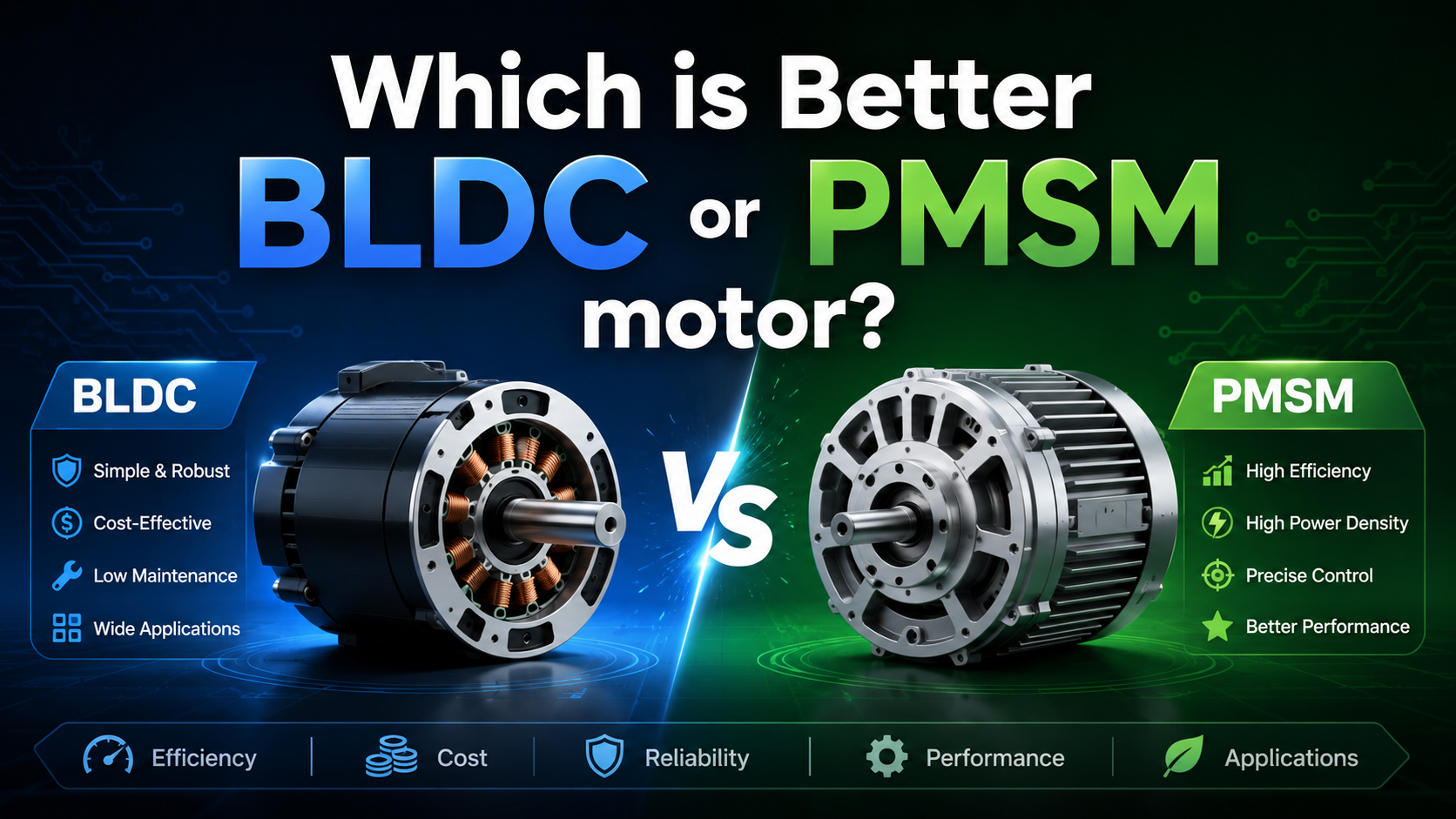
Selecting between a BLDC motor and a PMSM motor is one of the most common engineering decisions in modern motion control. While both belong to the permanent magnet synchronous motor family, they differ significantly in back-EMF waveform, control strategy, efficiency, torque smoothness, and application suitability.
For OEMs, automation engineers, and equipment manufacturers, understanding these differences helps optimize performance, reduce system costs, and improve product reliability.
This guide explains the engineering principles behind both motor types and provides practical recommendations for selecting the right solution.
Quick Answer about Which is Better BLDC or PMSM motor
If your priority is lower cost, easier control, and reliable industrial performance, choose a BLDC motor.
If your priority is maximum efficiency, smoother torque, quieter operation, and premium performance, choose a PMSM motor.
In general:
BLDC motors are ideal for industrial equipment, pumps, fans, AGVs, power tools, and general automation.
PMSM motors are preferred for electric vehicles, precision servo systems, CNC machines, robotics, aerospace, and high-end motion control.
What Is a BLDC Motor?
A Brushless DC motor is a permanent magnet motor whose stator windings are electronically commutated using a controller instead of mechanical brushes.
Although powered by DC through an inverter, the controller actually generates three-phase AC currents to drive the motor.
Characteristics include:
- Trapezoidal back-EMF
- Six-step (120°) commutation
- High starting torque
- Simple controller design
- Low maintenance
- Long service life
BLDC motors are widely used because they provide an excellent balance between efficiency, cost, and reliability.
What Is a PMSM Motor?
A Permanent Magnet Synchronous Motor (PMSM) also uses permanent magnets on the rotor but differs mainly in electromagnetic design.
Key characteristics include:
- Sinusoidal back-EMF
- Sinusoidal current excitation
- Field-Oriented Control (FOC)
- Extremely smooth torque output
- Higher efficiency
- Lower acoustic noise
PMSM technology has become the preferred choice for premium motion control applications requiring precision and energy efficiency.
BLDC vs PMSM: What’s the Real Difference?
Although many manufacturers use the terms interchangeably, they are not identical.
The primary engineering difference is the shape of the motor’s back electromotive force (Back-EMF).
| Feature | BLDC Motor | PMSM Motor |
| Back-EMF | Trapezoidal | Sinusoidal |
| Current waveform | Square wave | Sinusoidal |
| Commutation | Six-step | Field-Oriented Control (FOC) |
| Torque ripple | Moderate | Very low |
| Acoustic noise | Higher | Lower |
| Controller complexity | Lower | Higher |
| Position control | Good | Excellent |
| Manufacturing cost | Lower | Higher |
Engineering Insight
Mechanically, both motors often look nearly identical.
The largest differences appear in:
- Winding design
- Magnetic circuit optimization
- Controller algorithms
- Current waveform
How Do BLDC and PMSM Motors Work?
BLDC Operation
Step 1
Hall sensors or sensorless algorithms determine rotor position.
Step 2
The controller energizes two phases at a time.
Step 3
Electronic commutation occurs every 60 electrical degrees.
Step 4
Rotor magnets follow the rotating magnetic field.
Because phase switching is abrupt, small torque ripple naturally occurs.
PMSM Operation
Step 1
Rotor position is measured with an encoder or resolver.
Step 2
The inverter generates sinusoidal three-phase currents.
Step 3
Field-Oriented Control separates magnetic flux current from torque current.
Step 4
The rotor rotates synchronously with the magnetic field.
The result is smoother torque production and superior efficiency.
Which Motor Is More Efficient?
For most operating conditions, the PMSM motor is more efficient.
Typical full-load efficiencies are:
| Motor Type | Typical Efficiency |
| BLDC Motor | 85–94% |
| PMSM Motor | 92–97% |
At partial loads, PMSM motors usually maintain higher efficiency because Field-Oriented Control continuously optimizes current vectors.
According to the U.S. Department of Energy (DOE), electric motor systems consume approximately 70% of industrial electricity, making motor efficiency one of the most important factors in reducing operating costs. (U.S. DOE, Improving Motor and Drive System Performance, 2014.)
Research published by the International Energy Agency (IEA) also shows that high-efficiency motor systems represent one of the largest opportunities for industrial energy savings worldwide. (IEA, Energy Efficiency Report, 2022.)
Which Motor Produces Better Torque?
PMSM motors produce smoother torque.
This happens because sinusoidal current creates a nearly constant electromagnetic force.
Typical torque ripple:
BLDC: 5–15%
PMSM: below 3%
Lower torque ripple results in:
- Better positioning accuracy
- Less vibration
- Reduced bearing wear
- Longer gearbox life
This is especially important in:
- CNC equipment
- Robotics
- Semiconductor manufacturing
- Medical equipment
Which Motor Is Easier to Control?
BLDC motors are easier.
Typical BLDC control methods:
- Six-step commutation
- Hall sensor control
- Sensorless startup
- PWM speed regulation
Typical PMSM control methods:
- Field-Oriented Control (FOC)
- Space Vector PWM
- Encoder feedback
- High-speed DSP computation
Because FOC requires more mathematical computation, PMSM controllers are generally more expensive.
Which Motor Runs More Quietly?
PMSM motors generate significantly less noise.
Noise sources include:
- Torque ripple
- Current harmonics
- Cogging torque
- Mechanical resonance
Since PMSM motors minimize these effects, they are commonly selected for:
- Medical devices
- Service robots
- Laboratory equipment
- HVAC systems
- Passenger electric vehicles
Which Motor Has Better Speed Performance?
Both motor types offer wide speed ranges.
Typical values:
| Parameter | BLDC Motor | PMSM Motor |
| Base speed | 500–4000 rpm | 500–6000 rpm |
| Maximum speed | 20,000 rpm+ | 30,000 rpm+ |
| Speed regulation | Good | Excellent |
High-speed PMSMs often use interior permanent magnet (IPM) rotor designs to support field weakening above base speed.
This enables electric vehicle traction motors to operate efficiently over a very wide speed range.
Which Motor Costs Less?
BLDC systems generally have lower total cost.
Reasons include:
- Simpler controller
- Easier tuning
- Lower processor requirements
- Lower commissioning cost
PMSM systems require:
- More advanced software
- Faster processors
- High-resolution feedback devices
- More complex commissioning
For cost-sensitive OEM products, BLDC motors often provide the best value.
Typical Applications
Best Applications for BLDC Motors
- Industrial automatio
- Conveyor systems
- Pumps
- Fans
- Power tools
- AGVs
- Packaging equipment
- Medical pumps
- Commercial appliances
Best Applications for PMSM Motors
- Electric vehicles
- Industrial servo systems
- Robotics
- CNC machines
- Aerospace actuators
- Semiconductor equipment
- High-end compressors
- Precision positioning systems
How to Choose Between BLDC and PMSM?
Follow this engineering decision process.
Step 1 — Define Performance Requirements
Determine:
- Required torque
- Speed range
- Duty cycle
- Position accuracy
Step 2 — Evaluate Control Complexity
If simple speed control is enough:
Choose BLDC.
If dynamic servo performance is required:
Choose PMSM.
Step 3 — Analyze System Cost
Include:
- Motor price
- Controller cost
- Encoder
- Wiring
- Software development
- Maintenance
A lower motor price does not always mean a lower system cost.
Step 4 — Consider Efficiency Targets
Continuous-duty equipment benefits more from PMSM because electricity costs often exceed initial hardware costs over the equipment’s lifetime.
Step 5 — Evaluate Environmental Conditions
Consider:
- Ambient temperature
- Cooling method
- Dust
- Humidity
- Vibration
- IP protection rating
Proper motor selection extends service life.
Common Engineering Mistakes
| Mistake | Why It Causes Problems | Recommended Solution |
| Assuming BLDC and PMSM are identical | Different control methods affect performance | Match motor with controller |
| Choosing based only on motor price | Ignores lifetime energy costs | Calculate total cost of ownership (TCO) |
| Ignoring torque ripple | Causes vibration and positioning errors | Select PMSM for precision applications |
| Using a low-cost controller for PMSM | Limits performance | Use FOC-compatible servo drives |
| Oversizing the motor | Reduces efficiency | Size the motor based on actual load profile |
| Ignoring thermal management | Can shorten magnet life and insulation life | Verify continuous torque and cooling requirements |
Frequently Asked Questions
Is a PMSM motor the same as a BLDC motor?
No. Both use permanent magnets, but BLDC motors typically have trapezoidal back-EMF and six-step commutation, while PMSM motors use sinusoidal back-EMF and Field-Oriented Control for smoother, more precise operation.
Which motor is more efficient?
In most applications, PMSM motors achieve higher efficiency, typically ranging from 92–97%, while BLDC motors generally operate between 85–94%, depending on design and load conditions.
Why are PMSM motors used in electric vehicles?
PMSM motors provide high torque density, smooth operation, excellent efficiency across a wide speed range, and strong field-weakening capability, making them well suited for EV traction systems.
Is BLDC cheaper than PMSM?
Generally yes. BLDC systems usually require simpler controllers and lower commissioning costs, making them a more economical choice for many industrial and commercial applications.
Which motor is better for robotics?
For high-precision robotic joints, collaborative robots, and servo-driven automation, PMSM motors are typically preferred because of their low torque ripple, fast dynamic response, and precise motion control.
Can one controller drive both BLDC and PMSM motors?
Some advanced motor drives support both BLDC and PMSM control modes through configurable software. However, the controller must be designed for the motor’s back-EMF characteristics and appropriate commutation algorithm to achieve optimal performance.
Related blog: PMDC Motor vs BLDC Motor: Which Is Better for Industrial Automation?