
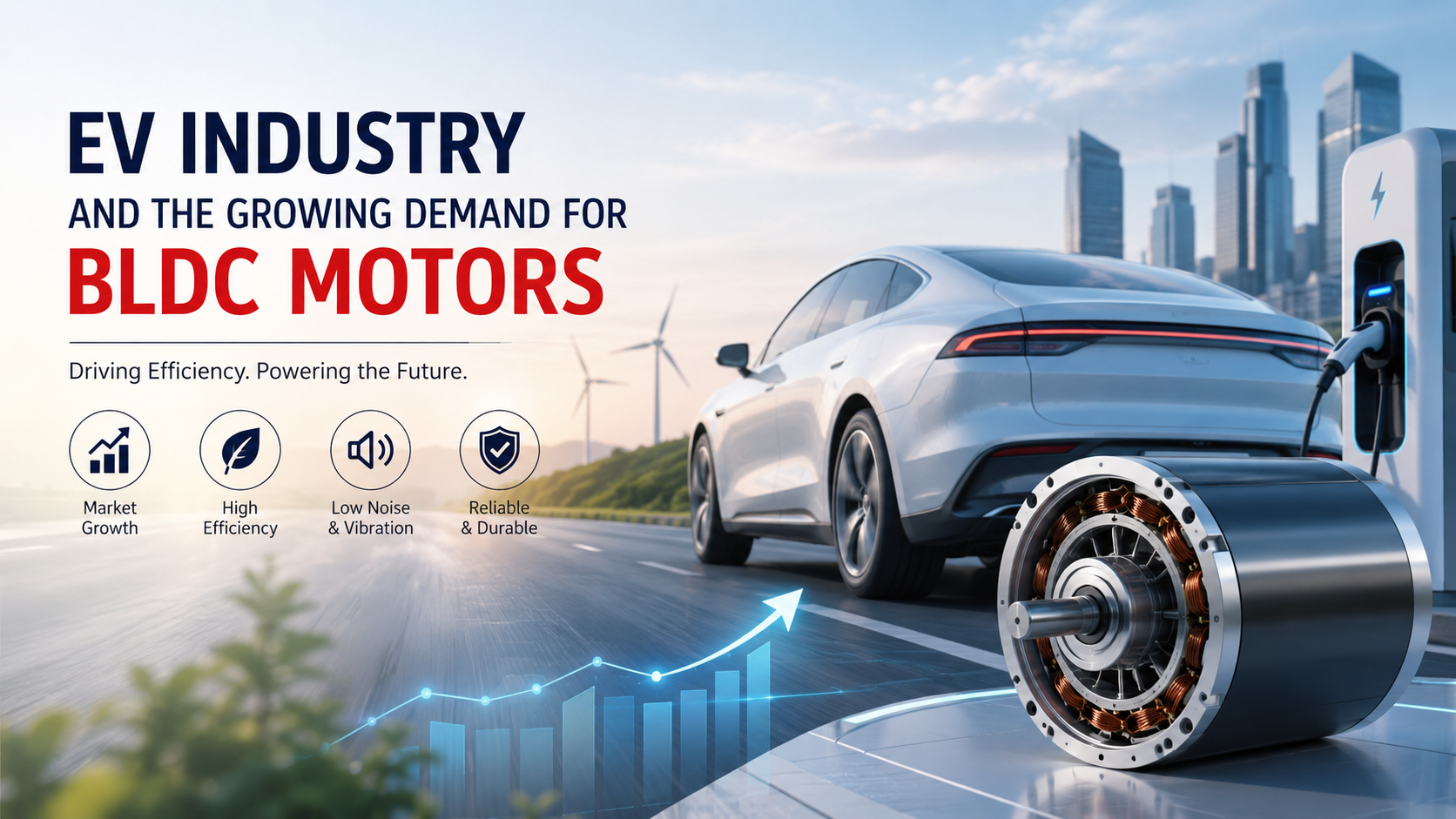
The growing demand for BLDC motors is closely connected to the rapid electrification of transportation, particularly in electric two-wheelers, three-wheelers, light electric vehicles, and auxiliary systems such as cooling fans, pumps, HVAC actuators, power steering, and other electromechanical subsystems. BLDC motors combine high power-to-weight ratio, low maintenance, compact construction, high efficiency, and precise electronic speed control, making them suitable where battery energy, packaging space, and reliability are important design constraints.
However, BLDC motors should not be treated as a universal replacement for every EV traction motor. Modern passenger EVs frequently use PMSM or IPM motors, while BLDC architectures remain particularly attractive for lower-power propulsion and auxiliary applications. The U.S. Department of Energy notes that internal permanent-magnet motors provide high power density and maintain high efficiency across a broad operating range, and recent engineering reviews continue to identify BLDC, PMSM, induction, SRM, and related machines as important EV motor technologies.
Why Is EV Demand Increasing the Need for BLDC Motors?
The first reason is simple: the global EV market is expanding rapidly, increasing demand not only for traction motors but for the many smaller electric motors installed throughout an EV.
According to the International Energy Agency (IEA), Global EV Outlook 2026, published in May 2026, global electric car sales exceeded 20 million units in 2025, representing approximately 25% of all new-car sales. The IEA expects global electric car sales to reach approximately 23 million in 2026, approaching 30% of worldwide car sales.
This growth creates demand across several motor categories rather than only for the main propulsion machine.
Typical BLDC applications include:
- Electric scooters and motorcycles
- E-bikes and light EVs
- Electric utility vehicles
- Cooling fans and pumps
- HVAC systems
- Electric power steering subsystems
- Battery thermal-management systems
- Actuators and automatic mechanisms
- Pumps and compressors
A 2026 Elsevier review of EV powertrains also notes that BLDC motors remain important in e-bikes, scooters, small EVs, and EV subsystems, while modern high-power passenger EVs are increasingly dominated by AC machine technologies.
What Makes BLDC Motors Suitable for EV Applications?
1. High Power-to-Weight Ratio
Vehicle designers continuously attempt to reduce motor mass because every unnecessary kilogram affects vehicle energy consumption, packaging, and dynamic performance.
A BLDC motor uses a permanent-magnet rotor and electronically commutated stator windings, eliminating the mechanical brushes and commutator found in conventional brushed DC motors. This architecture reduces mechanical wear and allows a compact motor package with a favorable power-to-weight ratio.
Engineering reviews have identified power density, efficiency, reliability, compact size, and low maintenance as important advantages of permanent-magnet brushless machines for EV applications.
2. High Efficiency Matters More in Battery-Powered Vehicles
In an internal-combustion vehicle, wasted mechanical energy ultimately appears as fuel consumption and heat. In an EV, electrical energy stored in the battery is limited, so motor efficiency directly affects usable driving energy.
Motor efficiency can be expressed as:
η = Pout / Pin × 100%
For example, if a motor receives 5 kW and produces 4.5 kW of mechanical output:
η = 4.5 / 5.0 × 100% = 90%
The remaining 500 W becomes losses, primarily through copper loss, iron loss, mechanical loss, and inverter-related losses.
A 2024 Applied Energy review emphasized that traction-motor efficiency depends on electromagnetic design, mechanical losses, thermal management, transmission configuration, and operating conditions rather than on motor topology alone.
BLDC Motor vs. Other EV Motor Technologies
| Parameter | BLDC Motor | PMSM/IPM | Induction Motor | Brushed DC Motor |
| Commutation | Electronic | Electronic | Electronic | Mechanical |
| Permanent magnets | Yes | Usually yes | No | Usually no |
| Maintenance | Low | Low | Low | Higher |
| Power density | High | Very high | Medium–high | Medium |
| Control complexity | Medium | High | High | Low |
| Torque ripple | Can be significant | Generally lower | Low | Moderate |
| Typical EV use | Small EVs, auxiliaries | Main traction | Main traction / selected applications | Legacy/light-duty |
| High-speed operation | Application dependent | Excellent with proper design | Excellent | Limited |
| Rare-earth dependency | Often | Often | None | Usually none |
The key engineering point is that BLDC and PMSM are not simply “better” or “worse” versions of the same motor. Their back-EMF waveform, commutation strategy, control method, torque-ripple characteristics, speed range, and application requirements can differ substantially.
The U.S. Department of Energy has specifically identified permanent-magnet traction motors as an important area of EV motor R&D while also emphasizing the challenge of reducing dependence on rare-earth materials.
How to Select a BLDC Motor for an EV?
Step 1: Define the Required Power
Motor power can be estimated from:
P = T × ω
where:
- P = mechanical power in watts
- T = torque in N·m
- ω = angular velocity in rad/s
For a 5 kW motor operating at 3,000 rpm:
ω = 2π × 3000 / 60 ≈ 314 rad/s
Therefore:
T ≈ 5000 / 314 ≈ 15.9 N·m
This calculation provides a first-order sizing point; acceleration requirements, gradeability, drivetrain efficiency, wheel diameter, vehicle mass, and peak-load duration must then be incorporated.
Step 2: Check the Voltage and Current
Common low-voltage BLDC applications may use systems such as 24 V, 36 V, 48 V, 60 V, or 72 V, while higher-power automotive systems use substantially higher DC-link voltages.
At the same mechanical power, increasing voltage reduces current.
For example, ignoring losses:
2 kW at 48 V ≈ 41.7 A
2 kW at 72 V ≈ 27.8 A
Lower current can reduce conductor losses because:
Pcu = I²R
This is particularly important for compact vehicle wiring and thermal design.
Step 3: Evaluate Continuous and Peak Torque
A common mistake is selecting a BLDC motor according only to its maximum rated power.
An EV motor must be evaluated according to:
- Continuous torque
- Peak torque
- Peak duration
- Base speed
- Maximum speed
- Duty cycle
- Ambient temperature
- Cooling method
- Controller current limit
A motor capable of 20 N·m peak torque for several seconds is not equivalent to a motor capable of continuously producing 20 N·m.
Common BLDC Motor Problems in EV Applications
| Problem | Typical Cause | Engineering Solution |
| Motor overheating | Excessive current or inadequate cooling | Reduce RMS current and improve thermal path |
| Low starting torque | Incorrect phase advance or insufficient current | Optimize commutation and controller settings |
| Torque ripple | Back-EMF harmonics or commutation strategy | Optimize winding, magnet geometry, and control |
| Excessive noise | Electromagnetic excitation or bearing issues | Analyze NVH and mechanical balance |
| Hall-sensor errors | Wiring, temperature, or sensor alignment | Verify Hall sequence and electrical angle |
| Short operating range | Low system efficiency | Optimize motor, inverter, gearing, and operating point |
| Demagnetization risk | Excessive temperature/current | Select appropriate magnets and thermal limits |
| Controller failure | Current or voltage transients | Verify inverter ratings and protection strategy |
Thermal management deserves particular attention because motor temperature affects winding resistance, magnet performance, insulation life, bearing life, and allowable continuous torque. Recent traction-motor research continues to identify thermal management as one of the major engineering factors influencing overall efficiency.
Common Engineering Mistakes
Choosing Motor Power Without Considering the Duty Cycle
A motor rated at 5 kW does not necessarily deliver 5 kW continuously under every operating condition.
Matching Motor and Controller Only by Voltage
A compatible system requires matching voltage, continuous current, peak current, Hall sequence, electrical angle, speed range, and thermal limits.
Ignoring Gear Reduction
For low-speed EVs, a suitable gear ratio can significantly change the motor’s required operating point. Instead of demanding extremely high torque directly from the motor, engineers can use a reduction gearbox to convert motor speed into wheel torque.
Evaluating Efficiency at Only One Operating Point
An EV rarely operates continuously at one speed and one load. Efficiency should be evaluated across a speed-torque operating map, particularly around common driving points.
FAQ
Are BLDC motors suitable for electric vehicles?
Yes. BLDC motors are suitable for many EV applications, particularly e-bikes, scooters, small EVs, auxiliary systems, pumps, fans, and actuators, although PMSM/IPM machines are also widely used for higher-power passenger-vehicle traction.
What voltage is commonly used for BLDC EV motors?
Low-voltage EV and mobility systems commonly use 24–72 V DC, while automotive traction systems can operate at substantially higher DC-link voltages. The correct voltage depends on motor power, inverter architecture, current limits, insulation requirements, and vehicle design.
Are BLDC motors more efficient than brushed DC motors?
Generally, BLDC motors can achieve higher efficiency because they eliminate brush and commutator losses and use electronic commutation, although actual efficiency depends on motor design, controller efficiency, operating speed, load, and thermal conditions.
What is the main disadvantage of a BLDC motor in EV applications?
Important limitations include controller dependence, torque ripple, electromagnetic noise, permanent-magnet cost, thermal constraints, and, for some designs, a narrower constant-power speed range than advanced IPM traction motors.
Are BLDC and PMSM motors the same?
No. Both are permanent-magnet brushless machines, but their back-EMF waveforms, winding configurations, commutation methods, and control strategies can differ. In practical industry discussions, the terminology is sometimes used loosely, so engineers should evaluate the actual electrical and mechanical design rather than relying only on the product name.
Related blog: How Electric Motors Drive Medical Devices?