
Quick Answer
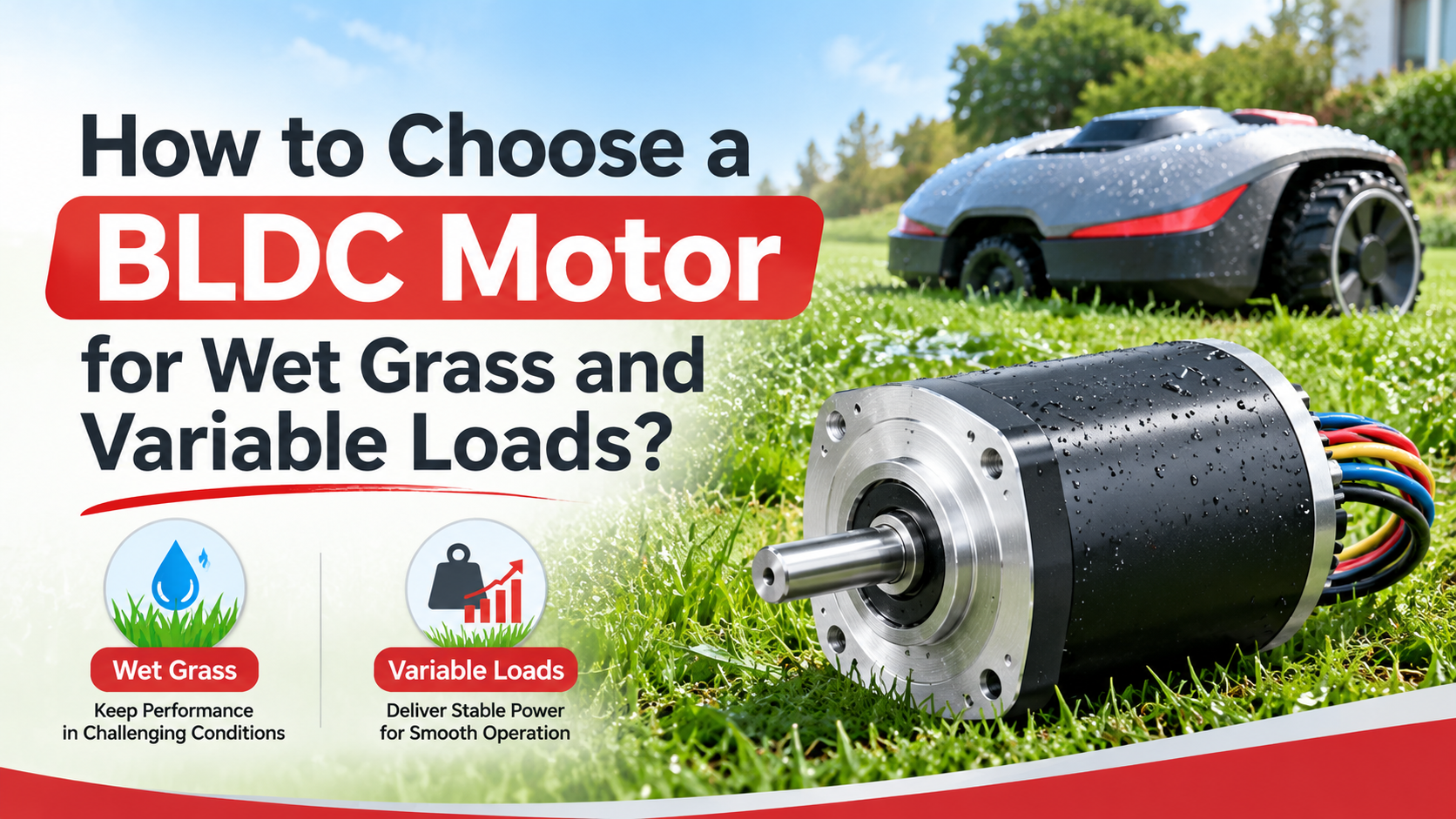
Choosing a BLDC motor for wet grass and variable loads requires more than matching rated power and rotational speed. Engineers must evaluate starting torque, continuous torque, peak torque, speed stability, thermal performance, current capacity, and motor control strategy under changing cutting conditions.
Wet grass creates additional cutting resistance because damp and dense vegetation can increase blade contact resistance, while uneven terrain and varying grass height introduce frequent load fluctuations. If the motor is undersized, the mower may experience speed drops, excessive current, overheating, blade stalling, or reduced operating efficiency.
For robotic and electric lawn mower applications, a suitable BLDC motor should provide sufficient torque reserve, stable low-speed operation, effective thermal management, and reliable overload handling. FOC (Field-Oriented Control), appropriate motor sizing, and application-specific gearbox or wheel-drive configurations can further improve system performance.
Engineering recommendation: Select the motor according to the actual cutting load and worst-case operating conditions rather than relying exclusively on nominal power ratings.
Why Wet Grass Creates More Demanding Motor Conditions?
Wet grass presents several challenges for electric lawn mower motors because moisture, grass density, cutting height, and vegetation conditions can change the resistance experienced by the cutting blade.
Compared with dry and regularly maintained grass, wet or overgrown grass can create:
– Higher cutting resistance.
– Greater torque demand during blade engagement.
– More frequent motor load fluctuations.
– Increased risk of blade speed reduction.
– Higher current demand during difficult cutting conditions.
– Greater thermal stress during extended operation.
For robotic lawn mowers, these conditions are particularly important because the machine may encounter different grass densities and terrain conditions without operator intervention.
A motor designed only for light, dry grass may therefore struggle when the cutting system encounters thick, damp vegetation.
Engineering insight: Wet-grass performance should be evaluated using actual cutting-load conditions, not simply the motor’s no-load speed or rated power.
Five Key Parameters When Selecting a BLDC Motor
Rated Torque and Peak Torque
Torque is one of the most important selection parameters for lawn mower motors because the cutting blade must maintain sufficient mechanical force when grass resistance increases.
Engineers should distinguish between:
– Continuous torque: The torque the motor can deliver throughout its specified thermal operating conditions.
– Peak torque: The higher torque available temporarily during acceleration or short-duration overload conditions.
– Starting torque: The torque available when the blade begins rotating from a stationary position.
For wet-grass applications, selecting a motor based only on continuous rated torque may result in insufficient overload capability.
A properly selected motor should maintain stable blade operation during sudden increases in cutting resistance without exceeding its allowable current or temperature limits.
Rated Power and Power Reserve
Rated power determines the motor’s continuous mechanical output capability under specified operating conditions, but it does not independently determine whether the motor can handle difficult cutting loads.
For example, UNITED MOTION INC. has documented a lawn mower motor application in which output power increased from 40 W to 77 W, representing approximately a 92.5% increase.
This application demonstrates how motor configuration and electromagnetic optimization can significantly influence available output performance.
However, the required power for another lawn mower must still be calculated according to blade dimensions, cutting speed, grass conditions, and duty cycle.
Operating Speed and Speed Stability
Blade speed affects cutting quality and the ability to maintain consistent performance when grass resistance changes.
If the motor speed drops excessively when cutting wet or dense grass, the mower may produce uneven cutting results or require repeated passes.
Engineers should evaluate:
– No-load speed.
– Rated operating speed.
– Loaded operating speed.
– Maximum operating speed.
– Speed recovery after sudden load changes.
A suitable BLDC motor and controller should maintain stable operation across the expected cutting-load range.
Current Capacity and Thermal Performance
When cutting resistance increases, the motor may require additional current to maintain torque.
If this condition continues for an extended period, winding temperature can rise, potentially reducing motor lifetime and triggering controller protection.
Motor selection should therefore consider continuous current, peak current, winding temperature, ambient temperature, cooling conditions, and overload duration.
Motor Control Strategy
Motor control is equally important because even a mechanically suitable motor can perform poorly if its controller cannot respond effectively to changing loads.
FOC is particularly useful for applications requiring smooth torque production, controlled acceleration, and stable operation under variable loads.
For lawn mower applications, engineers should evaluate the complete motor-and-controller combination rather than selecting the motor independently.
Why FOC Control Matters for Wet Grass Applications?
Field-Oriented Control (FOC) is a motor control strategy that regulates the motor’s magnetic field and torque-producing current components independently, allowing the controller to deliver smoother and more precise torque response than basic six-step commutation in suitable applications.
For lawn mower motors, FOC can provide several practical advantages:
– Improved torque control: Helps the motor respond to changing cutting resistance.
– Smoother operation: Reduces torque pulsation and improves low-speed operating behavior.
– Better speed regulation: Helps maintain blade speed when grass density changes.
– Reduced acoustic noise: Can improve the operating experience of residential robotic lawn mowers.
– More flexible control: Supports different operating conditions through controller parameter optimization.
UNITED MOTION INC.’s lawn mower motor testing has demonstrated a reduction in measured noise from 55 dB to 34 dB under six-step control comparisons, and from 45 dB to below 30 dB under FOC comparisons, using the company’s documented before-and-after test configurations.
These results illustrate the potential benefits of optimizing motor electromagnetic design and control strategy together, although actual results depend on the motor, controller, installation, and test conditions.
Engineering recommendation: For applications involving frequent changes in grass density, FOC should be evaluated as part of the complete drive system rather than treated as an optional software feature.
How to Match a BLDC Motor to Different Lawn Mower Loads?
Different lawn mower architectures require different motor configurations, and engineers should distinguish between the cutting motor and the wheel-drive motor because their load characteristics are not identical.
| Application | Main Load Characteristics | Recommended Motor Considerations |
|---|---|---|
| Robotic lawn mower | Frequent load changes and compact installation | Compact BLDC motor, stable speed control |
| Commercial lawn mower | Long operating periods and demanding cutting loads | Higher continuous torque and thermal capacity |
| Wet-grass cutting system | Increased and fluctuating blade resistance | Adequate peak torque and overload capability |
| Self-propelled mower | Variable traction and terrain resistance | Gear motor with suitable reduction ratio |
| Wheel-hub drive mower | Direct wheel integration and changing traction | Integrated hub motor and precise speed control |
For cutting applications, engineers should prioritize blade torque, operating speed, overload capability, and thermal performance.
For wheel-drive applications, the main considerations include vehicle weight, wheel diameter, required climbing ability, traction, reduction ratio, and acceleration requirements.
A motor configuration that works well for blade rotation may not be appropriate for wheel propulsion, even when both systems have similar rated power.
How to Calculate the Appropriate Motor Requirements?
A reliable selection process should begin with the mechanical application rather than an available motor catalogue.
Step 1: Determine the Cutting System Requirements
Identify the blade diameter, blade quantity, cutting speed, cutting height, and expected grass conditions.
These parameters establish the mechanical requirements that the motor must satisfy.
Step 2: Evaluate the Worst-Case Load
Consider the most demanding realistic operating conditions, including:
– Wet and dense grass.
– Overgrown vegetation.
– Sudden blade engagement.
– Repeated cutting and acceleration.
– Continuous operation at high ambient temperature.
Avoid designing exclusively around average grass conditions.
Step 3: Establish Torque and Speed Requirements
Determine the required continuous torque, peak torque, starting performance, and operating speed.
The selected motor should maintain acceptable performance without continuously operating at its maximum allowable current.
Step 4: Select the Motor and Controller
Match the motor’s voltage, power, speed, current, and torque characteristics with the controller.
For demanding cutting conditions, evaluate FOC control, current limiting, overload protection, and temperature monitoring.
Step 5: Validate the Complete System
Test the motor under representative grass conditions rather than relying entirely on laboratory no-load measurements.
Record blade speed, current, temperature, cutting consistency, and overload response.
Common BLDC Motor Selection Problems and Troubleshooting
| Problem | Possible Cause | Recommended Engineering Action |
|---|---|---|
| Blade speed drops in wet grass | Insufficient torque reserve | Re-evaluate peak torque and current capacity |
| Motor frequently overheats | Excessive continuous load or poor cooling | Check thermal design and operating duty cycle |
| Blade stalls during starting | Insufficient starting torque | Optimize starting current and control parameters |
| Excessive current fluctuations | Rapid changes in cutting resistance | Evaluate FOC and current regulation |
| Uneven cutting results | Unstable blade speed | Optimize speed feedback and torque response |
| Excessive operating noise | Electromagnetic or mechanical vibration | Check motor structure, balancing, and control |
| Short motor service life | Excessive thermal and mechanical stress | Review operating limits and protection strategy |
Important: Increasing motor power is not always the correct solution. Engineers should first determine whether the problem comes from insufficient torque, incorrect blade geometry, poor airflow, unsuitable control parameters, mechanical friction, or an undersized power supply.
Common Engineering Mistakes
Mistake 1: Selecting a Motor Based Only on Rated Power
Two BLDC motors with identical rated power can have significantly different torque-speed characteristics, thermal capabilities, and overload performance.
Always compare the complete motor specifications.
Mistake 2: Ignoring Peak Load Conditions
Wet grass and overgrown vegetation can introduce short-duration load peaks that are not represented by average operating conditions.
The motor and controller must be designed to handle these events safely.
Mistake 3: Overlooking Cooling Requirements
A motor operating in a compact mower housing may experience restricted airflow, grass accumulation, and elevated ambient temperatures.
Thermal performance should be validated in the actual installation environment.
Mistake 4: Treating the Motor and Controller as Separate Components
The motor, driver, feedback system, and mechanical load form one integrated motion-control system.
Poor matching between these components can reduce efficiency and reliability even when individual components meet their specifications.
Why Choose UNITED MOTION INC. for Custom BLDC Motor Solutions?
UNITED MOTION INC. provides customized motor solutions for OEM customers developing robotic lawn mowers, electric lawn equipment, industrial automation systems, and other motion-control applications.
Its BLDC motor portfolio covers approximately Φ28 mm to Φ110 mm, with different configurations available to support application-specific performance requirements.
Available customization options include:
– Voltage and speed configurations.
– Torque and power optimization.
– Gearbox integration.
– Encoder integration.
– Integrated motor drivers.
– Application-specific mechanical designs.
For lawn mower applications, motor development should consider cutting performance, variable-load response, operating noise, thermal management, and long-term reliability together.
UNITED MOTION INC. also has documented engineering experience in lawn mower motor optimization, including an application that increased output power from 40 W to 77 W and improved torque capability by approximately 110%.
These application results provide a practical reference for evaluating how electromagnetic design and motor configuration can improve performance under demanding operating conditions.
Looking for a BLDC motor manufacturer for your next lawn mower project? UNITED MOTION INC. supports OEM customers with customized motor configurations designed around their actual application requirements.
Frequently Asked Questions (FAQ)
1. What type of BLDC motor is best for wet grass?
A suitable BLDC motor should provide sufficient continuous torque, peak torque reserve, stable operating speed, and effective thermal management. FOC control is also worth considering when the cutting load changes frequently.
2. Does wet grass require a higher-power lawn mower motor?
Not necessarily. Wet grass often increases cutting resistance, but the required motor power depends on blade dimensions, cutting speed, grass density, and operating conditions. Engineers should evaluate torque and overload capability rather than increasing rated power without analysis.
3. Why does a lawn mower motor slow down when cutting thick grass?
The most common reason is that cutting resistance increases beyond the motor’s available torque at its current operating speed. Other possible causes include insufficient current capacity, controller limitations, voltage drop, or mechanical friction.
4. Is FOC better than six-step control for robotic lawn mowers?
FOC can provide smoother torque control, improved speed regulation, and lower acoustic noise in appropriately designed systems. However, the best control strategy depends on cost, operating requirements, motor characteristics, and controller design.
5. How do I select the correct BLDC motor power for a robotic lawn mower?
Start with blade dimensions, required cutting speed, expected grass conditions, continuous operating time, and mechanical losses. Then determine the required torque and power, allowing sufficient capacity for realistic peak loads and thermal limitations.
6. Can a BLDC motor be customized for different lawn mower applications?
Yes. Motor diameter, voltage, speed, torque, gearbox configuration, encoder feedback, and integrated driver options can be customized according to the OEM application’s requirements.
7. What is the difference between a cutting motor and a wheel-drive motor?
A cutting motor primarily needs to maintain blade speed and overcome cutting resistance, while a wheel-drive motor must provide sufficient traction, starting torque, and climbing capability. Their mechanical configurations and torque-speed requirements are therefore different.