
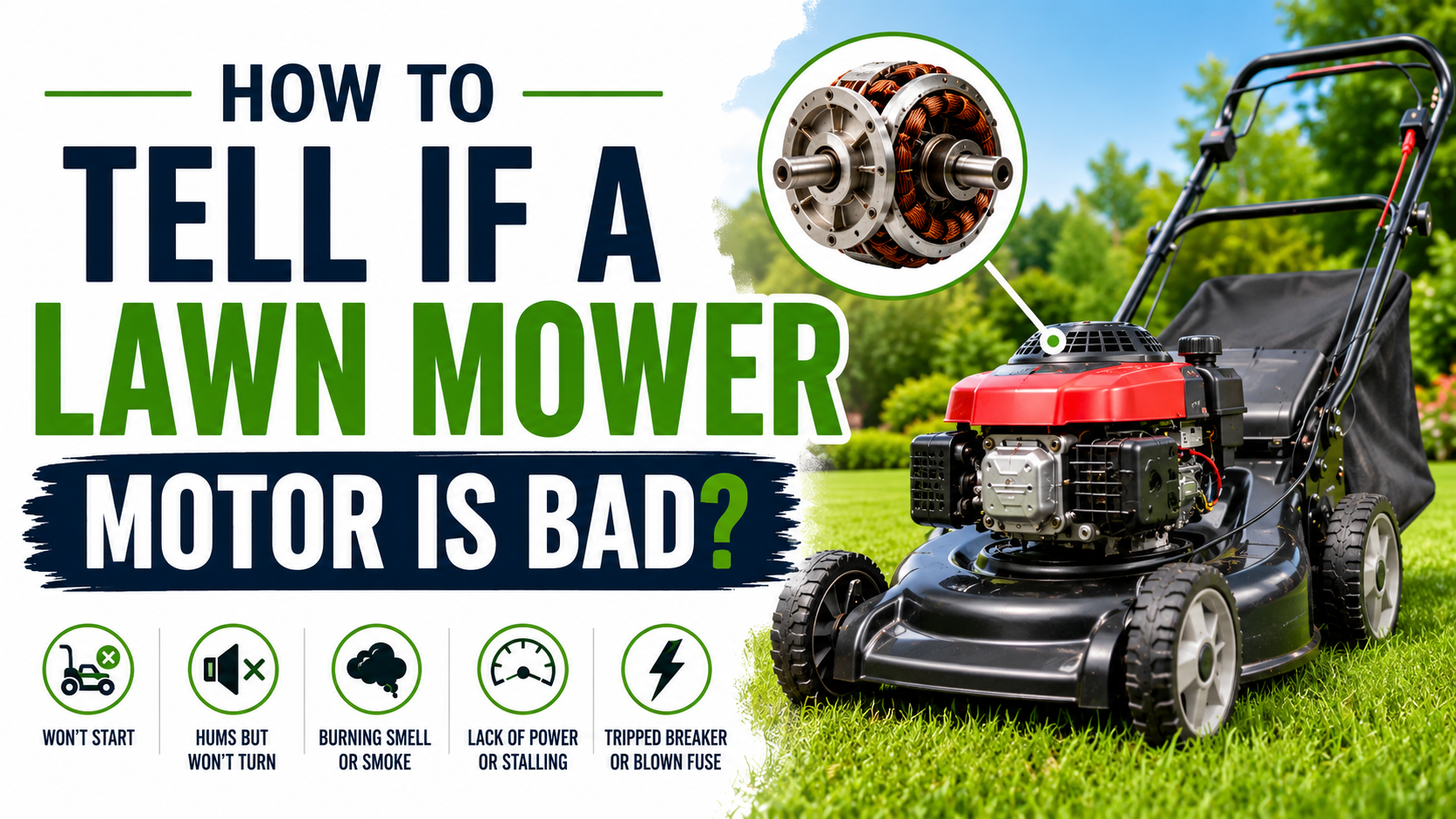
A lawn mower motor is likely failing if it exhibits one or more of the following symptoms:
It will not start despite a healthy power supply or battery.
It overheats within a few minutes of operation.
It produces unusual grinding, squealing, or knocking noises.
The blade rotates slowly or lacks cutting power.
The motor vibrates excessively.
A burning smell or visible smoke appears.
Electrical measurements show abnormal winding resistance or insulation failure.
The most reliable way to confirm a faulty lawn mower motor is to perform a systematic inspection, including visual examination, electrical testing with a multimeter, insulation testing, bearing inspection, and operational performance evaluation.
Engineering Reference: Electrical motor diagnostic methods recommended by the U.S. Department of Energy (DOE Motor Systems Program, 2014) and IEEE standards for rotating machinery condition assessment.
Why Lawn Mower Motors Fail?
Motor failures rarely happen suddenly. Most develop gradually due to several combined factors.
Common causes include:
- Bearing wear
- Moisture ingress
- Dirt contamination
- Overloading
- Poor cooling
- Voltage abnormalities
- Mechanical shock
- Blade obstruction
- Winding insulation degradation
- Continuous operation beyond rated duty cycle
According to the U.S. Department of Energy Motor Systems Sourcebook (2014), overheating and insulation deterioration remain the leading causes of electric motor failure in industrial applications. Similar mechanisms apply to outdoor power equipment.
Steps to Tell if a Lawn Mower Motor is Bad
Step 1: Observe the Motor During Startup
The startup behavior provides valuable diagnostic information.
Healthy motors should:
- Accelerate smoothly
- Reach rated speed within seconds
- Produce consistent torque
- Generate minimal vibration
Possible warning signs include:
Motor Does Not Start
Possible causes:
- Open winding
- Controller failure
- Damaged connectors
- Dead battery
- Broken Hall sensor (BLDC motors)
Motor Starts Slowly
Possible causes:
- Low battery voltage
- High internal resistanc
- Bearing friction
- Partial winding short
Motor Starts Then Stops
Possible causes:
- Thermal protection activated
- Overcurrent protection
- Locked rotor
- Controller fault
Always verify that the power source meets the motor’s rated voltage before assuming the motor itself has failed.
Step 2: Check for Unusual Noise
Abnormal sounds often indicate mechanical damage.
Listen for:
Grinding
Usually indicates:
- Worn bearings
- Contaminated grease
- Shaft damage
- Clicking
May indicate:
- Loose rotor
- Damaged coupling
- Foreign debris
- Squealing
Typically caused by:
- Dry bearings
- Bearing misalignment
- Knocking
Can indicate:
- Rotor contacting stator
- Bent shaft
- Severe bearing failure
Mechanical failures often increase current consumption because the motor must overcome additional friction.
Step 3: Inspect for Excessive Heat
Temperature is one of the best indicators of motor health.
Most electric lawn mower motors operate with winding temperatures below:
- Class B insulation: 130°C
- Class F insulation: 155°C
- Class H insulation: 180°C
The external housing should normally remain much cooler depending on load and ambient conditions.
Warning signs include:
- Housing too hot to touch
- Thermal shutdown
- Burnt odor
- Discolored windings
According to NEMA MG 1 (National Electrical Manufacturers Association), every 10°C increase above the insulation rating can significantly reduce insulation life.
Step 4: Measure Electrical Resistance
A digital multimeter provides valuable information.
For brushed DC motors:
Measure resistance across the terminals.
Possible findings:
Very high resistance
Usually indicates:
- Open winding
- Broken wire
- Burned commutator
Very low resistance
May indicate:
Shorted winding
Internal insulation failure
For three-phase BLDC lawn mower motors:
Measure:
U-V
V-W
W-U
All three readings should be nearly identical.
A large imbalance usually indicates winding damage.
Step 5: Perform an Insulation Test
Professional maintenance often uses a megohmmeter.
The insulation resistance between winding and housing should generally exceed:
1 MΩ minimum
Higher values are preferred for healthy motors
Low insulation resistance may result from:
- Moisture
- Dirt
- Aging insulation
- Physical damage
IEEE insulation testing standards recommend periodic insulation testing for critical rotating equipment.
Step 6: Inspect Bearings
Bearings represent one of the most common failure points.
Typical symptoms include:
- Shaft wobble
- Rough rotation
- Increased vibration
- Grinding noise
- Heat generation
Rotate the shaft manually.
A healthy bearing should rotate:
- Smoothly
- Quietly
- Without binding
- Without noticeable play
According to bearing reliability studies published by SKF, bearing failures account for a significant portion of rotating machinery breakdowns.
Step 7: Evaluate Motor Torque
Reduced torque often appears before complete failure.
Symptoms include:
- Poor cutting performance
- Blade slows in thick grass
- Difficulty maintaining speed
- Frequent controller overload
Possible causes:
- Demagnetized rotor
- Winding damage
- Low battery voltage
- Excessive bearing friction
Always eliminate mechanical blade problems before replacing the motor.
Step 8: Check Current Consumption
Motor current reflects internal condition.
Higher-than-normal current often indicates:
- Bearing seizure
- Rotor rubbing
- Shorted winding
- Mechanical overload
Lower-than-normal current may indicate:
- Open winding
- Weak magnetic field
- Controller malfunction
Compare measured current with the motor nameplate specifications whenever possible.
Common Lawn Mower Motor Failure Symptoms
| Symptom | Possible Cause | Recommended Action |
| Motor will not start | Open winding, controller fault | Check voltage and winding continuity |
| Motor overheats | Overload, blocked cooling, insulation damage | Inspect load and cooling system |
| Burning smell | Winding overheating | Stop operation immediately |
| Excessive vibration | Bearing wear, bent shaft | Replace bearings or shaft |
| Reduced cutting power | Low torque, winding damage | Measure current and resistance |
| Loud grinding | Bearing failure | Replace bearings |
| Frequent shutdown | Thermal overload | Inspect airflow and operating load |
| Blade rotates slowly | Battery or motor issue | Verify battery voltage and motor performance |
Step-by-Step Diagnostic Procedure
A structured inspection improves troubleshooting accuracy.
Visual Inspection
Check:
- Housing cracks
- Burn marks
- Loose connectors
- Damaged wiring
- Water ingress
Mechanical Inspection
Inspect:
- Bearings
- Shaft alignment
- Blade attachment
- Rotor movement
Electrical Inspection
Measure:
- Supply voltage
- Winding resistance
- Current draw
- Insulation resistance
Operational Test
Run the mower under light load.
Observe:
- Temperature
- Speed stability
- Noise
- Vibration
- Power output
Common Mistakes During Diagnosis
Many motors are replaced unnecessarily.
Avoid these mistakes:
Replacing the Motor Before Testing the Battery
Weak batteries often mimic motor failure.
Ignoring Blade Resistance
A jammed blade dramatically increases motor current.
Assuming All Overheating Indicates Motor Failure
Blocked ventilation frequently causes overheating.
Measuring Resistance Without Disconnecting the Controller
Electronic controllers can distort resistance readings.
Ignoring Bearing Noise
Replacing only electrical components will not solve mechanical problems.
Preventive Maintenance Tips
Routine maintenance greatly extends motor service life.
Recommended practices include:
Remove grass buildup after every use.
Keep cooling vents clean.
Avoid operating in standing water.
Inspect bearings annually.
Tighten electrical connectors.
Charge batteries correctly.
Replace damaged blades promptly.
Avoid prolonged overload operation.
Preventive maintenance reduces unexpected downtime and helps maintain consistent cutting performance.
When Should You Replace the Lawn Mower Motor?
Motor replacement is usually recommended when:
Windings are burned.
Insulation resistance remains below acceptable limits after drying.
Rotor magnets are damaged.
Shaft is severely bent.
Bearings have caused secondary rotor or stator damage.
Repair costs exceed replacement value.
For commercial equipment, downtime costs should also be considered when making repair decisions.
Choosing a Reliable Replacement Lawn Mower Motor
Selecting the correct replacement motor involves more than matching voltage.
Engineers should verify:
- Rated voltage
- Rated power
- Continuous torque
- Peak torque
- Speed (RPM)Shaft dimensions
- Mounting pattern
- Protection rating (IP)
- Duty cycle
- Cooling method
- Controller compatibility
- Operating temperature range
For robotic and battery-powered lawn mowers, high-efficiency BLDC lawn mower motors generally provide longer service life, lower maintenance, quieter operation, and improved energy efficiency compared with brushed alternatives.
At UNITED MOTION INC., we develop custom lawn mower motor solutions for residential, commercial, and robotic mowing equipment, including high-efficiency BLDC motors, drive motors, blade motors, gear motors, and integrated motion control solutions designed for demanding outdoor environments.
Frequently Asked Questions
How do I know if my lawn mower motor is burned out?
Common indicators include a burning odor, visible smoke, failure to start, abnormal winding resistance, overheating, or tripped thermal protection. Confirm the diagnosis using electrical measurements rather than visual inspection alone.
Can a lawn mower motor overheat without being damaged?
Yes. Heavy grass, blocked airflow, dull blades, or prolonged overload can temporarily raise motor temperature. Persistent overheating, however, accelerates insulation aging and may lead to permanent failure.
Can a bad bearing damage a lawn mower motor?
Yes. Worn bearings increase friction, vibration, and operating temperature. Continued operation can cause rotor-to-stator contact, winding damage, and eventual motor failure.
What is the average lifespan of a lawn mower motor?
Service life depends on operating conditions, duty cycle, maintenance, and motor quality. Well-designed brushless lawn mower motors commonly provide several thousand operating hours when properly maintained.
Should I repair or replace a faulty lawn mower motor?
Minor issues such as bearing replacement or connector repair are often economical. Burned windings, severe insulation failure, or extensive mechanical damage typically justify motor replacement.
Related blog: Lawn Mower Motor Solutions for Robotic Mowers