
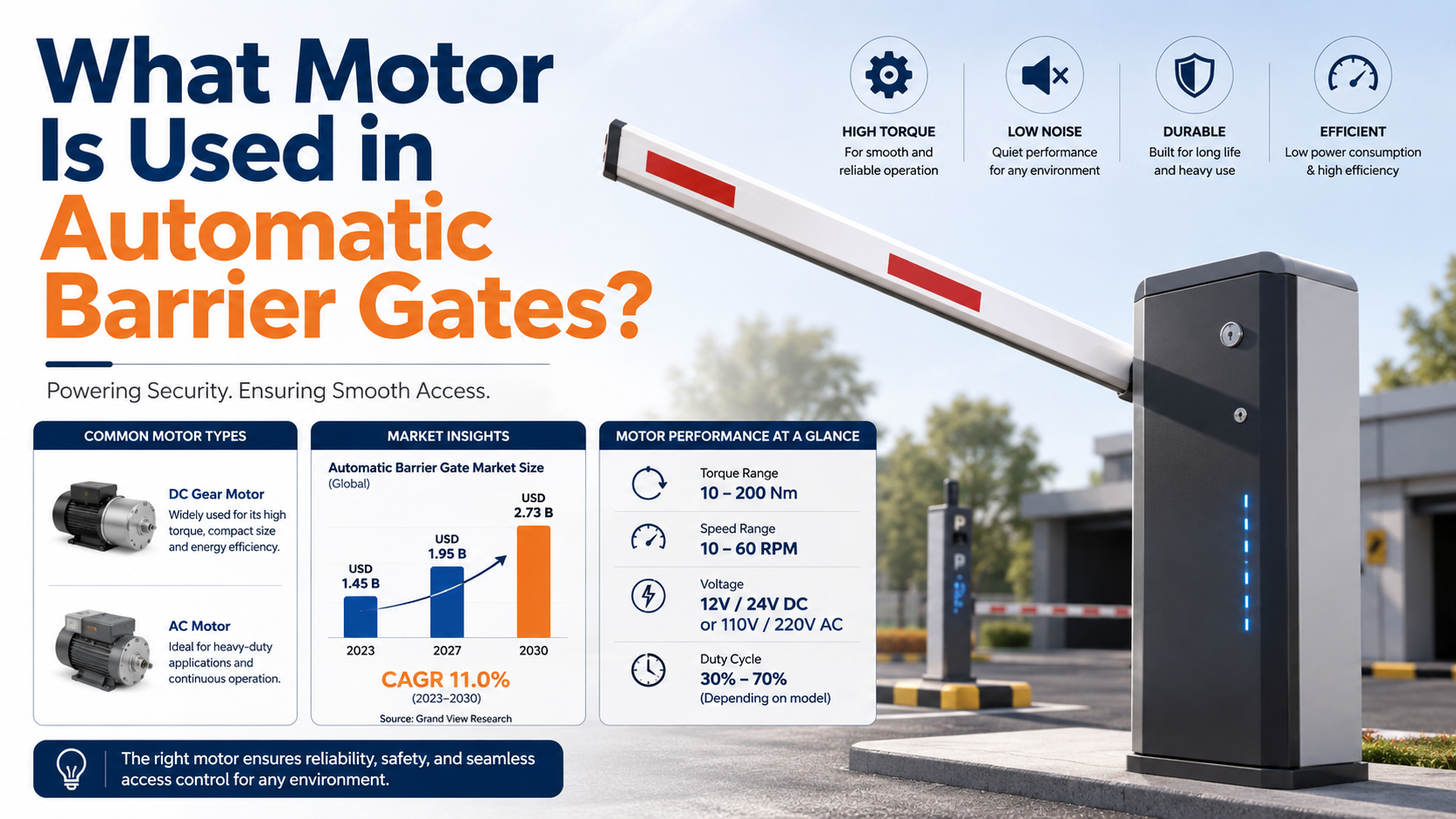
Automatic barrier gates commonly use BLDC (Brushless DC) motors, geared DC motors, or AC induction motors depending on gate size, duty cycle, speed requirements, and smart control features.
For modern smart parking systems, the preferred solution is usually a:
• BLDC motor for barrier gate systems
• High torque geared motor
• Brushless gate motor with encoder feedback
• Industrial barrier motor with continuous-duty capability
Compared with traditional brushed motors, BLDC motors provide:
• Higher efficiency (85–92%)
• Longer service life
• Lower maintenance
• Faster opening/closing response
• Better noise control
• More accurate speed positioning
Today, most premium parking systems and intelligent access control systems rely on high torque gate motors integrated with sensors, controllers, and IoT communication modules.
Why Motor Selection Matters in Automatic Barrier Gates?
Barrier gates operate in demanding environments:
• Continuous opening and closing
• Outdoor temperature exposure
• Dust and moisture
• Peak-hour traffic cycles
• Sudden impact loads
• 24/7 operation
A poorly selected motor can cause:
• Slow gate response
• Overheating
• Gear failure
• High maintenance costs
• Unstable arm positioning
• Excessive vibration and noise
This is why many OEMs now work directly with a specialized barrier gate motor manufacturer to develop optimized drive systems.
Main Types of Motors Used in Barrier Gates
1. BLDC Motor for Barrier Gate Systems
The most common solution in modern smart parking equipment is the brushless gate motor.
Why BLDC Motors Are Preferred
BLDC motors use electronic commutation instead of carbon brushes.
This design significantly improves:
• Lifespan
• Speed control
• Torque density
• Energy efficiency
• Reliability
Typical BLDC Motor Specifications
| Parameter | Typical Range |
|---|---|
| Voltage | 24V / 36V / 48V |
| Rated Power | 60W–400W |
| Rated Torque | 0.5–8 Nm |
| Speed | 1500–4000 RPM |
| Efficiency | 85–92% |
| Protection Level | IP54–IP65 |
| Duty Cycle | Continuous |
Advantages of BLDC Barrier Motors
| Advantage | Engineering Benefit |
|---|---|
| No brushes | Lower maintenance |
| High efficiency | Reduced power consumption |
| Encoder compatibility | Precise gate positioning |
| Fast dynamic response | Faster barrier operation |
| Compact structure | Easier integration |
| Low noise | Better urban deployment |
For smart parking systems, BLDC motors also support:
• Soft start/stop
• Anti-crash logic
• IoT integration
• Speed feedback control
• Vehicle detection systems
This makes them ideal for modern smart parking motor applications.
2. Geared DC Motors
Some low-cost parking systems still use brushed DC motors with gearboxes.
Common Applications
• Residential barrier gates
• Low-duty parking systems
• Budget access control equipment
| Issue | Impact |
|---|---|
| Brush wear | Frequent maintenance |
| Lower lifespan | Reduced reliability |
| Electrical sparks | EMI interference |
| Higher heat generation | Reduced efficiency |
These motors are gradually being replaced by OEM gate motor BLDC platforms.
3. AC Induction Motors
Heavy industrial barrier systems sometimes use AC motors.
Suitable For
• Large industrial entrances
• Logistics parks
• Heavy-duty boom barriers
• Extreme weather installations
Typical Characteristics
| Parameter | Typical Value |
|---|---|
| Voltage | 110V / 220V / 380V |
| Power | 250W–750W |
| Speed | 1400–2800 RPM |
| Efficiency | 75–88% |
However, AC motors usually require:
• VFD control
• Larger installation space
• More complex wiring
For compact smart parking systems, BLDC solutions are often preferred.
How Does a Barrier Gate Motor Work?
The motor converts electrical energy into rotational torque.
The motion is transferred through:
1. Motor shaft
2. Gear reduction system
3. Crank mechanism
4. Barrier arm linkage
The system controller monitors:
• Arm position
• Motor current
• Encoder feedback
• Obstacle detection
• Speed profile
Modern parking barrier motors usually include Hall sensors or magnetic encoders for closed-loop control.
Typical Motor Requirements for Automatic Barrier Gates
Torque Requirements
Barrier gate motors must generate enough torque to move the boom arm smoothly.
Typical Torque Ranges
| Barrier Arm Length | Recommended Torque |
|---|---|
| 2–3 meters | 1–3 Nm |
| 3–4.5 meters | 3–6 Nm |
| 4.5–6 meters | 6–12 Nm |
High wind resistance or heavier aluminum arms may require additional torque margin.
This is why many applications use a high torque gate motor with gearbox optimization.
Speed Requirements
Opening speed directly impacts traffic efficiency.
Common Opening Times
| Application | Opening Time |
|---|---|
| Residential | 3–6 seconds |
| Commercial parking | 1.5–3 seconds |
| Highway toll systems | <1.5 seconds |
Higher-speed gates require:
• Fast-response BLDC motors
• Accurate electronic braking
• Stable acceleration curves
Duty Cycle Considerations
One of the most overlooked engineering issues is duty cycle.
Typical Duty Cycles
| Application | Cycles/Day |
|---|---|
| Residential | 500–1000 |
| Commercial parking | 3000–8000 |
| Toll stations | 10,000+ |
Low-quality motors often fail due to overheating during continuous operation.
An industrial-grade industrial barrier motor should support:
• Continuous duty operation
• Efficient thermal dissipation
• Overcurrent protection
• Temperature monitoring
BLDC Motor vs Brushed Motor for Barrier Gates
| Feature | BLDC Motor | Brushed DC Motor |
|---|---|---|
| Lifespan | 10,000–30,000 hrs | 2,000–5,000 hrs |
| Maintenance | Minimal | High |
| Noise | Low | Moderate |
| Efficiency | High | Lower |
| Speed Control | Precise | Basic |
| EMI | Low | Higher |
| Smart Control | Excellent | Limited |
| Cost | Higher initial | Lower initial |
For OEM parking systems, BLDC motors deliver lower total ownership cost despite higher upfront pricing.
Key Components Inside a Barrier Gate Motor System
Motor Core
Usually:
• BLDC outer rotor motor
• Inner rotor servo-style motor
• Permanent magnet synchronous motor
High-grade NdFeB magnets improve torque density and efficiency.
Gearbox
The gearbox reduces RPM while increasing output torque.
Common Gear Types
| Gear Type | Advantages |
|---|---|
| Worm gear | Self-locking |
| Planetary gearbox | High efficiency |
| Helical gear | Low noise |
| Spur gear | Cost-effective |
Planetary gearboxes are increasingly common in custom motor solution projects.
Encoder
Encoders provide position feedback.
Benefits
• Accurate boom positioning
• Anti-collision logic
• Speed regulation
• Smart synchronization
Motor Driver
The driver controls:
• Current
• Torque
• Speed
• Direction
• Acceleration curve
Modern controllers support:
• RS485
• CAN Bus
• WiFi
• Bluetooth
• Cloud integration
Common Engineering Problems in Barrier Gate Motors
Problem 1: Motor Overheating
Causes
• Undersized motor
• Excessive duty cycle
• Poor ventilation
• High ambient temperature
Solutions
| Solution | Effect |
|---|---|
| Increase motor power | Lower thermal stress |
| Add cooling design | Improved heat dissipation |
| Optimize duty cycle | Reduced overload |
| Use BLDC motor | Higher efficiency |
Problem 2: Insufficient Torque
Symptoms
• Slow startup
• Arm shaking
• Failure during wind load
Engineering Fixes
• Increase gearbox ratio
• Use higher pole-count motor
• Improve controller tuning
• Add counterbalance spring
Problem 3: Excessive Noise
Common Sources
• Gear backlash
• Poor bearings
• PWM frequency issues
• Rotor imbalance
Recommended Solutions
| Issue | Recommended Fix |
|---|---|
| Gear noise | Helical gears |
| Bearing wear | NSK/SKF bearings |
| Electrical noise | Optimize PWM frequency |
| Vibration | Dynamic balancing |
Problem 4: Positioning Errors
Causes
• Encoder drift
• Hall sensor failure
• Controller calibration errors
Solutions
• Use magnetic encoders
• Add closed-loop control
• Improve firmware calibration
How to Choose the Right Barrier Gate Motor?
Step 1: Define Boom Arm Length
Longer arms require:
• Higher torque
• Stronger gearbox
• Better braking
Step 2: Calculate Daily Cycles
Continuous-use applications require industrial-grade motors.
Never select motors based only on peak torque.
Thermal performance matters more.
Step 3: Evaluate Environmental Conditions
Outdoor parking systems may require:
• IP65 protection
• Corrosion-resistant coating
• Wide-temperature operation
• Waterproof connectors
Step 4: Determine Smart Features
Modern parking systems often require:
• License plate recognition integration
• Remote monitoring
• Smart access control
• IoT connectivity
A smart parking motor should support advanced controller communication protocols.
Why OEMs Are Switching to Brushless Gate Motors?
Many parking equipment brands are replacing traditional motors with BLDC systems because of:
• Lower maintenance costs
• Higher reliability
• Better smart integration
• Lower energy consumption
• Faster response speed
An experienced automatic gate motor supplier can also provide:
• Custom shaft design
• Gearbox integration
• Encoder matching
• Driver customization
• Waterproof solutions
• Thermal optimization
This is increasingly important in smart city infrastructure projects.
OEM Custom Motor Solutions for Barrier Gates
A professional OEM gate motor partner typically offers:
| Customization Area | Options |
|---|---|
| Voltage | 12V / 24V / 48V |
| Shaft type | D-shaft / keyed / spline |
| Gear ratio | Custom reduction |
| Encoder | Hall / magnetic / optical |
| Protection | IP54–IP67 |
| Connector | Customized harness |
| Mounting | Custom flange |
A reliable barrier gate motor manufacturer should also provide:
• Torque curve data
• Thermal testing
• Lifetime testing
• EMC compliance
• CAD drawings
• Rapid prototyping
Key Takeaways
• Modern automatic barrier gates primarily use BLDC motors because of their efficiency, reliability, and smart control compatibility.
• A high-quality parking barrier motor should provide stable torque, low noise, and continuous-duty capability.
• Motor selection depends on boom length, duty cycle, environmental conditions, and control requirements.
• Brushless motors outperform brushed motors in lifespan, maintenance, and smart integration.
• Working with an experienced automatic gate motor supplier helps OEMs achieve better reliability and customization.
• Industrial applications require thermal optimization, encoder feedback, and high-cycle durability.
• Smart parking systems are accelerating demand for intelligent custom motor solutionplatforms.
FAQ
What motor is commonly used in automatic barrier gates?
Most modern automatic barrier gates use BLDC motors because they offer high efficiency, low maintenance, precise speed control, and long service life.
Why are BLDC motors preferred for smart parking systems?
BLDC motors provide better torque control, quieter operation, encoder compatibility, and improved reliability for continuous parking gate operation.
What torque is needed for a parking barrier motor?
Typical torque ranges from 1 Nm to 12 Nm depending on barrier arm length, wind load, and operating speed.
How long does a brushless gate motor last?
A high-quality brushless gate motor can operate for 10,000–30,000 hours under proper thermal and load conditions.
What is the difference between a brushed and brushless gate motor?
Brushless motors use electronic commutation instead of carbon brushes, resulting in lower maintenance, higher efficiency, and longer lifespan.
Can OEM barrier gate motors be customized?
Yes. Professional OEM suppliers can customize voltage, shaft type, gearbox ratio, encoder type, waterproof rating, and controller integration.