
Quick Answer
Choose a BLDC gear motor when your application requires high output torque, low operating speed, or the ability to drive relatively heavy loads within a compact installation space. Choose a direct-drive BLDC motor when the application requires higher rotational speed, a simpler mechanical structure, fewer transmission components, and reduced maintenance requirements.
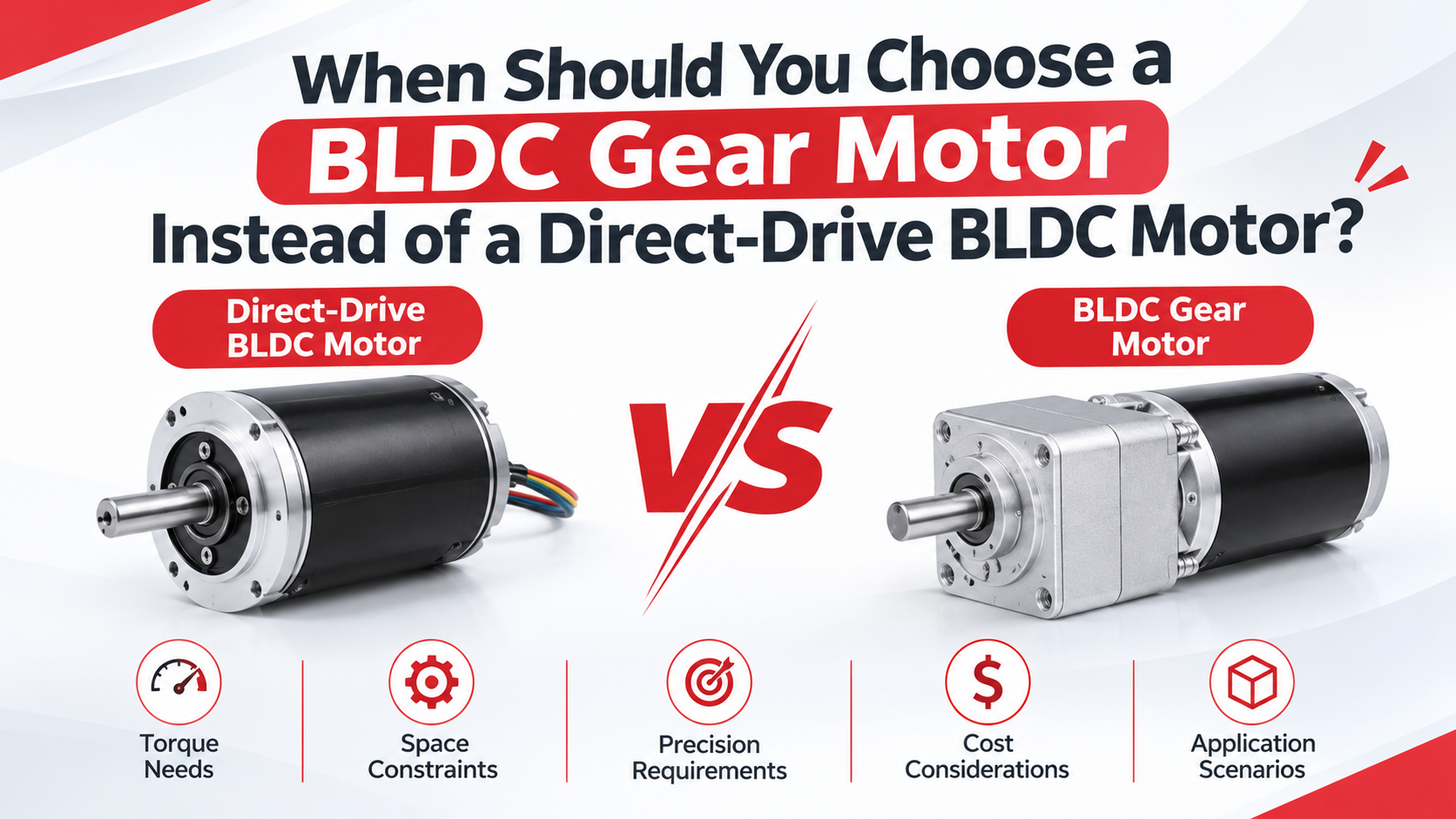
The main difference is that a direct-drive BLDC motor transfers rotational power directly to the driven equipment, while a BLDC gear motor uses a reduction gearbox to decrease output speed and increase available torque.
For OEM engineers, selecting between these two configurations requires more than comparing motor power ratings. Output torque, operating speed, load inertia, duty cycle, gearbox efficiency, installation dimensions, and control requirements must all be considered to ensure reliable operation.
Key engineering principle: If your application requires low speed and high torque, a BLDC gear motor is generally the more practical choice. If it requires high speed and a simpler transmission structure, a direct-drive BLDC motor may be more suitable.
What Is the Difference Between a BLDC Gear Motor and a Direct-Drive BLDC Motor?
A BLDC motor (Brushless DC Motor) uses electronic commutation instead of mechanical brushes, providing advantages such as reduced brush maintenance, good power density, and flexible speed control.
However, the mechanical transmission configuration determines how the motor delivers power to the application.
Direct-Drive BLDC Motor
A direct-drive BLDC motor connects directly to the driven mechanism without a reduction gearbox, meaning that the application generally operates at the motor’s rotational speed.
Its main characteristics include:
– Higher rotational speed potential
– Fewer mechanical transmission components
– No gearbox-related transmission losses
– Simpler mechanical structure
– Easier maintenance
– Direct power transmission
Direct-drive configurations are commonly considered for fans, pumps, ventilation equipment, and other rotating machinery that can operate within the motor’s available speed and torque range.
BLDC Gear Motor
A BLDC gear motor combines a brushless motor with a reduction gearbox, allowing the motor to operate at a relatively high speed while delivering lower output speed and higher torque to the application.
Common gearbox configurations include:
– Planetary gearbox
– Spur gearbox
– Helical gearbox
– Worm gearbox
Each gearbox type has different characteristics in terms of torque capacity, efficiency, noise, backlash, size, and mechanical construction.
For OEM applications, the gearbox should be selected according to the required output torque, reduction ratio, installation dimensions, and operating environment.
When Should You Choose a BLDC Gear Motor?
A BLDC gear motor is generally the better choice when the application requires substantial output torque at relatively low speeds, particularly when the equipment must start under load, overcome mechanical resistance, or maintain stable movement under changing operating conditions.
When High Torque Is Required at Low Speed
Many industrial applications require high torque but do not need the high rotational speed of a conventional BLDC motor.
A reduction gearbox allows the motor to operate within a suitable speed range while increasing the available output torque.
Typical applications include:
– AGV and AMR wheel drive systems
– Electric lawn mower drive systems
– Conveyor equipment
– Stairlift mechanisms
– Rehabilitation beds
– Electric actuators
– Automated doors
– Industrial material handling equipment
For example, consider a BLDC motor with a rated speed of 3,000 RPM connected to a 30:1 reduction gearbox. Its theoretical output speed is approximately 100 RPM, making it more suitable for applications requiring controlled, low-speed movement.
The actual output torque depends on gearbox efficiency, motor loading, and the mechanical rating of the transmission.
When the Application Has a Heavy or Variable Load
Applications involving heavy loads often require substantial starting torque and acceleration torque, particularly when the motor must repeatedly start, stop, reverse direction, or operate under changing mechanical resistance.
A properly selected gearbox provides mechanical advantage, allowing a relatively compact motor to drive a heavier load without requiring an unnecessarily large direct-drive motor.
However, engineers should evaluate both continuous output torque and peak output torque because gearbox thermal and mechanical limitations can differ significantly under continuous and intermittent operating conditions.
When Installation Space Is Limited
A BLDC gear motor can also be useful when an application requires high output torque but has limited installation space.
Instead of increasing motor dimensions to obtain the required torque directly, engineers can combine a compact, higher-speed BLDC motor with an appropriately selected reduction gearbox.
This configuration is particularly useful for compact automation equipment, robotic platforms, electric actuators, and medical equipment.
When Should You Choose a Direct-Drive BLDC Motor?
A direct-drive BLDC motor is generally preferable when the application can operate within the motor’s available speed and torque range without requiring additional mechanical reduction.
Because it eliminates the gearbox, the system has fewer mechanical components, fewer potential transmission-related failure points, and no gearbox-related friction losses.
Typical Applications
– Cooling fans
– Ventilation systems
– High-speed pumps
– Centrifugal equipment
– Spindles
– High-speed industrial machinery
– Lightweight rotating equipment
Direct-drive designs are particularly attractive when the driven load requires relatively high rotational speed and does not need substantial torque multiplication.
However, engineers should not assume that a direct-drive motor is always smaller or more efficient. If the application requires substantial torque at low speed, the motor may need a larger electromagnetic structure to achieve the required output directly.
BLDC Gear Motor vs. Direct-Drive BLDC Motor
The following table summarizes the main differences engineers should consider when selecting a motor configuration.
| Performance Factor | BLDC Gear Motor | Direct-Drive BLDC Motor |
|---|---|---|
| Output speed | Lower | Generally higher |
| Output torque | Increased through reduction | Determined by motor design |
| Gearbox | Required | Not required |
| Transmission efficiency | Includes gearbox losses | No gearbox transmission losses |
| Mechanical structure | More complex | Simpler |
| Maintenance | Gearbox requires attention | Generally lower |
| Noise | Gear engagement may generate noise | No gearbox gear noise |
| Heavy-load capability | Suitable for high-torque loads | Depends on motor torque |
| Installation | Requires gearbox space | Simpler transmission integration |
| Typical applications | AGVs, conveyors, actuators | Fans, pumps, spindles |
Important engineering consideration: A direct-drive BLDC motor is not automatically more efficient in every application. A properly sized motor combined with an efficient gearbox may consume less energy than an oversized direct-drive motor operating away from its optimal efficiency region.
The complete motor and transmission system should therefore be evaluated at the actual operating point.
How to Select the Right BLDC Gear Motor?
Choosing the correct BLDC motor configuration requires starting with the driven load rather than selecting a motor based only on rated power.
Step 1: Determine Required Output Speed
Identify the actual rotational speed required by the application.
For example:
– AGV wheel drive: Low-speed movement with controlled acceleration.
– Conveyor system: Stable output speed under changing loads.
– Cooling fan: Higher rotational speed with relatively low torque.
– Electric actuator: Controlled movement with sufficient output torque.
If the application requires substantially lower speed than a standard BLDC motor provides, a reduction gearbox should be considered.
Step 2: Determine Required Output Torque
Evaluate the following parameters:
– Continuous operating torque
– Starting torque
– Peak acceleration torque
– Maximum load torque
– Friction and mechanical resistance
– External shock loads
Do not select a gearbox using only its maximum advertised torque. Its continuous rated torque and intermittent overload capability must also match the application.
Step 3: Select the Appropriate Gear Ratio
The gear ratio should match the motor’s operating speed with the required output speed.
Consider a BLDC motor operating at 3,000 RPM:
| Gear Ratio | Approximate Output Speed |
|---|---|
| 5:1 | 600 RPM |
| 10:1 | 300 RPM |
| 20:1 | 150 RPM |
| 30:1 | 100 RPM |
| 50:1 | 60 RPM |
These values are illustrative and assume a motor operating at a constant 3,000 RPM. Actual output speed depends on motor loading and controller operation.
A higher reduction ratio generally increases torque multiplication but may also introduce greater transmission losses, backlash, and mechanical complexity.
Step 4: Choose the Correct Gearbox Type
Planetary gearbox
Suitable for compact applications requiring relatively high torque density and good load distribution.
Spur gearbox
Suitable for applications where straightforward construction, cost, and mechanical simplicity are important.
Helical gearbox
Useful when smooth gear engagement and reduced operating noise are priorities.
Worm gearbox
Suitable for applications requiring substantial speed reduction, although friction-related losses need careful consideration.
Engineers should also evaluate gearbox temperature, lubrication, bearing capacity, backlash, radial load, and axial load.
Step 5: Match the Motor with the Controller
The BLDC motor and driver must be compatible in terms of:
– Rated voltage
– Continuous current
– Peak current
– Speed range
– Hall sensor signals
– Encoder feedback
– Control mode
– Thermal protection
For applications requiring accurate speed regulation, an encoder-equipped BLDC motor with closed-loop control can provide better speed feedback under changing loads.
Common BLDC Gear Motor Selection Problems
| Problem | Possible Cause | Recommended Solution |
|---|---|---|
| Insufficient output torque | Gear ratio too low | Re-evaluate reduction ratio |
| Motor overheats | Excessive continuous load | Check motor current and thermal rating |
| Gearbox overheats | Excessive transmission load | Check gearbox rating and efficiency |
| Output speed too low | Excessive reduction ratio | Select a more suitable ratio |
| Excessive noise | Gear engagement or misalignment | Check gearbox type and mounting |
| Short service life | Gearbox overload | Verify continuous and peak torque |
| Poor speed stability | Inadequate feedback | Consider encoder-based control |
| Excessive vibration | Mechanical imbalance | Inspect shaft alignment and mounting |
Common Engineering Mistake
Mistake 1: Selecting a Motor Based Only on Rated Power
Two BLDC motors with identical power ratings can have very different speed and torque characteristics.
Always evaluate the complete torque-speed performance rather than comparing wattage alone.
Mistake 2: Choosing the Highest Available Gear Ratio
A higher reduction ratio is not necessarily better because it can reduce output speed excessively, increase transmission losses, and introduce additional mechanical complexity.
Mistake 3: Ignoring Duty Cycle
A motor that can deliver sufficient peak torque for several seconds may not be capable of sustaining that torque continuously without overheating.
Mistake 4: Ignoring Gearbox Limitations
The motor may be capable of producing more torque than the gearbox can safely transmit. The gearbox’s mechanical and thermal ratings must therefore be treated as important system constraints.
Mistake 5: Ignoring Feedback Requirements
For AGVs, robotics, and precision automation, Hall sensors or encoders may be necessary to achieve the required speed and position control.
How UNITED MOTION INC. Supports Custom BLDC Motor Applications?
For OEM manufacturers, choosing between a direct-drive BLDC motor and a BLDC gear motor is only the first step. The motor must also fit the equipment’s mechanical structure, electrical system, control requirements, and operating environment.
UNITED MOTION INC. provides BLDC motor solutions covering approximately Φ28–Φ110 mm frame sizes, with customization options including gearboxes, encoders, and integrated drivers.
Depending on the application, engineers can evaluate:
– Different motor diameters and lengths
– Customized operating voltage and speed
– Required continuous and peak torque
– Planetary and spur gearbox configurations
– Hall sensor and encoder feedback
– Integrated motor driver solutions
– Application-specific mounting and shaft designs
For example, an AGV manufacturer may require a compact BLDC gear motor with a planetary gearbox and encoder feedback, while a ventilation equipment manufacturer may prefer a direct-drive BLDC motor to reduce mechanical complexity and avoid gearbox transmission losses.
The correct solution depends on the actual load characteristics rather than simply choosing the motor with the highest power rating.
Explore our BLDC Motor Solutions or contact our engineering team to discuss your OEM requirements.
Frequently Asked Questions
1. What is the main difference between a BLDC gear motor and a direct-drive BLDC motor?
A BLDC gear motor uses a reduction gearbox to decrease output speed and increase available torque, while a direct-drive BLDC motor transfers rotational power directly to the driven equipment without an additional reduction gearbox.
2. Is a BLDC gear motor better for high-torque applications?
Generally, yes. A gearbox provides mechanical torque multiplication, making a BLDC gear motor suitable for applications requiring high output torque at relatively low speeds, provided the gearbox is correctly rated.
3. Is a direct-drive BLDC motor more efficient?
A direct-drive BLDC motor avoids gearbox transmission losses, but overall system efficiency also depends on motor sizing, operating speed, load torque, and controller performance.
4. Which gearbox is best for a BLDC motor?
Planetary gearboxes are suitable for compact applications requiring relatively high torque density, while spur, helical, and worm gearboxes may be more appropriate depending on cost, noise, reduction ratio, and operating requirements
5. Can a BLDC gear motor use an encoder?
Yes. An encoder can be integrated into a BLDC gear motor to provide position and speed feedback, supporting closed-loop control in robotics, AGVs, and industrial automation.
6. How do I choose the correct BLDC motor gear ratio?
Start with the required output speed, then evaluate the motor’s operating speed, gearbox efficiency, continuous output torque, peak torque, and mechanical limitations before selecting the final ratio.