
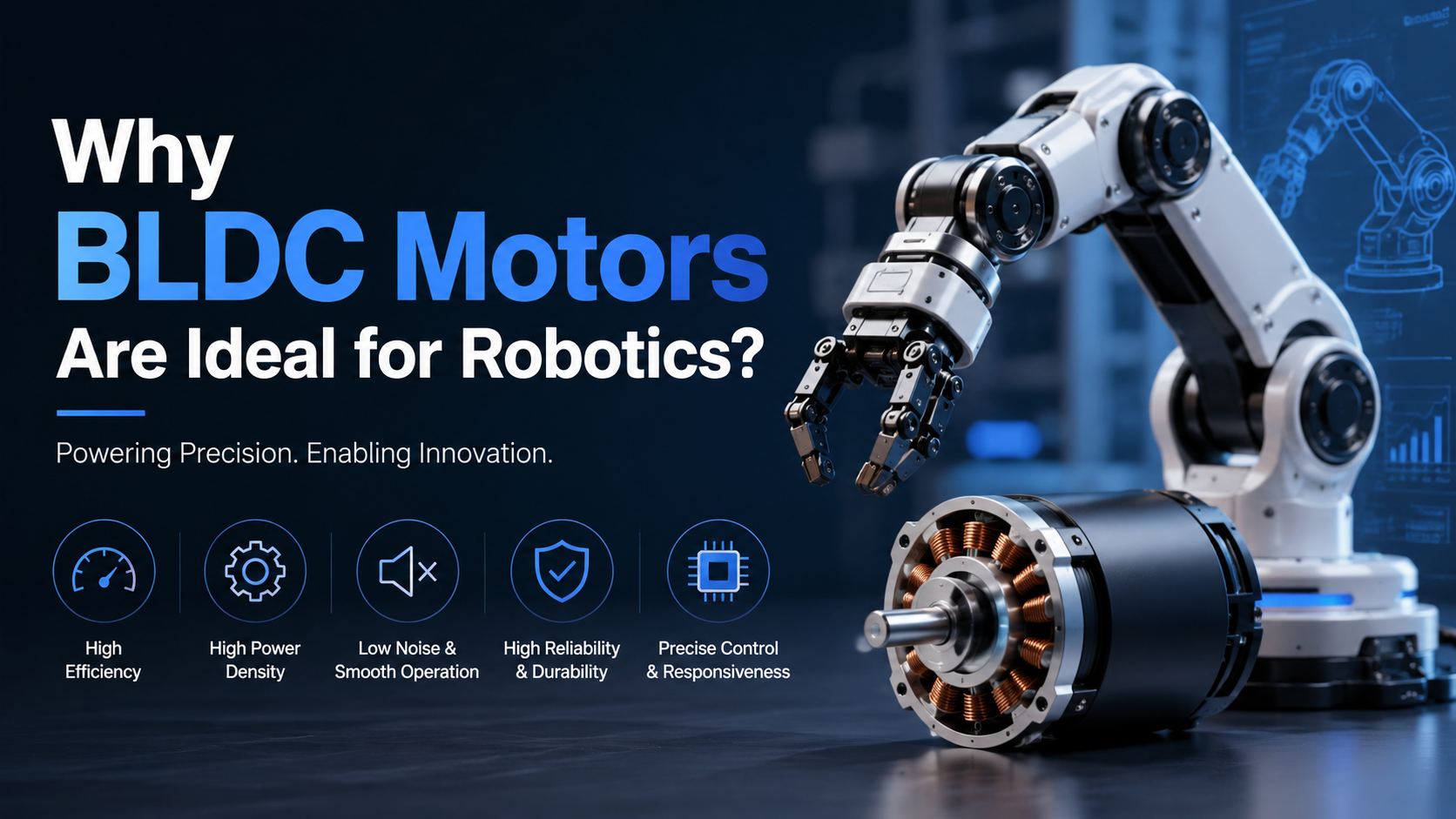
Robotics systems demand precise motion control, high efficiency, compact size, and long-term reliability. Whether in industrial robots, collaborative robots (cobots), autonomous mobile robots (AMRs), medical devices, or service robots, motor selection directly impacts performance.
Among all motor technologies, the BLDC motor (Brushless DC Motor) has become the industry standard for modern robotic systems because it delivers high torque density, accurate speed control, low maintenance, and superior energy efficiency.
This article explains why BLDC motors are ideal for robotics, how they compare with other motor technologies, and what engineers should consider when selecting a robotic motor.
Quick Answer
BLDC motors are ideal for robotics because they offer:
- High torque-to-weight ratio
- Excellent speed and position control
- Fast dynamic response
- High efficiency (typically 85–95%)
- Long service life
- Low maintenance requirements
- Compact size
- Reduced heat generation
- Compatibility with advanced servo control systems
These characteristics make BLDC motors suitable for robotic joints, wheels, grippers, actuators, conveyors, drones, and automated manufacturing equipment.
Why Motor Selection Matters in Robotics?
A robot’s performance is largely determined by its motion system.
The motor affects:
- Positioning accuracy
- Repeatability
- Cycle time
- Energy consumption
- Payload capacity
- Thermal stability
- System reliability
In advanced robotic applications, even small improvements in motor efficiency or response time can significantly improve productivity and reduce operating costs.
According to the U.S. Department of Energy (DOE), electric motor systems consume approximately 70% of industrial electricity usage, making motor efficiency a critical design consideration.
Source: U.S. Department of Energy (DOE), Motor Systems Market Assessment, 2014.
What Is a BLDC Motor?
A BLDC motor is a permanent magnet synchronous motor that uses electronic commutation instead of mechanical brushes.
The main components include:
- Permanent magnet rotor
- Stator windings
- Electronic controller (driver)
- Position feedback sensors or sensorless algorithms
Unlike brushed DC motors, BLDC motors eliminate physical brush contact, reducing wear and increasing reliability.
How BLDC Motors Work in Robotic Systems?
The motor controller energizes stator windings in a controlled sequence.
This creates a rotating magnetic field that drives the permanent magnet rotor.
The controller continuously adjusts:
- Current
- Voltage
- Commutation timing
- Speed
- Torque
This allows robots to achieve precise motion control and smooth operation.
Typical feedback devices include:
- Hall sensors
- Optical encoders
- Magnetic encoders
- Resolvers
These sensors enable closed-loop control for high-precision robotic movements.
Key Advantages of BLDC Motors for Robotics
1. High Torque Density
Torque density refers to the amount of torque produced relative to motor size and weight.
BLDC motors generate significantly higher torque density than traditional brushed motors.
Typical values:
| Motor Type | Torque Density |
| Brushed DC Motor | Low to Medium |
| Stepper Motor | Medium |
| BLDC Motor | High |
| Servo BLDC Motor | Very High |
Benefits for robotics:
• Smaller actuators
• Reduced robot weight
• Higher payload capacity
• Compact joint design
This is particularly important for collaborative robots and robotic arms where space is limited.
Source: Massachusetts Institute of Technology (MIT), Electric Machines and Drives Research Publications, updated continuously.
2. Exceptional Energy Efficiency
Most robotic systems operate continuously.
Energy losses directly affect:
• Battery life
• Operating costs
• Thermal performance
Typical motor efficiencies:
| Motor Type | Efficiency Range |
| Brushed DC Motor | 65–80% |
| Stepper Motor | 50–75% |
| AC Induction Motor | 75–90% |
| BLDC Motor | 85–95% |
Higher efficiency means:
• Longer battery runtime
• Reduced power consumption
• Lower operating temperature
• Smaller cooling requirements
According to the DOE, premium-efficiency motor technologies can reduce energy consumption by 2–8% compared with standard motor systems.
Source: U.S. Department of Energy (DOE), Energy Efficient Motor Systems Program, updated 2023.
3. Precise Position and Speed Control
Robots often require positioning accuracy measured in fractions of a millimeter.
BLDC motors paired with high-resolution encoders provide:
• Accurate positioning
• Smooth trajectory control
• High repeatability
• Stable low-speed operation
Typical positioning accuracy:
• ±0.01° to ±0.1°
• Repeatability better than ±0.02 mm in many robotic joints
Applications include:
• Pick-and-place robots
• Surgical robots
• Semiconductor automation
• CNC robotic systems
4. Fast Dynamic Response
Robotic motion frequently involves:
• Rapid acceleration
• Quick deceleration
• Frequent direction changes
BLDC motors have:
• Low rotor inertia
• High torque response
• Rapid current regulation
This allows faster cycle times and improved productivity.
Benefits include:
• Shorter robotic task completion times
• Improved path tracking
• Better collision avoidance performance
5. Longer Service Life
Traditional brushed motors suffer from brush wear.
Brushes require:
• Replacement
• Inspection
• Maintenance downtime
BLDC motors eliminate this issue.
Typical lifespan:
| Motor Type | Expected Service Life |
| Brushed DC Motor | 2,000–10,000 hours |
| BLDC Motor | 20,000–50,000+ hours |
Depending on bearing quality and operating conditions, industrial BLDC motors may exceed 50,000 operating hours.
Source: IEEE Transactions on Industrial Electronics, Permanent Magnet Motor Reliability Studies, various publications 2018–2024.
6. Reduced Maintenance Requirements
Because there are no brushes:
• No brush replacement
• No commutator cleaning
• Less downtime
• Lower maintenance costs
This is especially valuable in:
• Automated factories
• Warehouses
• Medical robotics
• Remote robotic systems
7. Better Thermal Performance
Heat is one of the primary causes of motor failure.
BLDC motors generate less heat due to:
• Lower electrical losses
• Reduced friction losses
• Efficient magnetic design
Benefits include:
• Improved reliability
• Stable performance
• Higher continuous torque capability
Research from the National Renewable Energy Laboratory (NREL) demonstrates that improved motor efficiency directly reduces thermal loading and increases system longevity.
Source: National Renewable Energy Laboratory (NREL), Electric Motor Efficiency Research, 2023.
Why BLDC Motors Outperform Stepper Motors in Robotics?
Many engineers compare BLDC motors with stepper motors.
Comparison Table
| Feature | Stepper Motor | BLDC Motor |
| Efficiency | Moderate | High |
| Speed Range | Limited | Wide |
| Noise Level | Higher | Lower |
| Torque Density | Moderate | High |
| Heat Generation | High | Low |
| Closed-Loop Control | Optional | Common |
| Battery Applications | Less Suitable | Excellent |
| Dynamic Response | Moderate | Excellent |
For advanced robotic systems, BLDC motors generally provide superior performance.
Common Robotic Applications of BLDC Motors
Industrial Robotic Arms
BLDC motors power:
• Shoulder joints
• Elbow joints
• Wrist joints
Requirements:
• High torque
• Precision control
• Smooth motion
Autonomous Mobile Robots (AMRs)
BLDC motors drive:
• Wheel systems
• Steering systems
• Lift mechanisms
Benefits:
• Extended battery life
• Compact design
• Reliable operation
Collaborative Robots (Cobots)
Cobots require:
• Accurate torque control
• Safe interaction
• Smooth movement
BLDC servo systems provide the necessary control precision.
Medical Robotics
Applications include:
• Surgical robots
• Rehabilitation equipment
• Laboratory automation
Critical requirements:
• Quiet operation
• Precision positioning
• Reliability
Drone and UAV Systems
BLDC motors dominate UAV propulsion because of:
• High power density
• Lightweight construction
• High efficiency
How to Select the Right BLDC Motor for Robotics?
Step 1: Determine Required Torque
Calculate:
Required Torque = Load × Radius × Safety Factor
Consider:
• Payload
• Gear ratio
• Acceleration
Step 2: Define Speed Requirements
Typical robotic motor speeds:
• Joint actuators: 50–500 RPM
• Mobile robots: 500–3,000 RPM
• UAV systems: 3,000–15,000 RPM
Step 3: Evaluate Voltage Requirements
Common voltage options:
• 12V
• 24V
• 48V
• 72V
Higher voltage generally reduces current demand.
Step 4: Consider Feedback Devices
Options include:
• Hall sensors
• Incremental encoders
• Absolute encoders
• Resolvers
High-precision robots usually require encoder feedback.
Step 5: Analyze Thermal Conditions
Consider:
• Ambient temperature
• Duty cycle
• Cooling method
• Enclosure requirements
Common BLDC Motor Selection Mistakes
| Mistake | Consequence |
| Undersized motor | Overheating |
| Ignoring peak torque | Stalling |
| Incorrect voltage selection | Reduced efficiency |
| Poor thermal analysis | Short lifespan |
| Low-resolution feedback | Position errors |
| Ignoring duty cycle | Reliability issues |
Troubleshooting BLDC Motors in Robotics
| Problem | Possible Cause | Solution |
| Motor overheating | Overload | Increase motor size |
| Vibration | Encoder alignment issue | Recalibrate feedback system |
| Position error | Poor tuning | Adjust servo parameters |
| Noise | Bearing wear | Replace bearings |
| Low torque | Current limitation | Verify driver settings |
| Motor stalling | Insufficient peak torque | Increase torque margin |
Why Robotics Manufacturers Choose UNITED MOTION INC.?
At UNITED MOTION INC., we specialize in advanced motion control solutions designed for demanding robotic applications.
Our capabilities include:
• Custom BLDC motor development
• Servo motor systems
• Planetary gear motors
• Integrated motor and driver solutions
• Encoder-equipped motors
• OEM and ODM manufacturing
As the U.S. subsidiary of Greensky Power, UNITED MOTION INC. leverages more than 15 years of motor engineering experience to deliver reliable and cost-effective solutions for industrial automation and robotics.
Whether you are developing a robotic arm, AGV, AMR, medical device, or intelligent automation system, our engineering team can help optimize motor performance and system efficiency.
Frequently Asked Questions
Why are BLDC motors preferred in robotics?
BLDC motors offer high efficiency, precise control, long service life, and excellent torque density, making them ideal for robotic applications.
Are BLDC motors better than stepper motors?
For most advanced robotic applications, yes. BLDC motors provide higher efficiency, smoother operation, and better dynamic performance.
What efficiency can a robotic BLDC motor achieve?
Most industrial BLDC motors operate between 85% and 95% efficiency depending on design and operating conditions.
Do BLDC motors require maintenance?
Very little. Since there are no brushes, maintenance is usually limited to bearing inspection and replacement.
Can BLDC motors be customized for robotics?
Yes. Parameters such as voltage, winding configuration, shaft design, encoder type, gearbox integration, and torque output can be customized.
What is the lifespan of a BLDC motor?
Industrial-grade BLDC motors commonly achieve 20,000 to 50,000 operating hours or more with proper application design.
Related blog: BLDC Motor Applications in Robotics and AGV Systems