
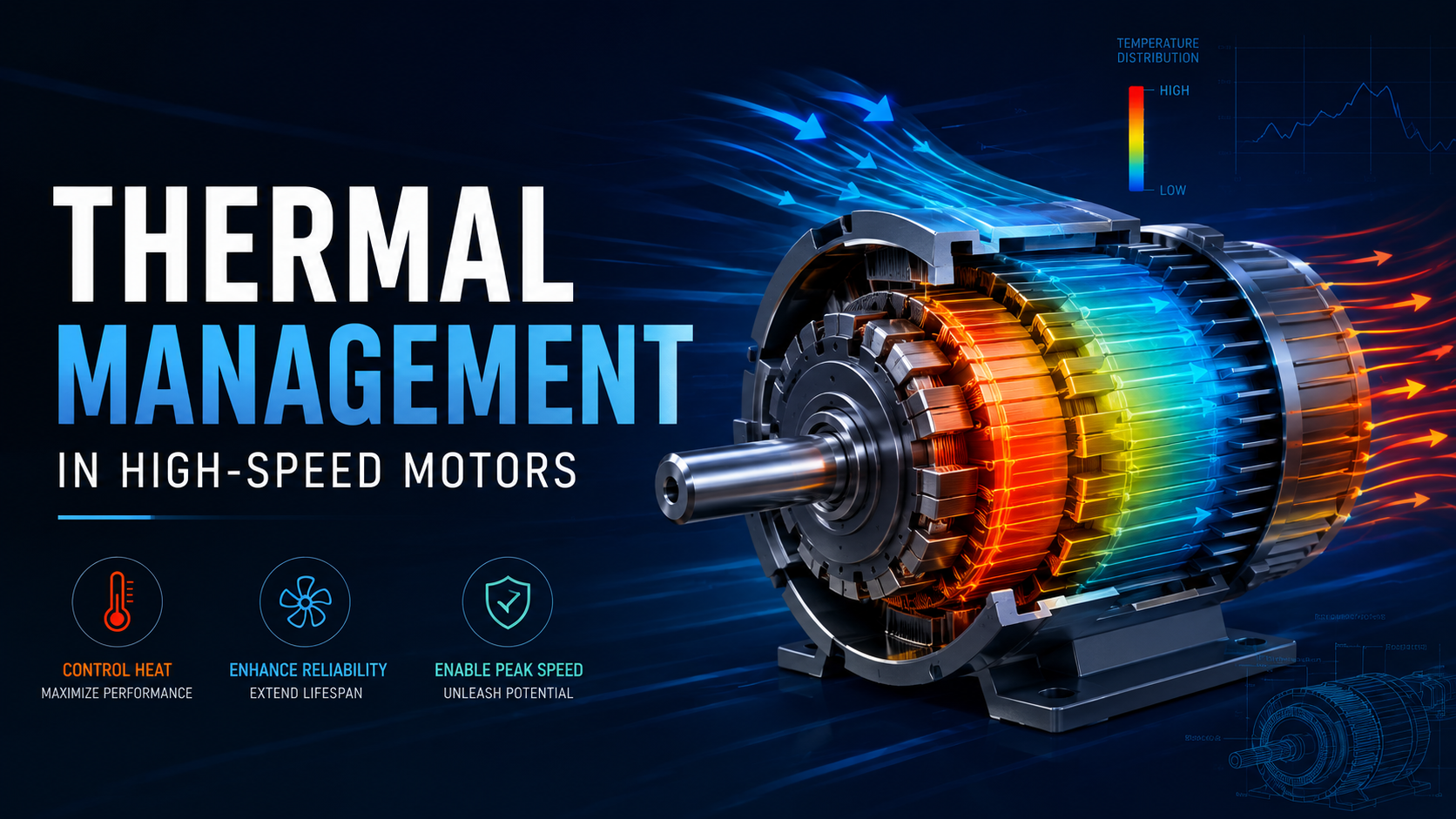
Thermal management is one of the most critical design challenges in high-speed motors because heat generation increases dramatically as motor speed rises. Excessive temperature can degrade winding insulation, demagnetize permanent magnets, shorten bearing life, reduce efficiency, and cause unexpected motor failures.
For most industrial high-speed motors operating above 10,000 RPM, maintaining winding temperatures below 155°C (Class F insulation) or 180°C (Class H insulation) is essential for reliability. Engineers typically use optimized electromagnetic design, advanced cooling systems, high-efficiency materials, and thermal simulation to control motor temperatures.
Key Takeaway: In many high-speed motor applications, thermal limitations—not torque or power density—become the primary constraint on motor performance.
Why Thermal Management Matters More in High-Speed Motors?
As rotational speed increases, motor designers face a hidden engineering challenge: heat.
Many engineers focus on torque density, efficiency, or speed capability. However, thermal performance often determines whether a high-speed motor succeeds or fails in real-world applications.
High-speed motors are widely used in:
- Electric turbochargers
- Medical centrifuges
- CNC machine spindles
- Compressors
- Aerospace actuators
- Robotics
- Industrial automation
- EV auxiliary systems
Operating speeds can range from:
| Motor Type | Typical Speed |
| Standard Industrial Motor | 1,500–3,600 RPM |
| Servo Motor | 3,000–8,000 RPM |
| High-Speed BLDC Motor | 10,000–50,000 RPM |
| Ultra High-Speed Motor | 50,000–200,000+ RPM |
As speed increases, heat generation rises faster than many engineers expect.
Source: National Renewable Energy Laboratory (NREL), U.S. Department of Energy, “Advanced Electric Drive Technologies,” 2023.
Where Does the Heat Come From?
Understanding thermal management begins with identifying heat sources.
1. Copper Losses (I²R Losses)
Copper losses occur when current flows through motor windings.
Formula:
Loss = Current² × Resistance
As winding temperature rises:
- Resistance increases
- More heat is generated
- Efficiency drops further
This creates a self-reinforcing thermal cycle.
Source: Massachusetts Institute of Technology (MIT), Electric Machines Course Materials, 2022.
2. Iron Losses
At high rotational speeds, magnetic field frequencies increase.
This causes:
- Hysteresis losses
- Eddy current losses
Iron losses can become a dominant heat source above 20,000 RPM.
Modern high-speed motors often use:
- Thin silicon steel laminations
- Soft magnetic composites
- High-frequency electrical steels to minimize these losses.
Source: IEEE Transactions on Industry Applications, “Core Loss Analysis in High-Speed Permanent Magnet Machines,” 2021.
3. Windage Losses
Windage refers to aerodynamic drag created by rotor rotation.
As speed doubles, windage losses increase dramatically.
High-speed rotors spinning at 30,000–100,000 RPM can generate significant heat simply by moving air.
Engineering solutions include:
- Rotor surface optimization
- Vacuum environments
- Low-drag housing designs
Source: NASA Glenn Research Center, High-Speed Rotor Dynamics Research, 2020.
4. Bearing Friction
Bearings are often overlooked thermal contributors.
Heat originates from:
- Rolling friction
- Lubrication shear
- Misalignment
- Preload settings
Bearing temperatures frequently become the first thermal bottleneck in motors above 20,000 RPM.
Source: SKF Engineering Handbook, Bearing Performance and Thermal Behavior, 2023.
5. Power Electronics Heat
In BLDC and PMSM systems, heat is generated not only inside the motor but also inside:
- Servo drives
- Inverters
- Controllers
Switching losses increase with:
- PWM frequency
- Current levels
- Semiconductor junction temperature
Source: U.S. Department of Energy, Wide Bandgap Power Electronics Report, 2023.
What Happens When a High-Speed Motor Overheats?
Thermal failure is often progressive rather than immediate.
Winding Insulation Breakdown
Insulation life drops rapidly as temperature increases.
A commonly accepted engineering rule states:
Every 10°C increase above rated insulation temperature approximately halves insulation life.
| Temperature Increase | Approximate Life Reduction |
| +10°C | 50% |
| +20°C | 75% |
| +30°C | 87.50% |
Source: IEEE Standard 117, Insulation Aging Principles, updated 2022.
Permanent Magnet Demagnetization
High-speed BLDC motors typically use:
- NdFeB magnets
- SmCo magnets
NdFeB magnets may begin losing magnetic strength at elevated temperatures depending on grade.
Consequences include:
- Torque loss
- Reduced efficiency
- Permanent performance degradation
Source: Arnold Magnetic Technologies Technical Guide, 2023.
Bearing Failure
Excessive temperatures cause:
- Lubricant degradation
- Increased wear
- Reduced fatigue life
Bearing failures account for a large percentage of electric motor downtime.
Source: Electric Power Research Institute (EPRI), Motor Reliability Study, 2022.
Thermal Limits in High-Speed Motor Design
Motor designers work with several critical temperature limits.
| Component | Typical Maximum Temperature |
| Class B Insulation | 130°C |
| Class F Insulation | 155°C |
| Class H Insulation | 180°C |
| NdFeB Magnets | 80–180°C (grade dependent) |
| Bearings | 80–120°C |
| Electronics | 125–175°C Junction Temperature |
The lowest thermal limit often determines overall system performance.
Cooling Methods Used in High-Speed Motors
Air Cooling
Air cooling remains the simplest solution.
Advantages:
- Low cost
- Easy maintenance
- No coolant leakage
Disadvantages:
- Limited heat transfer capability
- Less effective at very high power densities
Best suited for:
- Small industrial motors
- Light-duty applications
- Forced-Air Cooling
Fans or blowers increase airflow.
Benefits include:
- Improved heat dissipation
- Better temperature uniformity
Common in:
- CNC spindle motors
- Industrial servo systems
- Liquid Cooling
Liquid cooling is becoming standard for high-performance motors.
Typical coolants include:
- Water-glycol mixtures
- Dielectric fluids
Benefits:
- 5–20× higher heat transfer than air
- Compact motor designs
- Higher continuous power density
Applications:
- EV traction motors
- Aerospace systems
- High-speed compressors
Source: Oak Ridge National Laboratory (ORNL), Electric Drive Thermal Management Research, 2024.
Oil Cooling
Oil cooling directly removes heat from:
- Windings
- Bearings
- Rotor assemblies
Advantages:
- Excellent heat transfer
- Reduced thermal gradients
Common in:
- Aviation motors
- Ultra-high-speed applications
- Thermal Design Strategies Used by Leading Motor Manufacturers
- Optimize Copper Fill Factor
Increasing slot fill factor reduces resistance.
Benefits:
- Lower copper loss
- Improved efficiency
- Reduced heat generation
Typical fill factor:
- 40–65%
- depending on manufacturing method.
- Reduce Iron Losses
Designers select:
- Thin laminations (0.2–0.35 mm)
- High-grade silicon steel
- Optimized stator geometries to reduce core heating.
Improve Rotor Design
Advanced rotor designs focus on:
- Reduced windage
- Better airflow
- Lower magnetic losses
CFD analysis is commonly used during development.
Use Thermal Simulation
Modern motor development relies heavily on:
- Finite Element Analysis (FEA)
- Computational Fluid Dynamics (CFD)
- Digital twin modeling
Simulation allows engineers to predict hot spots before prototypes are built.
Source: ANSYS Motor-CAD Engineering White Paper, 2024.
Common Thermal Management Mistakes
Undersized Cooling Systems
Many engineers size motors based solely on torque requirements.
Ignoring thermal limits often leads to overheating during continuous operation.
Ignoring Ambient Temperature
A motor operating safely at 25°C may overheat at 50°C ambient conditions.
Industrial environments often exceed laboratory conditions.
Incorrect Bearing Selection
Standard bearings may fail quickly in high-speed applications.
Specialized options include:
- Ceramic hybrid bearings
- Air bearings
- Magnetic bearings
- Inadequate Temperature Monitoring
Without sensors, thermal issues remain invisible until damage occurs.
Recommended sensors:
- PT100 RTDs
- Thermistors
- Embedded winding temperature sensors
Troubleshooting High-Speed Motor Overheating
| Symptom | Possible Cause | Recommended Action |
| Housing too hot | Insufficient cooling | Improve airflow or liquid cooling |
| Reduced torque | Magnet overheating | Check thermal limits |
| High current draw | Excessive winding temperature | Inspect winding resistance |
| Bearing noise | Bearing overheating | Verify lubrication and preload |
| Drive faults | Inverter thermal overload | Improve controller cooling |
| Hot spots | Uneven heat distribution | Conduct thermal analysis |
How UNITED MOTION INC. Addresses Thermal Challenges?
At UNITED MOTION INC., thermal management is considered from the earliest design stage of high-speed motor development.
Engineering practices include:
- Electromagnetic optimization to reduce losses
- High-efficiency stator winding design
- Advanced thermal simulation
- Customized cooling solutions
- High-temperature insulation systems
- Application-specific motor customization
By integrating thermal performance into the overall design process, high-speed motors can achieve higher efficiency, longer service life, and improved reliability in demanding industrial applications.
Future Trends in High-Speed Motor Thermal Management
Several technologies are reshaping motor cooling strategies.
Direct Winding Cooling
Coolant flows closer to heat-generating copper conductors.
Benefits:
- Faster heat removal
- Higher power density
- Additive Manufacturing
3D-printed cooling channels enable complex internal thermal paths.
This improves cooling efficiency while reducing weight.
Smart Thermal Monitoring
AI-driven predictive maintenance systems can:
- Monitor temperature trends
- Predict failures
- Optimize cooling performance
Source: International Energy Agency (IEA), Digitalization and Industrial Energy Efficiency Report, 2024.
Conclusion
Thermal management is one of the most important—and frequently underestimated—engineering challenges in high-speed motor design.
As motor speed increases, heat generation from copper losses, iron losses, windage, bearings, and power electronics rises significantly. If thermal issues are not addressed, overheating can shorten insulation life, damage magnets, reduce efficiency, and cause costly downtime.
Successful high-speed motor design requires a combination of optimized electromagnetic architecture, advanced cooling methods, thermal simulation, and real-world operating analysis.
For engineers selecting or designing a high-speed motor, the most important question is often not “How fast can it spin?” but rather “How effectively can it remove heat?”
Frequently Asked Questions
What temperature is too hot for a high-speed motor?
Most industrial high-speed motors should maintain winding temperatures below 155°C for Class F insulation systems and below 180°C for Class H insulation systems.
Why do high-speed motors generate more heat?
Higher speeds increase iron losses, windage losses, bearing friction, and switching losses in power electronics, resulting in greater heat generation.
Is liquid cooling necessary for high-speed motors?
Not always. Air cooling is sufficient for many lower-power applications, but liquid cooling becomes increasingly important as power density and rotational speed increase.
Can overheating damage permanent magnets?
Yes. Excessive temperatures can partially or permanently demagnetize NdFeB magnets, reducing motor torque and efficiency.
What is the best way to monitor motor temperature?
Embedded RTD sensors, thermistors, and real-time drive monitoring systems provide the most accurate thermal protection.
Related blog: How well do BLDC motors perform in low-speed, high-torque applications?