
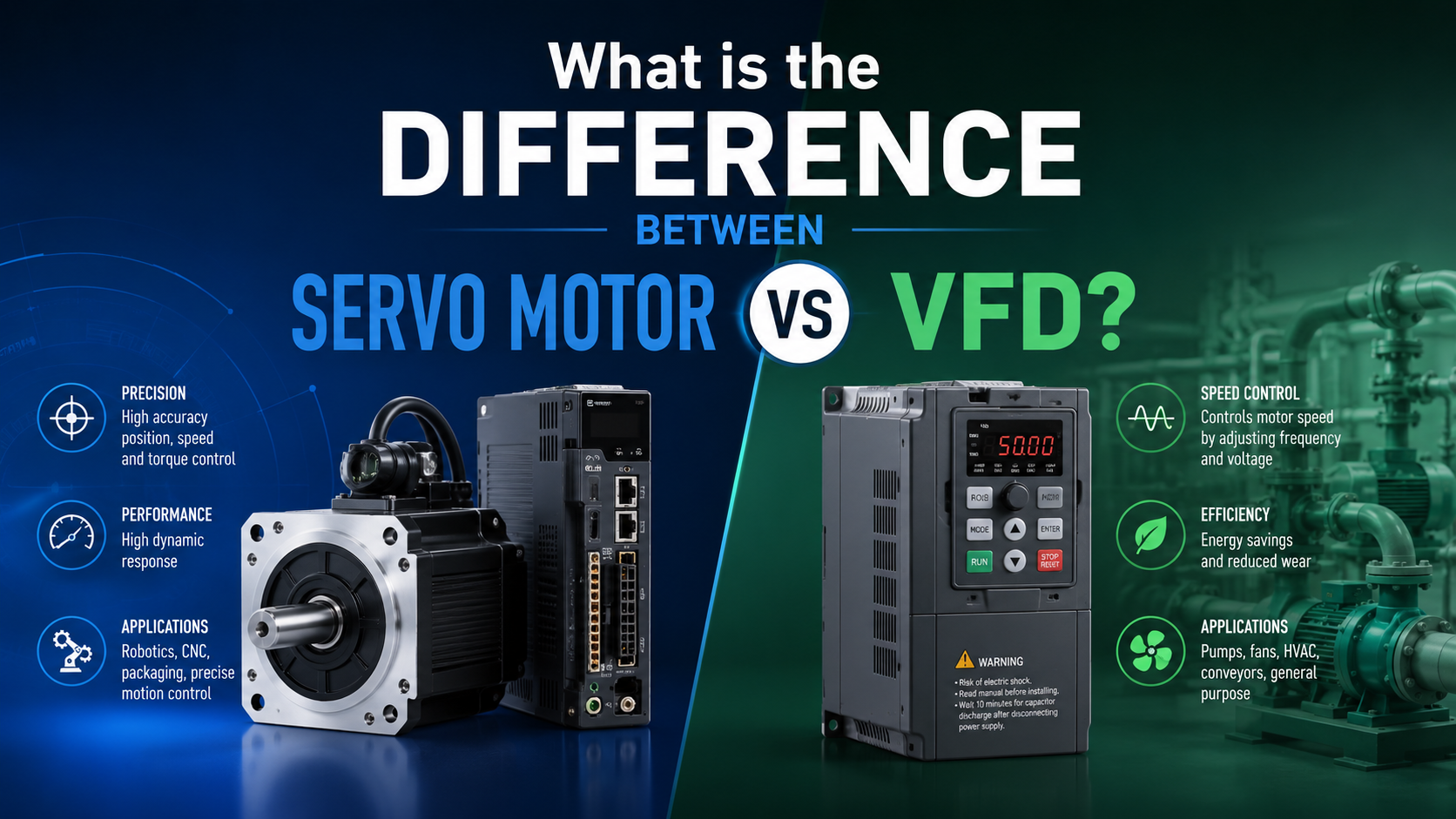
A servo motor is a closed-loop motion control system designed for precise positioning, speed regulation, and torque control. A VFD (Variable Frequency Drive) is an electronic controller that regulates the speed of an AC motor by adjusting frequency and voltage.
The key difference is:
Servo systems provide high-precision positioning with feedback devices such as encoders.
VFD systems primarily control motor speed and are commonly used for pumps, fans, conveyors, and general industrial machinery.
In applications requiring positioning accuracy within fractions of a degree, rapid acceleration, and dynamic torque control, servo motors are preferred. For energy-efficient speed control of standard AC motors, VFDs are often the more economical solution.
Understanding the Basics about Servo Motor and VFD
What Is a Servo Motor?
A servo motor is an electric motor integrated into a closed-loop control system.
The system typically consists of:
- Servo motor
- Servo drive
- Encoder or resolver
- Motion controller
The encoder continuously sends position feedback to the servo drive, allowing real-time corrections.
Key Characteristics
- Closed-loop control
- High positioning accuracy
- Fast acceleration and deceleration
- High torque at low speeds
- Precise speed regulation
According to research published by the Massachusetts Institute of Technology (MIT), feedback control systems significantly improve positioning accuracy and disturbance rejection compared to open-loop systems (MIT OpenCourseWare, Control Systems Engineering).
Source: Massachusetts Institute of Technology (MIT), OpenCourseWare Control Systems, ongoing educational publication.
What Is a VFD?
A Variable Frequency Drive (VFD) is an electronic device used to control the speed of AC motors.
It works by:
- Converting incoming AC power to DC.
- Filtering the DC voltage.
- Converting DC back to AC at a controlled frequency.
Since motor speed is directly related to supply frequency, changing frequency changes motor speed.
Key Characteristics
- Speed control
- Energy savings
- Soft starting
- Reduced mechanical stress
- Lower installation costs
The U.S. Department of Energy reports that VFDs can reduce energy consumption by 20%–50% in variable-torque applications such as pumps and fans.
Source: U.S. Department of Energy (DOE), Improving Motor and Drive System Performance, latest available edition.
Servo Motor vs VFD: Core Difference
Many engineers mistakenly compare a servo motor directly to a VFD.
In reality:
A servo motor is a motor system.
A VFD is a motor controller.
The more accurate comparison is:
Servo System vs VFD-Controlled AC Motor System
How Servo Systems Work?
Step 1: Command Signal
A controller sends a target position, speed, or torque command.
Example:
Move a robotic arm:
- 150 mm
- Within 0.5 seconds
- Accuracy ±0.01 mm
Step 2: Encoder Feedback
The encoder continuously measures:
- Position
- Speed
- Direction
Encoder resolutions commonly range from:
- 17-bit
- 20-bit
- 23-bit
High-end servo systems exceed 8 million counts per revolution.
Step 3: Error Correction
The servo drive compares:
- Target Position
- vs
- Actual Position
Any deviation creates an error signal.
The drive immediately adjusts current and torque output.
Step 4: Continuous Optimization
This process repeats thousands of times per second.
Typical servo control update rates:
- 1 kHz
- 2 kHz
- 4 kHz
- 8 kHz
Advanced motion systems can exceed 16 kHz.
How VFD Systems Work?
Step 1: Frequency Adjustment
The VFD changes output frequency.
For example:
- 60 Hz = 1800 RPM
- 30 Hz = 900 RPM
- 15 Hz = 450 RPM
For a four-pole induction motor.
Step 2: Voltage Regulation
Voltage is adjusted proportionally to frequency.
This maintains motor flux and efficiency.
Step 3: Motor Speed Control
The motor rotates at the desired speed.
Unlike servo systems, standard VFD applications typically do not monitor precise shaft position.
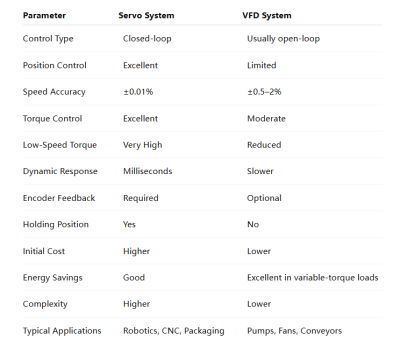
Servo Motor vs VFD Comparison
Positioning Accuracy Comparison
One of the most important differences is positioning capability.
Servo Motor Accuracy
Typical values:
- ±0.001° to ±0.1°
- Repeatability ±0.01 mm
Used in:
- CNC machines
- Semiconductor equipment
- Medical devicesRobotics
VFD Accuracy
Standard VFD systems generally provide:
- Speed control
- Process control
Not precise positioning.
Additional sensors and controllers are required for positioning applications.
Torque Performance Comparison
Servo Motor Torque
Servo motors can generate:
Rated torque continuously
Peak torque 200%–300% of rated value
For short durations.
Example:
A 2 Nm servo motor may deliver:
Continuous torque = 2 Nm
Peak torque = 6 Nm
This makes servo systems ideal for rapid acceleration.
VFD Motor Torque
Induction motors generally provide:
Constant torque over specific speed ranges
Reduced torque at very low speeds
Unless advanced vector control is implemented.
Research published by the Institute of Electrical and Electronics Engineers (IEEE) indicates that servo systems outperform induction motor drives in high-dynamic motion applications requiring rapid torque response.
Source: IEEE Transactions on Industrial Electronics, motor control performance studies.
Energy Efficiency Comparison
Where VFDs Excel
VFDs dramatically improve efficiency in:
- HVAC systems
- Pumps
- Compressors
- Fans
The affinity laws show that reducing fan speed by 20% can reduce power consumption by nearly 50%.
Source: U.S. Department of Energy Motor Systems Guide.
Where Servo Motors Excel
Servo motors are optimized for:
- Precision motion
- Dynamic operation
- Intermittent cycles
Many modern permanent magnet servo motors achieve:
90%–96% efficiency
Depending on operating conditions.
Source: International Energy Agency (IEA), Electric Motor Systems Reports.
Typical Industrial Applications
Applications Best Suited for Servo Motor
CNC Machines
Precise axis movement.
Robotics
Multi-axis synchronized motion.
Packaging Machines
High-speed indexing.
Medical Equipment
Precision dosing and positioning.
Semiconductor Manufacturing
Micron-level accuracy.
Applications Best Suited for VFDs
Water Pumps
Flow control.
HVAC Systems
Energy optimization.
Industrial Fans
Variable airflow control.
Conveyors
Speed adjustment.
Cooling Towers
Demand-based operation.
Common Engineering Selection Criteria
When selecting between a servo system and a VFD system, engineers should evaluate:
Required Position Accuracy
If positioning matters:
Choose Servo.
If only speed matters:
Choose VFD.
Required Response Time
Servo systems:
Milliseconds
VFD systems:
Hundreds of milliseconds
Choose servo for dynamic machinery.
Load Characteristics
Constant load:
Servo often preferred
Variable flow load:
VFD often preferred
Budget Constraints
Typical relative cost:
VFD system:
1×
Servo system:
2×–5×
Depending on power rating and encoder sophistication.
Common Mistakes Engineers Make
Using a VFD for high-precision indexing
Result:
Poor repeatability.
Using a servo system for simple pump applications
Result:
Unnecessary capital expenditure.
Ignoring load inertia ratio
Servo systems perform best when properly matched to load inertia.
Improper sizing can cause:
- Oscillation
- Overheating
- Poor accuracy
Oversizing the motor
Oversized motors:
- Cost more
- Operate inefficiently
- Increase installation expenses
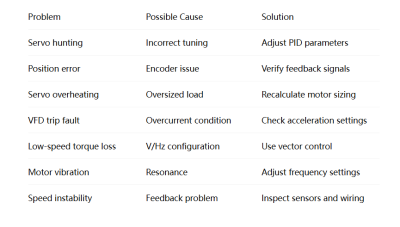
Troubleshooting Guide
Which One Should You Choose?
Choose a Servo Motor System if:
- Position accuracy is critical
- Fast response is required
- Robotics or CNC applications are involved
- Dynamic torque control is needed
Choose a VFD System if:
- Energy savings are the primary goal
- Speed control is sufficient
- Pumps or fans are being controlled
- Budget is limited
For many modern automation systems, both technologies coexist.
A packaging line may use:
Servo motors for indexing and positioning
VFD-controlled motors for conveyors and ventilation
The best solution depends on application requirements rather than motor technology alone.
Why Engineers Choose UNITED MOTION INC.?
UNITED MOTION INC. is the U.S. subsidiary of Greensky Power, a professional motor and drive manufacturer with more than 15 years of industry experience.
Our product portfolio includes:
- Servo motors
- Brushless DC motors
- PMDC motors
- Gear motors
- Integrated motor solutions
- Servo drives
- Motion control systems
We help OEMs and industrial equipment manufacturers optimize:
- Precision
- Reliability
- Efficiency
- Cost performance
Through customized motion-control solutions tailored to real-world operating conditions.
Frequently Asked Questions
Is a servo motor better than a VFD?
Not necessarily. Servo systems are better for positioning and dynamic control, while VFD systems are often better for energy-efficient speed control applications.
Can a VFD control a servo motor?
Generally no. Servo motors require dedicated servo drives that process encoder feedback and execute closed-loop control algorithms.
Are servo motors more energy efficient than induction motors?
Servo motors can achieve very high efficiencies, often above 90%. However, VFD-controlled induction motors may offer greater system-level energy savings in pump and fan applications.
Why are servo motors more expensive?
Servo systems include:
- Encoder feedback devices
- High-performance drives
- Advanced control electronics
These components increase cost but provide significantly higher performance.
Can a VFD provide position control?
Basic VFDs cannot provide precise positioning. Specialized closed-loop vector drives with feedback devices can improve positioning capability but generally do not match servo system performance.
What industries use servo motors most?
Common industries include:
- Robotics
- Semiconductor manufacturing
- Packaging automation
- CNC machining
- Medical equipment
- Automated inspection systems