
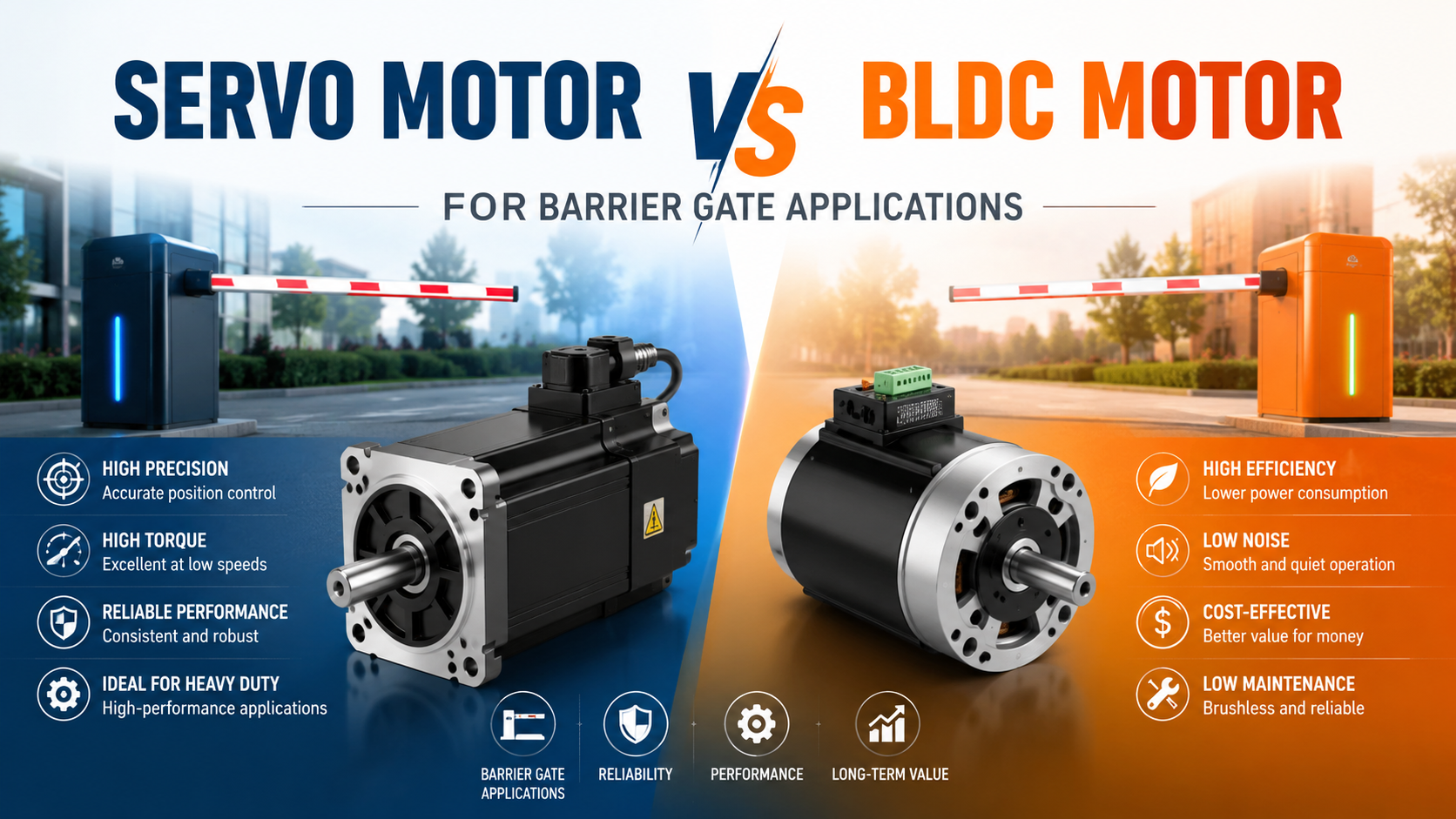
Barrier gate systems are expected to operate reliably thousands of times every day. Whether installed in parking lots, toll stations, logistics centers, or industrial facilities, the motor determines opening speed, positioning accuracy, maintenance frequency, and service life.
The most common choices today are the servo motor and the BLDC motor. While both use permanent magnets and electronic control, they serve different engineering purposes.
This guide compares servo motors and BLDC motors specifically for barrier gate applications, helping engineers, OEM designers, and system integrators choose the most suitable solution.
Quick Answer about Servo Motor vs BLDC Motor for Barrier Gate Applications
For most standard barrier gate applications, a BLDC motor offers the best balance of efficiency, reliability, low maintenance, and cost.
A servo motor becomes the better choice when the system requires:
- Extremely accurate position control
- Dynamic torque adjustment
- High-speed acceleration/deceleration
- Complex motion profiles
- Continuous feedback positioning
In short:
Residential & commercial parking barriers → BLDC motor
High-end intelligent access systems → Servo motor
Source: IEC 60034 Rotating Electrical Machines (International Electrotechnical Commission, latest edition); NEMA Motor Standards (National Electrical Manufacturers Association).
Why Motor Selection Matters for Barrier Gates?
A barrier gate motor directly affects:
- Opening and closing speed
- Vehicle throughput
- Position accuracy
- Safety response
- Energy consumption
- Equipment lifetime
- Maintenance costs
Unlike conveyor systems or pumps, barrier gates repeatedly start, stop, reverse direction, and hold position. These operating characteristics demand motors with excellent transient performance.
Modern automatic barrier gates typically perform:
- 500–5,000 cycles/day
- Opening time: 1–6 seconds
- Torque range: 5–60 Nm (gearbox output)
Operating voltage:
24 VDC
48 VDC
110 VAC
220 VAC
Source: Manufacturer design manuals from leading gate automation suppliers; IEC 60335 safety standards.
What Is a BLDC Motor?
A Brushless DC (BLDC) motor uses permanent magnets on the rotor and electronically commutated windings on the stator.
Instead of brushes, Hall sensors or sensorless control determine rotor position.
For barrier gates, BLDC motors are commonly paired with:
- Planetary gearboxes
- Worm gear reducers
- Electromagnetic brakes
- Dedicated BLDC controllers
Typical characteristics include:
- High efficiency
- Low maintenance
- Long service life
- Quiet operation
- Compact size
BLDC motors are widely used in:
- Parking barriers
- Boom gates
- Sliding gates
- Swing gates
- Industrial doors
Source: IEEE Transactions on Industrial Electronics, Brushless Permanent Magnet Motor Applications; U.S. Department of Energy Motor Systems publications.
What Is a Servo Motor?
A servo motor combines a motor with:
- High-resolution encoder
- Closed-loop controller
- Servo drive
- Feedback algorithms
Unlike standard BLDC systems, servo motors continuously measure actual shaft position and automatically correct motion errors.
Typical encoder resolutions range from:
- 17-bit
- 20-bit
- 23-bit
Equivalent to over 8 million counts per revolution for high-end systems.
Servo motors excel in applications requiring:
- Precise positioning
- Rapid acceleration
- Controlled deceleration
- Stable torque at varying speeds
Source: IEEE Industrial Electronics Society publications; IEC 61800 Adjustable Speed Electrical Power Drive Systems.
Servo Motor vs BLDC Motor: Key Differences
1. Position Control Accuracy
Servo motors are designed for precise motion control.
Using encoder feedback, positioning errors can often be maintained below:
±0.05°
BLDC motors generally rely on:
Hall sensors
Sensorless estimation
These methods provide adequate positioning for gate operation but not precision industrial automation.
For barrier gates:
A stopping accuracy within several millimeters is usually sufficient, making BLDC motors an excellent practical choice.
2. Torque Performance
Barrier gates require high torque during startup because the boom arm has inertia.
Servo motors provide:
- Peak torque up to 300% rated torque
- Fast dynamic response
- Continuous torque regulation
BLDC motors also generate excellent starting torque, especially with gear reduction, although overload capability is typically lower.
Typical continuous torque ranges:
- Small gates: 2–8 Nm
- Commercial gates: 10–30 Nm
- Heavy-duty barriers: 30–60 Nm (gear output)
Source: NEMA MG 1 Motors and Generators; IEEE motor drive research papers.
3. Energy Efficiency
Both technologies are highly efficient because neither uses brushes.
Typical efficiency:
| Motor Type | Typical Efficiency |
| BLDC motor | 85–95% |
| Servo motor | 88–96% |
Servo systems may consume additional energy because of:
- Encoder electronics
- Servo drive
- Continuous feedback processing
For constant repetitive gate movement, the efficiency difference is usually small.
Source: U.S. Department of Energy, Improving Motor and Drive System Performance, DOE Motor Challenge Program.
4. Motion Smoothness
Servo motors deliver:
- Smoother acceleration
- Controlled deceleration
- Minimal overshoot
- Excellent vibration suppression
BLDC motors provide smooth operation for most parking systems but may exhibit slightly less refined motion under aggressive acceleration profiles.
5. Cost
Cost is often the deciding factor.
A servo system includes:
- Motor
- Encoder
- Servo drive
- Feedback cables
- Commissioning software
A BLDC solution typically requires:
- Motor
- BLDC controller
Therefore, servo systems generally cost significantly more than comparable BLDC systems.
For standard parking barriers, the additional precision rarely justifies the higher investment.
6. Maintenance
Both technologies eliminate brush replacement.
Routine maintenance usually involves:
- Bearings
- Gearbox lubrication
- Mechanical inspection
Servo systems introduce additional components such as encoders and feedback cables that require careful installation and protection.
BLDC systems generally have a simpler architecture, reducing maintenance complexity.
Source: IEEE Transactions on Industry Applications; SKF Bearing Life Handbook.
Which Motor Is Better for Different Barrier Gate Applications?
| Application | Recommended Motor | Reason |
| Residential parking | BLDC motor | Cost-effective and reliable |
| Commercial parking | BLDC motor | High efficiency and long life |
| Toll stations | Servo motor | Fast, accurate operation |
| Industrial security gates | Servo motor | Precise positioning and dynamic control |
| Warehouse access | BLDC motor | Continuous duty with low maintenance |
| Smart access systems | Servo motor | Advanced motion control and diagnostics |
How to Select the Right Motor?
Step 1. Calculate Gate Inertia
Determine:
- Boom length
- Boom weight
- Counterbalance
- Gear ratio
Improper inertia calculations can cause excessive motor heating and poor response.
Step 2. Estimate Duty Cycle
Typical duty classifications include:
Low: under 500 cycles/day
Medium: 500–2,000 cycles/day
High: over 2,000 cycles/day
Higher duty cycles benefit from efficient motors with superior thermal performance.
Step 3. Define Positioning Requirements
Ask:
Does the gate simply open and close?
Is millimeter-level stopping accuracy required?
Will the gate synchronize with other automated equipment?
If precise synchronization is necessary, servo motors are preferred.
Step 4. Consider Environmental Conditions
Outdoor barrier gates may experience:
- Rain
- Dust
- Snow
- High humidity
- Temperature extremes
Recommended enclosure ratings:
IP54 minimum
IP65 preferred for outdoor installations
Source: IEC 60529 Degrees of Protection (IP Code).
Step 5. Evaluate Total System Cost
Engineers should consider:
- Initial investment
- Controller compatibility
- Maintenance expenses
- Expected lifespan
- Downtime costs
The lowest purchase price does not always deliver the lowest lifecycle cost.
Common Engineering Mistakes
Selecting an Oversized Motor
Oversized motors:
- Increase costs
- Reduce efficiency
- Increase system inertia
Motor sizing should be based on calculated load rather than excessive safety margins.
Ignoring Gearbox Efficiency
Gearboxes typically operate at:
- Worm gear: 50–90%
- Planetary gearbox: 90–97%
Ignoring transmission losses leads to inaccurate torque calculations.
Underestimating Peak Torque
Barrier gates require maximum torque during:
- Startup
- Emergency stop
- Wind loading
Continuous torque alone is not sufficient for motor selection.
Neglecting Thermal Design
Repeated cycling generates heat.
Engineers should verify:
- Duty cycle
- Ambient temperature
- Cooling conditions
- Motor thermal ratings
Source: IEEE Thermal Management of Electric Machines; IEC 60034-1.
Troubleshooting Guide
| Problem | Possible Cause | Recommended Solution |
| Gate opens slowly | Insufficient torque | Increase gear ratio or motor capacity |
| Excessive vibration | Mechanical misalignment | Inspect shaft alignment and couplings |
| Motor overheating | High duty cycle or overload | Verify thermal rating and reduce load |
| Position drift | Encoder or sensor issue | Check feedback system and controller settings |
| High power consumption | Improper tuning | Optimize acceleration and speed parameters |
| Frequent controller faults | Voltage fluctuations | Stabilize power supply and inspect wiring |
Why Many OEMs Choose BLDC Motors?
Modern BLDC motors have become the preferred solution for most automatic barrier gates because they offer:
- High efficiency
- Compact size
- Long maintenance intervals
- Quiet operation
- Excellent reliability
- Lower overall system cost
- Easy integration with intelligent controllers
Servo motors remain the preferred option for specialized applications requiring advanced motion control, synchronized automation, or exceptionally accurate positioning.
Why Choose UNITED MOTION INC.?
UNITED MOTION INC. is the U.S. subsidiary of Greensky Power and provides professional motion control solutions for industrial automation and access control systems.
Our product portfolio includes:
- High-performance BLDC motors
- Precision servo motors
- Planetary gear motors
- Integrated motor drivers
- Custom electric motor OEM solutions
- Motion control systems for barrier gates, AGVs, robotics, and industrial automation
With more than 15 years of motor manufacturing experience, our engineering team supports customers from prototype development through high-volume production, delivering reliable solutions tailored to demanding applications.
Frequently Asked Questions
Is a servo motor better than a BLDC motor for barrier gates?
Not always. A BLDC motor is sufficient for most parking and commercial barrier gates. Servo motors are recommended when high positioning accuracy, rapid dynamic response, or synchronized motion is required.
Why are BLDC motors commonly used in automatic barrier gates?
BLDC motors provide high efficiency, low maintenance, quiet operation, and long service life while keeping system costs relatively low.
Can a BLDC motor achieve precise positioning?
Yes. With a suitable controller and encoder, a BLDC motor can achieve accurate positioning for most gate applications. However, servo systems generally provide higher precision and faster correction of positioning errors.
How long does a barrier gate motor typically last?
A properly selected and maintained BLDC or servo motor can operate for 20,000–50,000 hours, depending on duty cycle, load, and environmental conditions.
Source: Bearing life calculations based on ISO 281 and industrial motor maintenance guidelines.
Which motor is more energy efficient?
Both technologies are highly efficient, typically operating above 85% efficiency. The actual energy consumption depends more on motor sizing, controller tuning, gearbox efficiency, and application duty cycle than on the motor type alone.
Related blog: What Motor Is Used in Automatic Barrier Gates?