
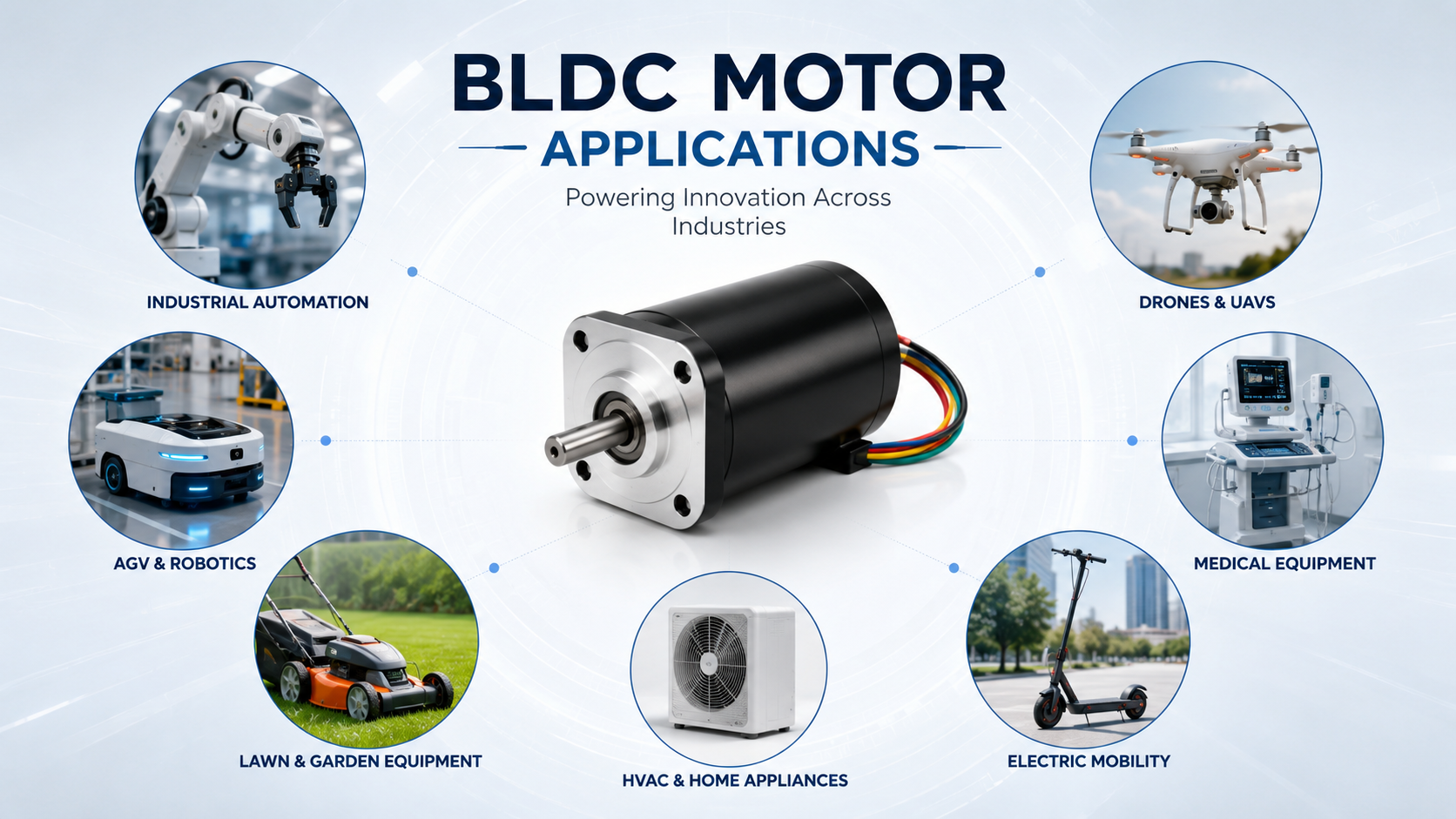
A BLDC motor (Brushless DC Motor) is widely used in electric vehicles, industrial automation, robotics, medical equipment, HVAC systems, drones, power tools, AGVs, and smart home devices because it offers:
- High efficiency (85–95%)
- Long service life (typically over 20,000 operating hours)
- Precise speed and torque control
- Low maintenance
- Quiet operation
- High power density
Compared with brushed DC motors, BLDC motors eliminate mechanical brushes, reducing wear while improving reliability and energy efficiency.
Engineering Fact
According to the U.S. Department of Energy (DOE), electric motor systems consume approximately 50% of global electricity, making high-efficiency motor technologies one of the most effective ways to reduce industrial energy consumption.
Source: U.S. Department of Energy, Energy Efficiency & Renewable Energy, 2024.
Why Are BLDC Motors Becoming the Preferred Choice?
Modern industries require motors that are:
- More efficient
- Smaller
- More reliable
- Easier to control digitally
A BLDC motor meets these requirements by replacing mechanical commutation with electronic commutation.
Instead of carbon brushes, the motor controller energizes stator windings according to rotor position using Hall sensors or sensorless algorithms.
This design significantly reduces:
- Mechanical wear
- Electrical arcing
- Maintenance costs
- Heat generation
As a result, BLDC motors outperform conventional brushed motors in demanding applications.
How Does a BLDC Motor Work?
A BLDC motor consists of:
- Permanent magnet rotor
- Three-phase stator windings
- Electronic controller (driver)
- Position feedback (Hall sensors or encoder)
Operating Process
- DC power enters the controller.
- The controller converts DC into three-phase AC pulses.
- Rotor position is detected.
- Stator windings are energized sequentially.
- Magnetic fields rotate.
- Rotor follows the rotating magnetic field.
Unlike brushed motors, there is no physical contact between rotor and stator.
Typical Performance Specifications
| Parameter | Typical Range |
| Voltage | 12–600 VDC |
| Rated Power | 5 W–50 kW |
| Speed | 500–20,000 RPM |
| Efficiency | 85–95% |
| Torque | 0.02–300 Nm |
| Operating Temperature | -20°C to +80°C |
| Service Life | 20,000–50,000 hours |
Actual values depend on motor size, cooling method, controller, and application.
Major BLDC Motor Applications
1. Industrial Automation

Industrial automation is one of the largest markets for BLDC motors.
Applications include:
- Conveyor systems
- Packaging machines
- CNC equipment
- Pick-and-place robots
- Assembly lines
Why BLDC Motors?
- High positioning accuracy
- Continuous-duty operation
- Low maintenance
- Excellent efficiency
Typical operating conditions:
| Requirement | Typical Value |
| Speed | 1,000–6,000 RPM |
| Duty Cycle | Continuous |
| Torque Control | High precision |
2. Electric Vehicles (EVs)

Electric mobility heavily relies on permanent magnet motor technology.
BLDC motors are commonly used in:
- Electric scooters
- E-bikes
- Electric wheelchairs
- Small electric vehicles
- Utility vehicles
Advantages include:
- High starting torque
- Wide speed range
- High efficiency
- Regenerative braking compatibility
According to the International Energy Agency (IEA), global electric vehicle sales exceeded 17 million units in 2024, increasing demand for efficient motor technologies.
Source: IEA Global EV Outlook 2025.
3. Robotics

Modern robots require:
- Smooth motion
- High precision
- Fast acceleration
BLDC motors power:
- Collaborative robots
- Service robots
- AGVs
- AMRs
- Robotic arms
Engineers often pair BLDC motors with:
- Planetary gearboxes
- Servo drivers
- Absolute encoders
for accurate motion control.
4. Medical Equipment

Medical devices demand:
- Quiet operation
- Low vibration
- High reliability
Typical applications include:
- Surgical robots
- Infusion pumps
- Ventilators
- Diagnostic equipment
- Dental instruments
Because there are no brushes generating particles, BLDC motors are ideal for clean environments.
5. HVAC Systems
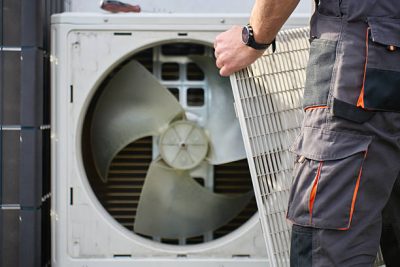
Modern HVAC systems increasingly replace induction motors with electronically commutated BLDC motors.
Applications:
- Air handlers
- Fans
- Compressors
- Heat pumps
- Air purifiers
Benefits include:
- Lower electricity consumption
- Variable-speed operation
- Reduced noise
The U.S. DOE reports that variable-speed motor systems can significantly improve energy efficiency compared with fixed-speed systems, depending on application and load profile.
Source: U.S. Department of Energy, Motor Systems Program, 2024.
6. Electric Lawn Equipment
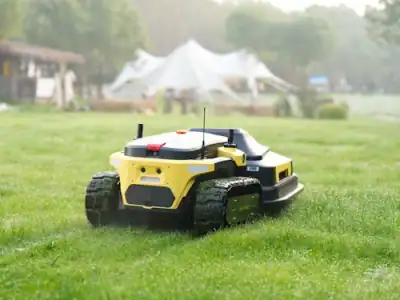
BLDC motors have transformed outdoor power equipment.
Applications include:
- Robotic lawn mowers
- Grass trimmers
- Leaf blowers
- Hedge trimmers
Compared with gasoline engines:
- Lower maintenance
- Zero local emissions
- Lower noise
- Higher energy efficiency
7. Drones and UAVs
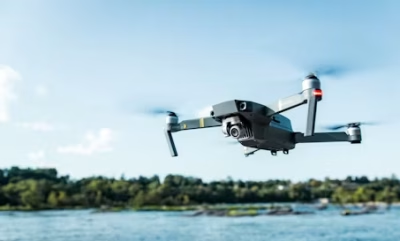
Drone motors must deliver:
- Extremely high power density
- Rapid acceleration
- Lightweight construction
Typical specifications:
| Parameter | Typical Value |
| Speed | 5,000–15,000 RPM |
| Efficiency | 90%+ |
| Weight | 30–500 g |
8. Smart Home Devices
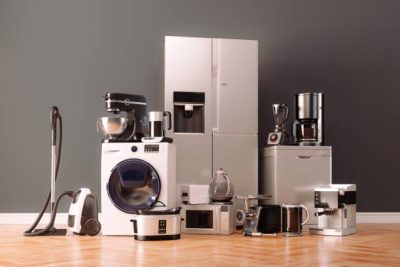
BLDC motors are increasingly found in:
- Robot vacuums
- Smart curtains
- Air purifiers
- Smart fans
- Water pumps
Electronic speed control enables quieter operation and lower energy consumption.
Comparison of BLDC Motor Applications
| Industry | Speed Requirement | Torque Requirement | Control Precision | Recommended BLDC Type |
| Robotics | High | Medium | Excellent | Servo BLDC |
| Medical | Medium | Medium | Excellent | Low-noise BLDC |
| HVAC | Low-Medium | Medium | Good | ECM/BLDC |
| AGV | Medium | High | Excellent | Gear BLDC |
| Lawn Equipment | High | High | Medium | High-power BLDC |
| Industrial Automation | Variable | Variable | Excellent | Closed-loop BLDC |
Advantages of BLDC Motors
| Feature | Benefit |
| No brushes | No mechanical wear |
| High efficiency | Lower operating cost |
| Permanent magnets | Higher power density |
| Electronic commutation | Precise control |
| Lower heat generation | Longer component life |
| Lower maintenance | Reduced downtime |
How to Select the Right BLDC Motor?
Engineers should evaluate the following factors.
Step 1 — Determine Load Torque
Calculate:
- Continuous torque
- Peak torque
- Starting torque
A motor should provide approximately 20–30% torque margin above continuous load to accommodate transient conditions and avoid overheating.
Step 2 — Choose Rated Speed
Typical ranges:
- Conveyor: 500–2,000 RPM
- Fans: 800–3,000 RPM
- Pumps: 1,500–3,600 RPM
- Robotics: 3,000–8,000 RPM
Step 3 — Select Voltage
Common industrial voltages:
- 12 V
- 24 V
- 48 V
- 72 V
- 310 VDC
- 560 VDC
Step 4 — Consider Environmental Conditions
Evaluate:
- Ambient temperature
- Humidity
- Dust
- IP protection level
- Duty cycle
- Cooling method
Step 5 — Select the Controller
Controller functions may include:
- Hall sensor feedback
- Sensorless control
- Encoder interface
- CAN communication
- EtherCAT
- RS485
- Modbus
Common Engineering Mistakes
| Mistake | Consequence | Solution |
| Undersized motor | Overheating | Calculate continuous torque correctly |
| Wrong controller | Startup failure | Match voltage and current ratings |
| Poor cooling | Reduced lifespan | Improve airflow or heatsinking |
| Ignoring inertia | Oscillation | Match rotor inertia to the load |
| Incorrect voltage | Efficiency loss | Use recommended operating voltage |
Troubleshooting Guide
| Problem | Possible Cause | Recommended Action |
| Motor won’t start | Driver fault | Verify controller output and wiring |
| Excessive temperature | Overload | Reduce load or select a larger motor |
| Low torque | Incorrect current limit | Adjust controller parameters |
| Vibration | Rotor imbalance | Inspect bearings and balance the rotor |
| Speed fluctuation | Hall sensor error | Check sensors and wiring |
BLDC Motor vs Brushed DC Motor
| Feature | BLDC Motor | Brushed DC Motor |
| Efficiency | 85–95% | 70–80% |
| Maintenance | Very Low | High |
| Noise | Low | Higher |
| Lifespan | 20,000–50,000 h | 2,000–5,000 h |
| Speed Control | Excellent | Moderate |
| Initial Cost | Higher | Lower |
| Reliability | Excellent | Moderate |
Engineering Selection Chart
| Application | Power Range | Voltage | Typical Speed | Recommended Motor |
| AGV | 100–1000 W | 24–48 V | 500–3000 RPM | Gear BLDC |
| Medical Pump | 10–200 W | 24 V | 1000–5000 RPM | Compact BLDC |
| Industrial Conveyor | 200–3000 W | 48–310 V | 500–2500 RPM | Industrial BLDC |
| Robotic Arm | 50–1500 W | 24–48 V | 2000–6000 RPM | Servo BLDC |
| Lawn Mower | 500–2500 W | 36–60 V | 3000–8000 RPM | High-Torque BLDC |
| HVAC Fan | 100–1000 W | 110–240 VAC (ECM) | 800–2500 RPM | ECM / BLDC |
Frequently Asked Questions
What industries commonly use BLDC motors?
BLDC motors are widely used in industrial automation, robotics, electric vehicles, medical devices, HVAC systems, drones, power tools, agricultural equipment, and smart home products.
Why are BLDC motors more efficient than brushed motors?
Because they use electronic commutation instead of mechanical brushes, BLDC motors eliminate brush friction and electrical arcing, reducing energy losses and improving efficiency.
Do BLDC motors require a controller?
Yes. A BLDC motor requires an electronic controller to energize the stator windings in the correct sequence based on rotor position.
How long does a BLDC motor last?
With proper sizing and cooling, a BLDC motor can operate for 20,000–50,000 hours or more, depending on bearings, duty cycle, and environmental conditions.
Can BLDC motors operate at variable speeds?
Yes. One of the primary advantages of a BLDC motor is its wide speed control range through pulse-width modulation (PWM) and electronic commutation.