
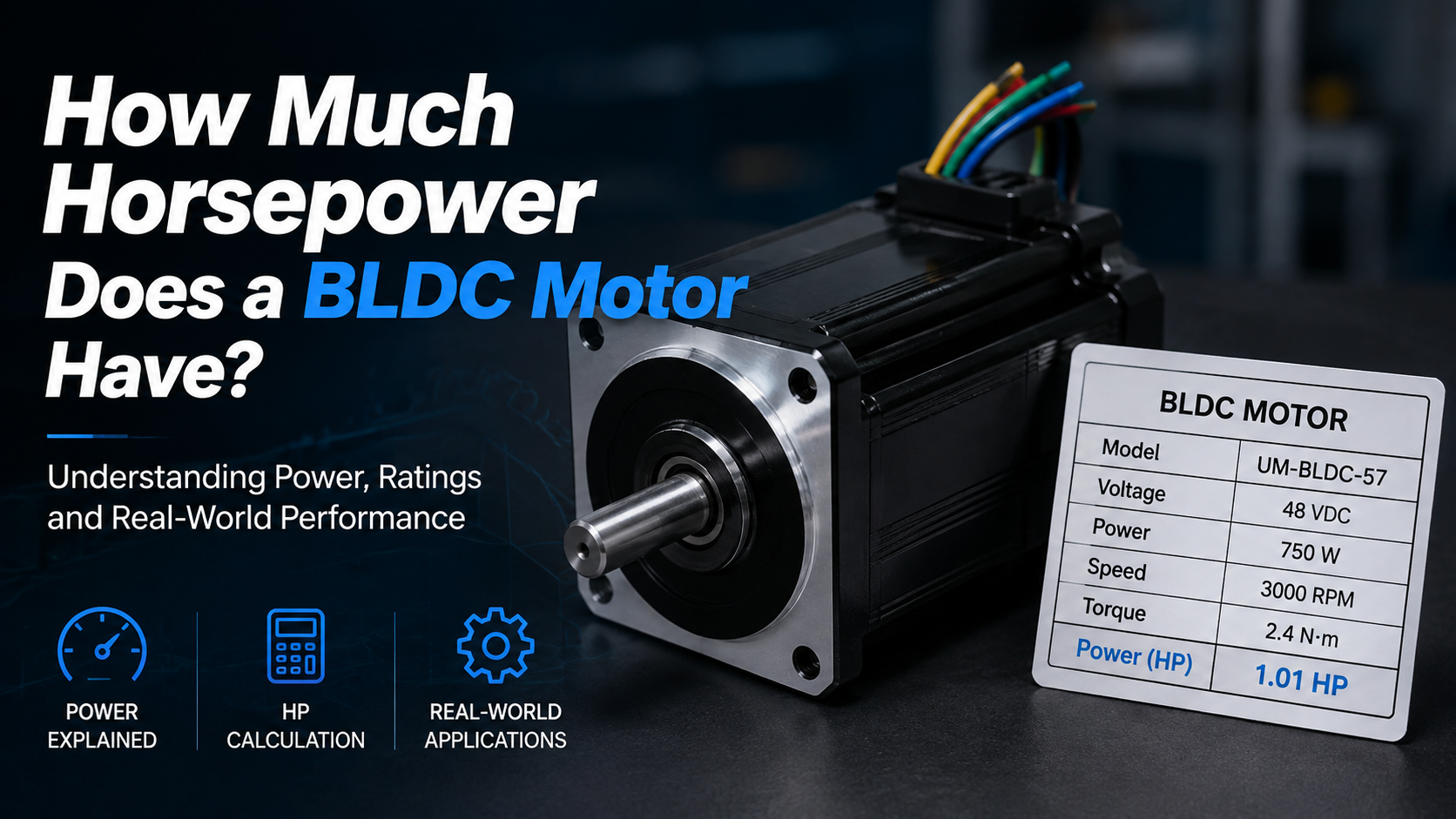
A BLDC motor can produce anywhere from 0.01 HP to over 500 HP, depending on its design, voltage, cooling method, and application.
Typical power ranges include:
| BLDC Motor Type | Power Output | Horsepower |
| Small cooling fan motor | 5–100 W | 0.007–0.13 HP |
| Robotics motor | 100–750 W | 0.13–1 HP |
| Industrial automation motor | 750 W–5 kW | 1–6.7 HP |
| Electric vehicle traction motor | 50–300 kW | 67–402 HP |
| Aerospace / racing applications | 300–500+ kW | 402–670+ HP |
Conversion Formula
Horsepower (HP) = Watts ÷ 746
For example:
250 W = 0.34 HP
750 W = 1.0 HP
1500 W = 2.0 HP
3000 W = 4.02 HP
7500 W = 10 HP
Understanding Horsepower in BLDC Motors
Horsepower is simply another unit used to describe mechanical output power. While engineers typically specify watts (W) or kilowatts (kW) when selecting BLDC Motors, many industries—particularly automotive, agricultural machinery, HVAC equipment, and North American industrial markets—still refer to motor output in horsepower because it is easier for customers to compare with traditional AC and gasoline-powered machines.
Unlike internal combustion engines, a BLDC motor can deliver its rated torque from very low speed, which often makes a lower-horsepower BLDC motor perform similarly to a higher-horsepower combustion engine in real-world applications. Therefore, horsepower alone should never be used as the only selection criterion.
Engineering Insight: Always evaluate horsepower, torque, efficiency, duty cycle, and operating speed together rather than relying on horsepower alone.
Data Source: IEEE Industry Applications Society, Electric Motor Fundamentals, IEEE Publications.
What Determines the Horsepower of a BLDC Motor?
Horsepower is not fixed for all BLDC motors. Several engineering factors directly influence the amount of usable mechanical power a motor can deliver.
1. Input Voltage
Increasing supply voltage generally allows the controller to deliver more electrical power while maintaining lower current, reducing conductor losses and enabling higher output power.
Typical industrial voltages include:
- 12 V
- 24 V
- 36 V
- 48 V
- 72 V
- 96 V
- 310 VDC bus
- 220 VAC servo systems
Higher voltage systems are commonly used in industrial automation because they improve efficiency and reduce current-related heating.
Source: U.S. Department of Energy, Premium Efficiency Motor Systems, DOE, updated 2024.
2. Current Capability
Electrical power is calculated as:
Power = Voltage × Current × Efficiency
Example:
48 V × 20 A = 960 W
Assuming 92% efficiency:
Mechanical output ≈ 883 W
Horsepower:
883 ÷ 746 = 1.18 HP
This demonstrates why both the motor winding and the controller’s current capacity are critical in determining horsepower.
3. Speed (RPM)
Horsepower depends on both torque and rotational speed.
The relationship is:
HP = Torque × RPM ÷ 5252
A motor producing high torque at low RPM may have lower horsepower than one producing moderate torque at high speed.
This explains why spindle motors often have much higher horsepower ratings than gear motors of similar size.
Source: Machinery’s Handbook, Industrial Press.
4. Cooling Method
Continuous horsepower is largely limited by temperature rise.
Cooling options include:
- Natural air cooling
- Forced-air cooling
- Water cooling
- Oil cooling
Improved cooling enables higher continuous current without exceeding insulation temperature limits.
Industrial servo motors frequently use forced-air or liquid cooling to achieve continuous operation at high power levels.
Source: IEC 60034 Rotating Electrical Machines.
5. Motor Size
Larger stators provide:
- Greater copper volume
- Larger magnetic circuits
- Improved heat dissipation
- Higher continuous torque
Consequently, larger BLDC motors typically produce higher horsepower.
BLDC Motor Horsepower by Application
| Application | Typical Power | Horsepower |
| Computer cooling fan | 5–20 W | 0.007–0.03 HP |
| Smart home actuator | 20–100 W | 0.03–0.13 HP |
| Electric bicycle | 250–750 W | 0.34–1 HP |
| Electric scooter | 500–2000 W | 0.67–2.7 HP |
| AGV robot | 400 W–2 kW | 0.5–2.7 HP |
| CNC servo motor | 750 W–15 kW | 1–20 HP |
| Industrial conveyor | 1–10 kW | 1.3–13 HP |
| Electric vehicle | 50–300 kW | 67–402 HP |
| Industrial compressor | 20–200 kW | 27–268 HP |
Horsepower vs Torque: Which Matters More?
Many engineers mistakenly believe horsepower is the most important specification.
In reality, torque determines whether the motor can actually move the load.
| Parameter | Horsepower | Torque |
| Indicates | Overall power capability | Turning force |
| Unit | HP or kW | Nm |
| Depends on RPM | Yes | No |
| Affects acceleration | Indirectly | Directly |
| Critical for gear motors | Moderate | High |
For example, a robotic arm lifting heavy objects requires high torque even if the horsepower rating is relatively modest, whereas a high-speed spindle relies on horsepower because torque is multiplied by rotational speed.
Step-by-Step: How to Calculate BLDC Motor Horsepower
Step 1 – Identify Rated Power
Example:
1500 W
Step 2 – Convert Watts to Horsepower
HP = 1500 ÷ 746
Result:
2.01 HP
Step 3 – Verify Efficiency
If efficiency equals 90%:
Electrical input:
1667 W
Mechanical output:
1500 W
Step 4 – Check Continuous vs Peak Ratings
Many manufacturers publish:
- Continuous horsepower=
- Peak horsepower
Peak values may only be available for several seconds before thermal protection limits are reached.
Always compare continuous ratings when selecting motors for industrial machinery.
Typical Horsepower Ratings of Industrial BLDC Motors
| Frame Size | Typical Power | Horsepower |
| 28 mm | 20–80 W | 0.03–0.11 HP |
| 42 mm | 50–200 W | 0.07–0.27 HP |
| 57 mm | 200–750 W | 0.27–1 HP |
| 80 mm | 750 W–2 kW | 1–2.7 HP |
| 110 mm | 2–5 kW | 2.7–6.7 HP |
| Servo BLDC | 5–30 kW | 6.7–40 HP |
These values vary depending on winding configuration, cooling system, controller current limits, and duty cycle.
Common Mistakes When Comparing BLDC Motor Horsepower
Mistake 1: Comparing Peak HP with Continuous HP
Peak ratings can be several times higher than continuous ratings, making direct comparisons misleading.
Mistake 2: Ignoring Controller Limitations
Even if a motor is rated for 5 HP, an undersized controller may restrict current and prevent the motor from reaching its full output.
Mistake 3: Overlooking Thermal Conditions
Ambient temperature, enclosure design, airflow, and duty cycle all influence continuous horsepower.
Mistake 4: Focusing Only on Horsepower
A motor with lower horsepower but higher torque at operating speed may perform better in gear-driven systems.
Mistake 5: Forgetting Gear Reduction
Adding a gearbox increases output torque significantly while reducing speed, allowing a relatively small BLDC motor to drive heavy loads efficiently without increasing motor horsepower.
Troubleshooting Horsepower-Related Issues
| Problem | Possible Cause | Solution |
| Motor feels weak | Low supply voltage | Verify rated voltage |
| Cannot reach rated HP | Controller current limit | Upgrade motor driver |
| Motor overheats | Continuous overload | Improve cooling or select larger motor |
| Poor acceleration | Insufficient torque | Increase gear ratio or motor size |
| Speed drops under load | Voltage sag | Check power supply and wiring |
| Frequent thermal shutdown | High ambient temperature | Improve ventilation or reduce duty cycle |
Why Industrial Engineers Choose BLDC Motors?
Compared with brushed DC motors and many induction motors, modern BLDC Motors provide several engineering advantages that make them well suited for demanding industrial applications:
High efficiency, typically 85–97% under rated conditions.
High power density, enabling more output power from a compact frame size.
Wide speed control range with precise electronic commutation.
Low maintenance because there are no brushes to wear.
Excellent torque response for servo and motion-control systems.
Long operational life due to reduced mechanical wear.
These characteristics allow BLDC motors to achieve higher usable output and lower lifecycle costs, making them a preferred choice for automation equipment, AGVs, medical devices, electric mobility, and precision machinery.
Data Source: U.S. Department of Energy, Improving Motor and Drive System Performance, DOE, 2024; IEEE Transactions on Industry Applications.
Conclusion
There is no single horsepower value that applies to all BLDC Motors. Depending on their intended application, they can range from less than 0.01 HP in miniature cooling fans to well over 400 HP in electric vehicle traction systems. While converting watts to horsepower is straightforward using the formula HP = Watts ÷ 746, selecting the right motor requires a broader engineering evaluation that includes torque, speed, efficiency, duty cycle, thermal management, controller capability, and gearbox matching. For industrial OEMs, considering these parameters together leads to more reliable system performance and longer service life.
At UNITED MOTION INC., we help OEMs and automation equipment manufacturers select BLDC motor solutions based on real operating requirements rather than horsepower alone, ensuring optimal efficiency, reliability, and application performance.
Frequently Asked Questions (FAQ)
Is a 750W BLDC motor equal to 1 horsepower?
Yes. Since 1 HP equals approximately 746 W, a 750 W BLDC motor is generally considered a 1 HP motor.
How many horsepower is a 48V BLDC motor?
Voltage alone does not determine horsepower. A 48 V BLDC motor may produce anywhere from 0.1 HP to more than 10 HP, depending on its current rating, efficiency, and operating speed.
Are BLDC motors more powerful than AC motors?
Not necessarily. BLDC motors are often more efficient and offer higher power density, but the achievable horsepower depends on the specific motor design and application requirements rather than the motor type alone.
Does a gearbox increase horsepower?
No. A gearbox does not increase horsepower. It increases output torque by reducing speed, while the overall mechanical power remains approximately the same aside from transmission losses.
Can a BLDC motor produce 100 horsepower?
Yes. Large liquid-cooled BLDC motors used in electric vehicles, aerospace systems, and industrial machinery can exceed 100 HP, with some traction motors producing several hundred horsepower.
Related blog: What is the Best Voltage for BLDC Motor?