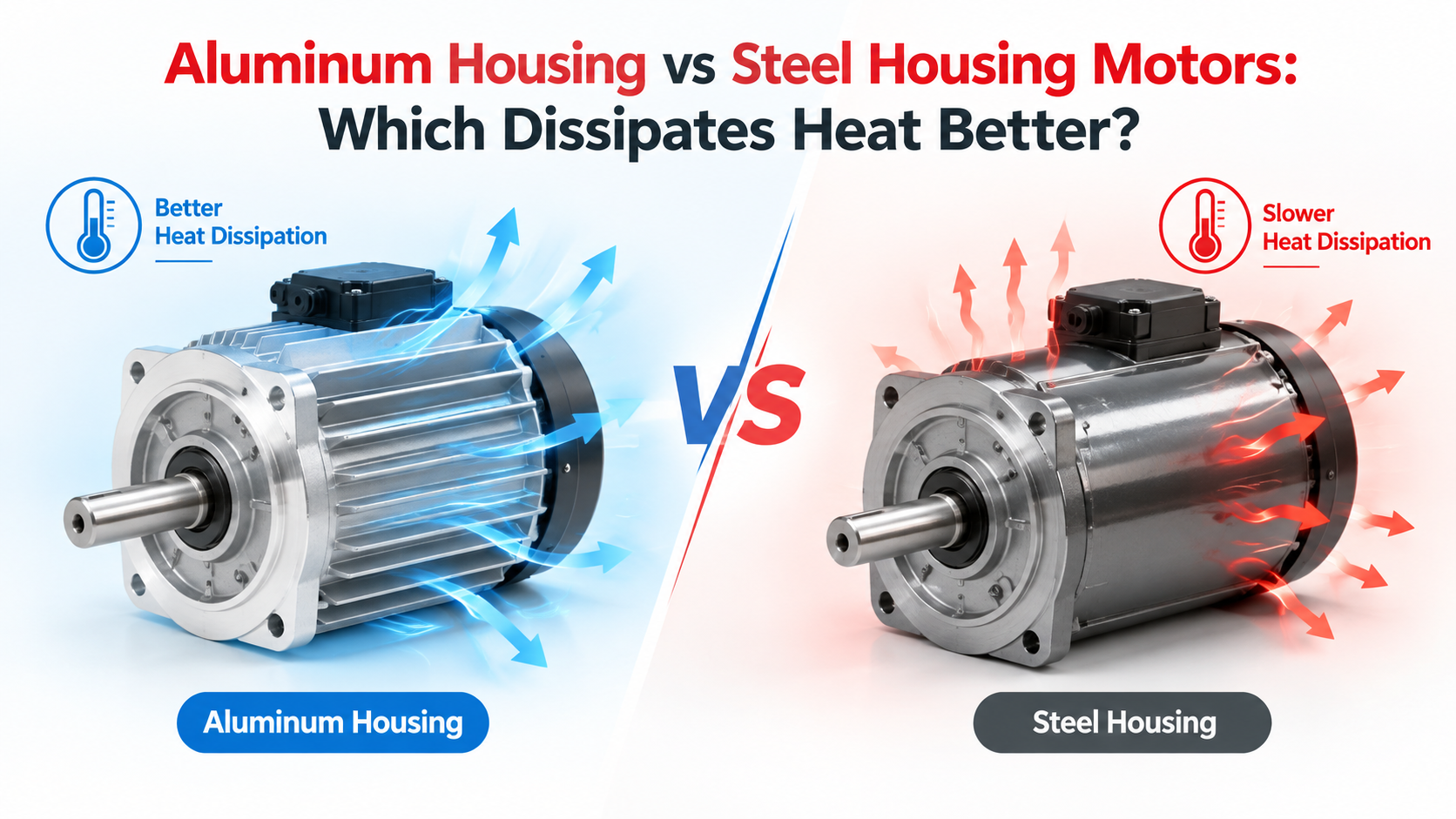
When engineers compare aluminum housing vs steel housing motors, thermal conductivity is usually the first specification they examine, but it should not be the only one. Aluminum generally transfers heat through the motor housing much more readily than steel, while the actual operating temperature of a motor depends on the complete thermal path, including winding losses, stator-to-housing contact, housing geometry, cooling fins, airflow, ambient temperature, mounting conditions, and duty cycle.
For compact BLDC motors, where high power density can place significant thermal demands on a relatively small frame, housing material can therefore influence continuous torque capability, winding temperature, efficiency, and service life.
Quick Answer
Aluminum housing generally dissipates motor heat better than steel housing because aluminum has substantially higher thermal conductivity. NIST reference data list aluminum at approximately 235 W/m·K at 295 K, while 304 stainless steel is approximately 15 W/m·K; carbon-steel thermal conductivity varies considerably with composition and processing but is also generally much lower than aluminum.
However, thermal conductivity alone does not determine motor cooling performance. A steel motor with a larger surface area, optimized cooling fins, forced-air cooling, or better stator-to-housing thermal contact can outperform a poorly designed aluminum housing.
For most compact, high-power-density BLDC applications, aluminum is attractive when low weight and efficient heat spreading are priorities, while steel can be advantageous when mechanical rigidity, impact resistance, dimensional stability, or manufacturing requirements dominate.
How Motor Housing Affects Heat Dissipation?
A motor generates heat primarily because electrical and mechanical losses are converted into thermal energy.
In a BLDC motor, important heat sources include:
- Copper losses in the stator windings
- Iron losses in the magnetic circuit
- Bearing losses
- Windage and mechanical losses
- Controller or switching losses in integrated designs
The heat then needs to travel from the internal heat sources to the surrounding environment.
A simplified thermal path is:
Winding → stator → housing → external surface → air
The housing is therefore part of the motor’s thermal resistance network.
For a simplified conductive path:
Rθ = L / (k × A)
where:
- Rθ = thermal resistance
- L = heat-transfer distance
- k = thermal conductivity
- A = heat-transfer area
As thermal conductivity increases, conductive thermal resistance decreases, assuming the geometry and interfaces remain unchanged.
This is why housing material matters, but it also explains why housing geometry and surface area can be equally important.
Aluminum vs Steel: Thermal Conductivity Comparison
The material difference is significant.
| Property | Aluminum | Steel / Stainless Steel |
| Typical thermal conductivity | ~150–235 W/m·K depending on alloy | Often ~15–60 W/m·K depending on grade |
| Density | ~2.7 g/cm³ | ~7.8–8.0 g/cm³ |
| Heat spreading | Excellent | Moderate to low |
| Weight | Low | High |
| Thermal expansion | Relatively high | Generally lower |
| Mechanical stiffness | Lower | Higher |
| Corrosion resistance | Good with suitable alloy/coating | Highly grade-dependent |
| Typical thermal advantage | Faster heat spreading | More dependent on geometry and cooling method |
NIST lists aluminum at 235 W/m·K at approximately 295 K, while its reference table gives 304 stainless steel at about 15 W/m·K. NIST also reports measured carbon-steel data showing that thermal conductivity varies with composition, reinforcing the point that “steel” should not be treated as one single thermal material.
A separate U.S. Department of Energy-supported motor thermal model used 167 W/m·K for aluminum in Nissan LEAF motor thermal modeling, demonstrating why aluminum is frequently selected as a heat-spreading material in electric motor structures. The study also showed that thermal resistance changes substantially with cooling flow rate.
Why Aluminum Housing Usually Dissipates Heat Faster?
1. Higher Thermal Conductivity
The largest advantage is straightforward: aluminum conducts heat through the housing much faster than most steels.
If a hot stator transfers heat into an aluminum housing, the housing can spread that heat over a larger external area relatively quickly, reducing localized hot spots.
This is particularly useful for compact BLDC motors, where the distance between the stator and outer surface may be small but the available cooling area is limited.
2. Lower Weight
Aluminum has a density of roughly 2.7 g/cm³, compared with approximately 7.8–8.0 g/cm³ for steel and stainless steel.
This makes aluminum attractive for robotics, electric mobility, portable equipment, and other applications where motor mass directly affects system design.
UNITED MOTION INC. offers BLDC motor frame sizes from 28 mm to 110 mm, covering compact motion systems through larger industrial applications, so the relationship between housing mass, power density, and thermal performance can become important during motor selection.
3. Better Heat Spreading When Combined With Fins
Aluminum becomes particularly effective when the housing incorporates external cooling fins.
A fin increases the surface area available for convection, while aluminum spreads heat from the stator region toward those fins.
A 2016 ASME research study on a passively cooled electric motor used an aluminum housing with integrated cooling fins and measured a 24% improvement in heat-transfer performance compared with its nominal motor design; forced airflow increased the measured heat-transfer coefficient further.
This illustrates an important engineering principle:
Material conductivity and housing geometry must be designed together.
Does Steel Housing Mean Poor Motor Cooling?
No.
Steel has lower thermal conductivity than aluminum, but a steel motor can still achieve adequate thermal performance when the overall cooling system is properly engineered.
For example, a TEFC motor uses an external fan to force air over the motor frame, and ribbed frames increase the available heat-transfer area. NEMA motor enclosure guidance and U.S. Department of Energy material both emphasize that enclosure design and cooling method are fundamental to motor thermal performance.
A steel housing may therefore compensate for its lower conductivity through:
- Larger external surface area
- Deeper cooling fins
- Forced-air cooling
- Improved stator-to-housing contact
- Larger motor frame dimensions
- Higher airflow velocity
- Lower internal losses
Consequently, comparing two motors solely by “aluminum versus steel” can produce the wrong engineering conclusion.
Aluminum Housing vs Steel Housing Motors: Practical Comparison
| Engineering Factor | Aluminum Housing | Steel Housing |
| Heat conduction | Strong | Lower |
| Heat spreading | Strong | Moderate |
| Weight | Lower | Higher |
| Structural rigidity | Moderate | High |
| Impact resistance | Good | Very good |
| Thermal expansion | Higher | Lower |
| Machining/casting flexibility | Excellent for many designs | Good |
| High power density applications | Often advantageous | Application-dependent |
| Compact BLDC motors | Frequently suitable | Suitable when mechanical strength is important |
| Forced-air cooling | Highly effective | Also effective |
| Corrosive environment | Alloy/coating dependent | Grade/coating dependent |
What Actually Determines Motor Operating Temperature?
Engineers should evaluate the complete thermal system rather than the housing material alone.
Step 1: Calculate Motor Losses
Start with the motor’s electrical and mechanical losses.
For copper loss:
Pcu = I²R
Because copper loss increases with the square of current, a motor operating at high torque can generate substantially more heat than it does at light load.
This is especially important for BLDC motors because torque demand is closely associated with current.
Step 2: Determine the Thermal Path
Evaluate:
Winding → stator → housing → air
Any poor interface in this chain can dominate the thermal resistance.
Step 3: Check Housing Geometry
Look at:
- Housing wall thickness
- Cooling-fin height
- Fin spacing
- External surface area
- Stator fit
- Mounting interface
Increasing aluminum conductivity cannot compensate indefinitely for poor geometry.
Step 4: Evaluate Airflow
Forced convection can significantly improve cooling.
DOE guidance explains that TEFC motors dissipate heat externally, with cooling air directed across the motor frame, while research on aluminum motor housings has demonstrated additional improvement from forced airflow.
Step 5: Check Ambient Temperature and Duty Cycle
A motor operating continuously at 40°C ambient has considerably less thermal margin than the same motor operating at 25°C ambient.
Continuous-duty applications should therefore be evaluated using actual load profiles rather than short-duration peak ratings.
Common Motor Overheating Problems
| Problem | Typical Thermal Effect | Recommended Engineering Check |
| Motor overloaded | Excessive winding current and I簡R loss | Check continuous and peak torque |
| Insufficient airflow | Higher housing temperature | Check fan, ventilation and fin clearance |
| High ambient temperature | Reduced temperature margin | Recalculate thermal operating point |
| Poor stator-housing contact | Increased thermal resistance | Check fit, interface and contact pressure |
| Undersized motor | High continuous current | Select larger frame or improve cooling |
| Excessive gearbox load | Increased motor torque/current | Verify gearbox ratio and output load |
| Incorrect controller settings | Excessive phase current | Check current limits and commutation |
| Dirty cooling fins | Reduced convection | Clean external cooling surfaces |
| Installation against insulating material | Restricted heat transfer | Review mounting arrangement |
UNITED MOTION INC. similarly identifies overload, excessive current, insufficient cooling, incorrect controller settings, poor ventilation, bearing problems, high ambient temperature, and operation beyond rated duty cycle as common causes of BLDC motor overheating.
Aluminum Housing vs Steel Housing: Which Should Engineers Choose?
The answer depends on the application’s priorities.
Choose aluminum housing when:
Thermal performance is important.
Low motor weight is required.
The motor has high power density.
External cooling fins are available.
The application involves robotics or electric mobility.
Compact BLDC construction is required.
Consider steel housing when:
Structural stiffness is a major requirement.
The motor experiences substantial mechanical loading.
Impact resistance is important.
Dimensional stability is prioritized.
The application already provides effective forced-air cooling.
Manufacturing or environmental requirements favor steel.
For OEM applications, the better approach is to specify the required continuous torque, peak torque, RPM, voltage, ambient temperature, duty cycle, mounting configuration, cooling method, and allowable winding temperature before selecting the housing material.
BLDC Motor Thermal Design: An Important Selection Point
Modern BLDC motor systems increasingly combine the motor with Hall sensors, encoders, gearboxes, and motor drivers, which means thermal analysis should consider the complete motion-control system rather than the motor housing independently.
For example, a compact BLDC motor with gearbox integration may experience higher motor current because the gearbox is being used to produce high output torque, while an encoder or integrated driver may introduce additional thermal considerations around the motor assembly.
UNITED MOTION INC. provides BLDC motor configurations with 28–110 mm frame sizes, multiple voltage options, Hall sensors, encoder integration, gearbox integration, and driver integration, allowing the mechanical and electrical configuration to be adapted to application requirements.
The practical engineering objective is therefore not simply to select the material with the highest thermal conductivity, but to create a low-resistance thermal path from the winding to the surrounding environment while maintaining the required mechanical strength, weight, protection level, and production cost.
FAQ
Is aluminum housing better than steel housing for motor cooling?
Generally, yes. Aluminum has substantially higher thermal conductivity than steel, so it can transfer and spread heat through the motor housing more effectively. However, actual motor temperature also depends on housing geometry, thermal interfaces, airflow, losses, ambient temperature, and duty cycle.
Why do many BLDC motors use aluminum housings?
Aluminum provides a combination of high thermal conductivity, low density, and good manufacturing flexibility, making it suitable for compact BLDC motors where power density and weight are important.
Does a steel motor overheat more easily?
Not necessarily. Steel has lower thermal conductivity, but a properly designed steel motor can use larger surface area, cooling fins, forced airflow, or a larger frame to achieve the required thermal performance.
Do cooling fins matter more than housing material?
They can. Cooling fins increase external surface area and can substantially improve convection. A well-designed steel housing with effective forced cooling can outperform a poorly designed aluminum housing.
How does motor current affect temperature?
Copper loss approximately follows I²R, so increasing current can produce a disproportionate increase in winding heat. This is why continuous torque and peak torque must be distinguished during BLDC motor selection.
Can an aluminum housing improve BLDC motor life?
Potentially. Lower operating temperature can improve thermal margin and reduce stress on insulation and other components. The U.S. Department of Energy notes that insulation life is strongly affected by operating temperature, with lower temperatures generally providing longer insulation life.
What is more important: motor housing material or motor size?
Both matter. A larger motor generally provides more active material and cooling area, while housing material influences the thermal resistance of the path to the environment. Engineers should evaluate both together.
Can UNITED MOTION INC. customize BLDC motor housings?
Yes. UNITED MOTION INC. provides OEM customization for motor dimensions, winding design, voltage, speed, shaft configuration, mounting flange, Hall sensors, encoder integration, gearbox integration, and driver integration. Housing and thermal requirements can therefore be considered as part of the overall motor configuration.