
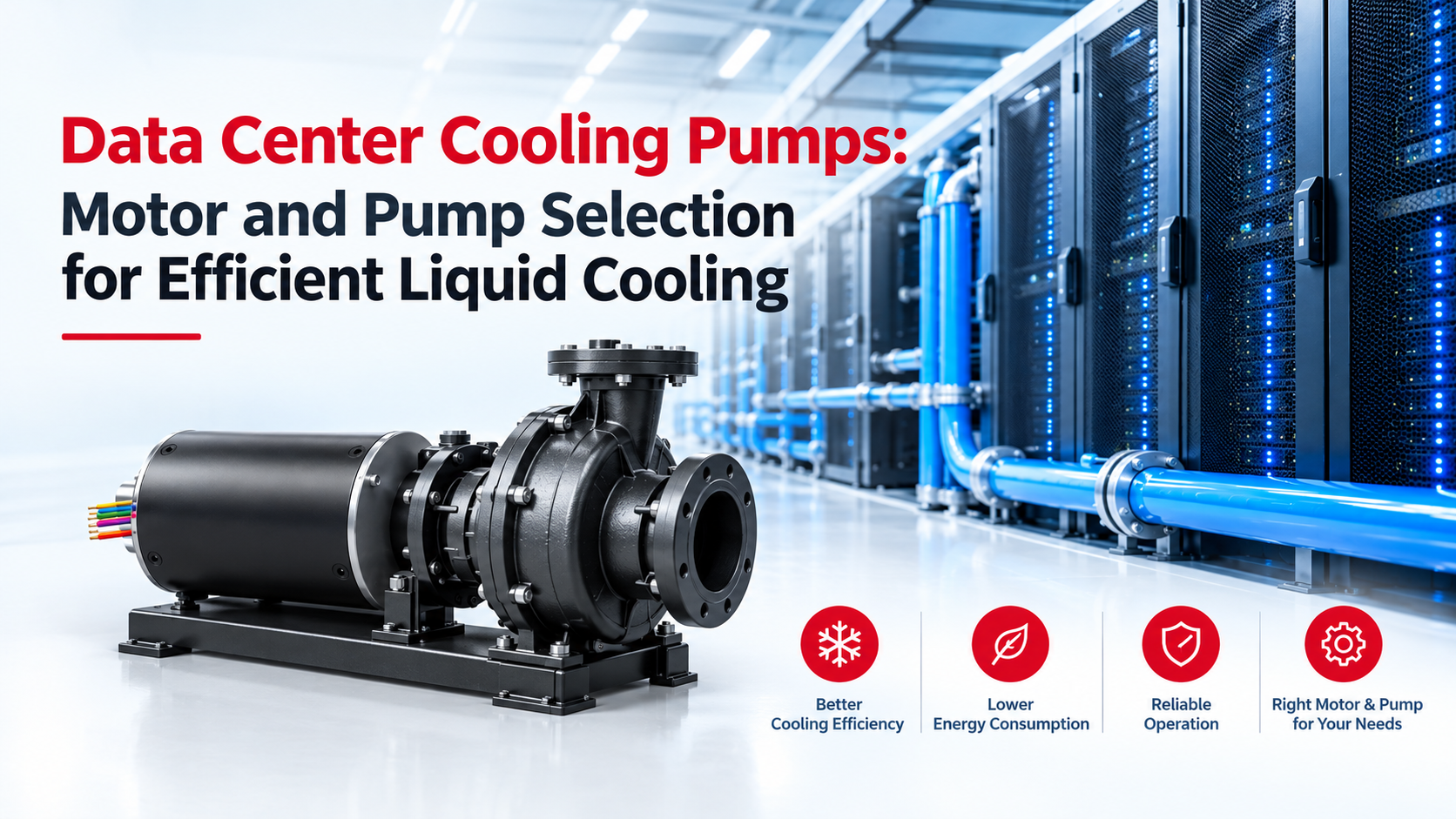
As data centers deploy more AI servers, GPUs, and high-density computing systems, managing heat has become a critical engineering challenge. Traditional air cooling may not provide sufficient cooling capacity for high-density racks, making liquid cooling an increasingly important solution.
At the heart of many liquid cooling systems are data center cooling pumps, which circulate coolant between heat-generating components and heat exchangers or cooling distribution units (CDUs). The pump must provide stable flow, sufficient pressure, low noise, and reliable continuous operation.
What Are Data Center Cooling Pumps?
Data center cooling pumps are used to circulate cooling fluids through liquid cooling systems. Depending on the system architecture, they can support:
- Direct-to-chip liquid cooling
- Coolant distribution units (CDUs)
- Rear-door heat exchangers
- Immersion cooling systems
- Chilled-water circulation systems
The pump continuously moves coolant through the system to transfer heat away from CPUs, GPUs, and other high-power components.
Why Pump Performance Matters in Data Center Cooling
A cooling pump directly affects the circulation capacity and thermal performance of a liquid cooling system.
If the pump cannot provide sufficient flow or pressure, coolant may not reach all cooling components effectively. Excessive pump speed, meanwhile, can increase energy consumption, noise, and mechanical stress.
For this reason, pump selection should consider several parameters:
1. Flow Rate
Flow rate determines how much coolant can circulate through the cooling loop within a given period.
The required flow depends on factors such as server power, coolant temperature difference, heat exchanger efficiency, and system design.
2. Pressure and Head
The pump must overcome resistance from pipes, valves, heat exchangers, cold plates, and other components.
A pump with adequate pressure capability helps maintain stable coolant circulation even when system resistance changes.
3. Motor Speed Control
Cooling demand can vary significantly depending on server utilization. A variable-speed motor allows the pump to adjust its output according to real-time cooling requirements.
This can help reduce unnecessary energy consumption compared with continuously operating the pump at maximum speed.
4. Continuous Operation
Data center cooling systems may operate 24/7. Pump motors therefore need to support long operating periods with stable performance and appropriate thermal management.
BLDC Motors for Data Center Cooling Pumps
A BLDC motor can be a suitable motor technology for compact cooling pump applications because it offers electronic commutation, controllable speed, and a compact design.
When integrated with an appropriate pump, a BLDC motor can provide:
- Variable-speed operation
- Compact mechanical design
- Stable speed control
- Low maintenance requirements
- High efficiency across suitable operating ranges
- Integration with intelligent control systems
For data center applications, motor selection should be based on the actual pump operating point rather than motor power alone.

How to Select a Motor for a Cooling Pump?
The motor and pump should be matched according to the complete operating requirements.
Key parameters include:
Flow rate: How much coolant needs to be circulated?
Pump head: What pressure must the pump generate to overcome system resistance?
Operating speed: What speed range is required for normal and peak cooling conditions?
Power: What mechanical power is required at the target operating point?
Duty cycle: Will the pump operate continuously or under variable load?
Noise: Is the cooling system installed near occupied areas or sensitive equipment?
Control method: Does the system require PWM, analog, digital, or closed-loop speed control?
A simplified relationship between hydraulic power and pump requirements is:
P = ρ × g × Q × H / η
where:
- P = required hydraulic power
- ρ = coolant density
- g = gravitational acceleration
- Q = flow rate
- H = pump head
- η = overall pump efficiency
The motor should then be selected with appropriate margin based on the pump’s actual efficiency and operating conditions.
Pump Motor Design for High-Density Computing
AI servers and high-performance computing equipment can generate significant heat in a relatively small space. This places greater demands on cooling infrastructure.
For compact cooling systems, the motor may need to deliver sufficient torque while maintaining a small form factor. In addition, speed control can help the cooling system respond to changes in computing load.
For example, when server utilization is relatively low, the pump can operate at a lower speed. When thermal load increases, the control system can increase pump speed to provide additional coolant flow.
This approach can help balance cooling capacity, energy consumption, and system reliability.
What Should Data Center Operators Consider?
Selecting a cooling pump should not be based only on maximum flow or motor power. Engineers should evaluate the complete pump operating curve and the expected system operating range.
Important considerations include:
- Required flow and pressure
- Coolant characteristics
- Operating temperature
- Continuous-duty requirements
- Motor efficiency
- Speed-control requirements
- Noise and vibration
- Available installation space
- Communication and control requirements
- Expected service life
The motor, pump, controller, and cooling system should be considered as an integrated solution.
Custom Motor Solutions for Data Center Cooling Pumps
Different cooling systems have different requirements for flow, pressure, speed, dimensions, voltage, and control interfaces. A standard motor may therefore not always provide the optimal solution.
A motor manufacturer can customize parameters such as:
- Rated voltage
- Speed range
- Torque
- Motor dimensions
- Shaft configuration
- Feedback or sensor options
- Driver and control interface
For OEM cooling pump applications, early coordination between the pump manufacturer and motor supplier can help optimize the complete drive system.
Conclusion
Data center cooling pumps are a critical part of liquid cooling systems for modern high-density computing infrastructure. The right pump motor must provide the required flow and pressure while supporting efficient speed control, continuous operation, compact integration, and reliable performance.
For applications such as direct-to-chip cooling, CDUs, and other liquid cooling systems, BLDC motors with variable-speed control can provide a flexible foundation for developing compact and controllable cooling pump solutions.
When selecting a motor for a data center cooling pump, engineers should evaluate the complete operating point—including flow, pressure, speed, torque, efficiency, coolant conditions, and control requirements—rather than selecting a motor based on rated power alone.