
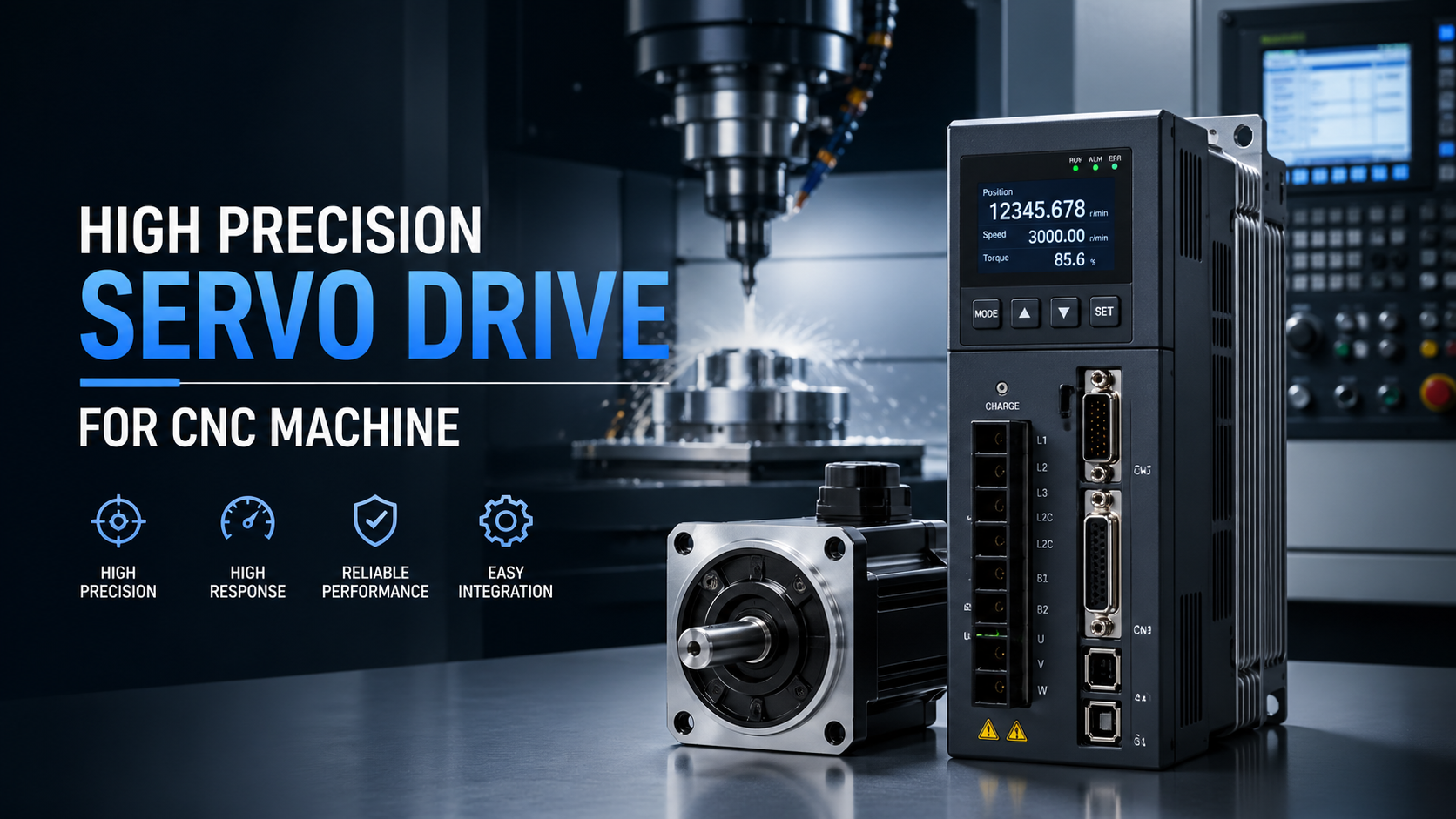
In modern manufacturing, precision is no longer optional. CNC machines are expected to deliver consistent accuracy, high speed, and reliable output under demanding conditions. At the center of this performance lies one critical component: the high precision servo drive.
Many buyers struggle with issues like positioning errors, unstable motion, overheating, or poor system integration. Choosing the right servo drive is not just about specs—it directly impacts productivity, product quality, and long-term operating costs.
This guide breaks down everything you need to know about high precision servo drives for CNC machines, helping you make informed, practical decisions.
What Is a High Precision Servo Drive?
A high precision servo drive is an electronic device that controls the motion of a servo motor by regulating voltage, current, and position feedback. In CNC machines, it ensures that every movement—whether linear or rotational—is executed with exact accuracy.
Unlike traditional motor controllers, servo drives operate in a closed-loop system. This means they constantly receive feedback from encoders and adjust performance in real time. This feedback loop is what allows CNC machines to achieve micron-level precision.
For buyers, the key benefit is simple: consistent, repeatable accuracy under dynamic loads.
Why CNC Machines Demand High Precision Servo Drives?
CNC machining is not forgiving. Even a slight deviation in positioning can result in defective parts, wasted material, and lost production time.
Here are the core reasons why high precision servo drives are essential:
1. Ultra-Accurate Position Control
CNC machines often require positioning accuracy within microns. A high precision servo drive ensures exact movement by continuously correcting deviations.
2. Smooth Motion at All Speeds
Low-speed instability is a common pain point. High-end servo drives eliminate vibration and ensure smooth motion even at very low RPM.
3. Fast Response Time
In high-speed machining, delay is costly. Servo drives with high bandwidth respond instantly to command changes, improving cycle times.
4. Stability Under Load Changes
Cutting forces vary during machining. A reliable servo drive compensates instantly, maintaining consistent performance.
Common Buyer Pain Points (And How Servo Drives Solve Them)
Understanding real-world problems helps buyers make better decisions. Below are the most common issues faced in CNC applications:
Position Drift and Inaccuracy
Many systems lose accuracy over time due to poor feedback control. High precision servo drives use advanced algorithms to maintain positioning accuracy continuously.
Vibration and Noise
Mechanical vibration can damage tools and reduce surface finish quality. Servo drives with optimized tuning reduce resonance and ensure smooth operation.
Overheating Issues
Low-quality drives often overheat under heavy loads. Advanced servo drives include thermal protection and efficient power management.
Integration Complexity
Buyers often struggle to integrate servo systems with existing CNC controllers. Modern servo drives support multiple communication protocols, simplifying integration.
Key Features to Look for in a High Precision Servo Drive
Choosing the right servo drive requires understanding the features that actually matter.
High Resolution Encoder Support
The higher the encoder resolution, the more precise the control. Look for drives that support 17-bit or higher encoders.
Advanced Control Algorithms
Modern servo drives use adaptive control, feedforward compensation, and auto-tuning to improve performance.
High Bandwidth Response
A high bandwidth system reacts faster to changes, improving accuracy and reducing lag.
Multi-Protocol Communication
Support for EtherCAT, Modbus, CANopen, or other industrial protocols ensures easy integration.
Safety Features
Built-in protections such as overcurrent, overvoltage, and thermal shutdown are essential for long-term reliability.
Servo Drive vs Stepper Drive: Why Servo Wins in CNC
Many buyers consider stepper motors due to lower cost, but they come with limitations.
| Feature | Servo Drive | Stepper Drive |
|---|---|---|
| Accuracy | High (closed-loop) | Moderate (open-loop) |
| Speed | High | Limited |
| Torque at High Speed | Strong | Weak |
| Efficiency | High | Lower |
| Reliability | High | Can lose steps |
For CNC machines, servo drives provide higher efficiency, better control, and long-term cost savings.
How High Precision Servo Drives Improve CNC Productivity?
Servo drives are not just about motion—they directly impact business performance.
Faster Machining Cycles
Improved response time reduces idle time between movements.
Better Surface Finish
Smooth motion control leads to higher quality output.
Reduced Scrap Rate
Accurate positioning minimizes errors and material waste.
Lower Maintenance Costs
Stable operation reduces wear on mechanical components.
Applications of High Precision Servo Drives in CNC Machines
High precision servo drives are widely used across multiple CNC applications:
CNC Milling Machines
Require precise tool path control and smooth motion for complex shapes.
CNC Lathes
Demand consistent rotational accuracy for high-quality finishes.
CNC Grinding Machines
Need ultra-fine control for micron-level surface precision.
CNC Laser Cutting
Require high-speed, high-accuracy positioning for clean cuts.
Integration Considerations for Buyers
Compatibility with CNC Controllers
Ensure the servo drive supports your CNC system’s communication protocol.
Power Matching
The drive must match the motor’s voltage and current requirements.
Environmental Conditions
Consider dust, temperature, and humidity in your working
environment.
Installation Space
Compact designs are preferred in modern CNC systems.
Future Trends in Servo Drive Technology
Smart Servo Systems
Integration with IoT allows real-time monitoring and predictive maintenance.
AI-Based Optimization
Advanced algorithms can automatically adjust performance for optimal efficiency.
Energy Efficiency Improvements
Modern drives reduce energy consumption without sacrificing performance.
Miniaturization
Compact servo drives are becoming more powerful and space-efficient.
Why Choose United Motion Inc.?
At United Motion Inc., we understand the real challenges faced by CNC machine manufacturers and system integrators.
Our high precision servo drive solutions are designed to deliver:
• Reliable and stable performance
• High positioning accuracy
• Easy integration with CNC systems
• Long service life under demanding conditions
We focus on practical engineering and consistent quality, ensuring that our solutions meet industrial standards and real-world needs.
Practical Tips for Selecting the Right Servo Drive
When evaluating options, keep these practical tips in mind:
• Always match the servo drive with your motor specifications
• Prioritize reliability over low cost
• Test performance under real operating conditions
• Choose suppliers with strong technical support
• Consider long-term scalability
Conclusion
High precision servo drives are the backbone of modern CNC machines. They ensure accuracy, improve efficiency, and reduce operational risks.
For buyers, the key is not just choosing a product, but selecting a solution that aligns with real production needs. By understanding the technology, evaluating key features, and focusing on long-term value, you can significantly improve your CNC system performance.
References
1. Industrial Motion Control Systems – Engineering Guidelines
2. CNC Machine Design and Control Principles
3. Servo Motor and Drive Technology Handbook
4. Modern Manufacturing Automation Standards
5. Advanced Motion Control Algorithms Research Papers
Related blog: What is a Servo Drive?