
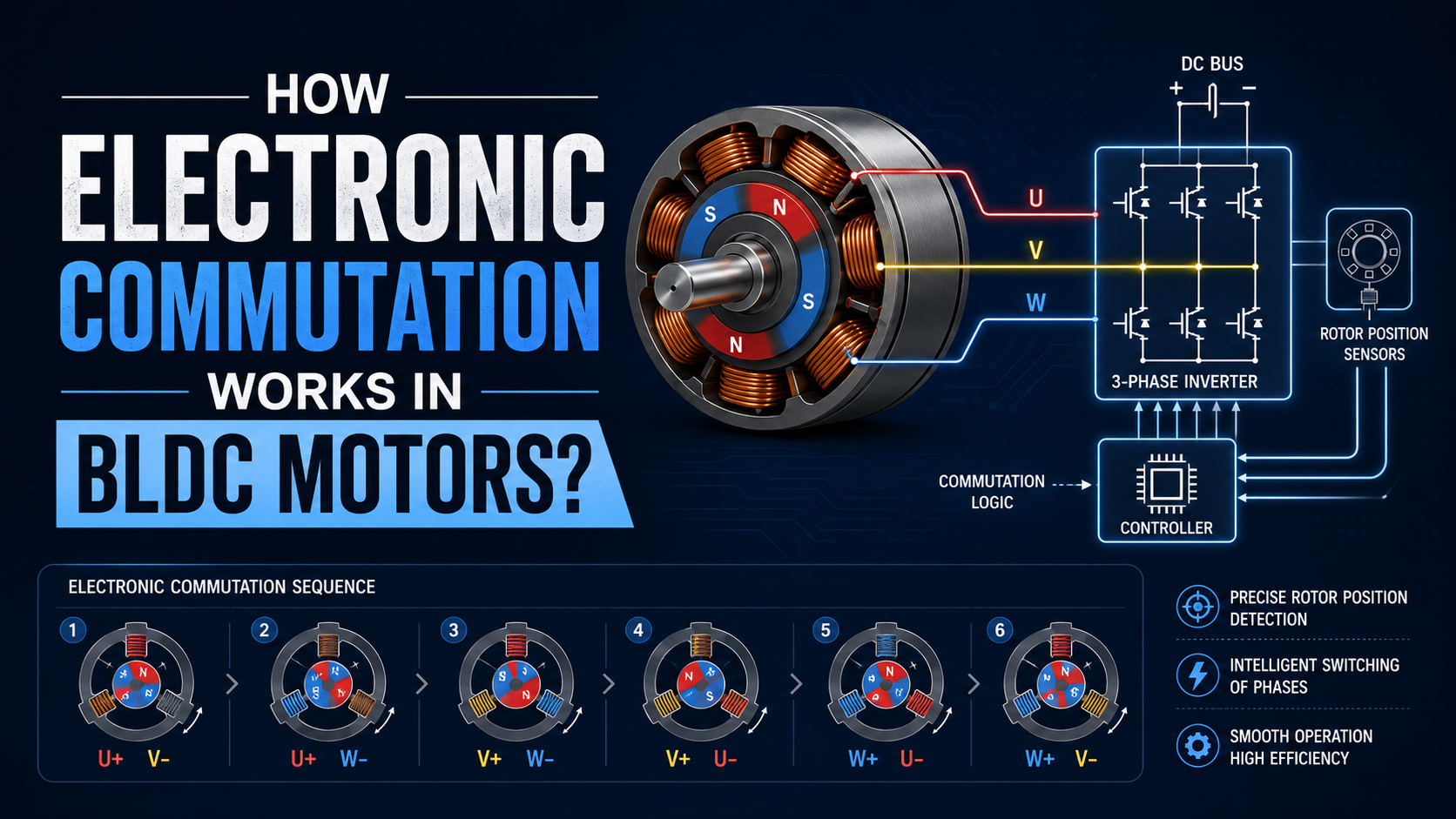
In modern motion control systems, efficiency, precision, and reliability are no longer optional—they are expected. This is exactly why Brushless DC (BLDC) motors are replacing traditional brushed motors across industries. At the center of this shift is one key technology: electronic commutation.
Unlike brushed motors that rely on physical contact, BLDC motors use electronic switching to control current flow. This not only improves performance but also removes common failure points. For engineers and buyers evaluating motor solutions, understanding how electronic commutation works is critical to making the right decision.
This guide explains the working principle in a practical and industry-focused way, while also addressing real-world challenges and selection considerations.
What Is Electronic Commutation in BLDC Motors?
Electronic commutation is the process of controlling current flow in a BLDC motor using electronic circuits instead of mechanical brushes. In a traditional brushed motor, brushes physically switch the current direction as the rotor spins. This creates friction, sparks, and wear over time.
In contrast, BLDC motors replace this mechanical system with an electronic controller that switches current based on the rotor’s position. This method ensures smoother operation, higher efficiency, and longer service life.
From a buyer’s perspective, this means fewer maintenance issues, better energy savings, and more consistent performance in demanding applications such as robotics, automation, and electric vehicles.
Why the Industry Is Moving Toward Electronic Commutation?
Many industrial users are actively moving away from brushed motors due to recurring pain points. These include frequent maintenance, carbon dust contamination, noise, and limited lifespan. Electronic commutation directly solves these problems.
Another key driver is energy efficiency. With rising energy costs and stricter environmental regulations, companies are prioritizing motors that can deliver higher output with lower power consumption. BLDC motors, powered by electronic commutation, often achieve efficiency levels above 85–90%, making them ideal for modern systems.
In addition, electronic commutation allows for precise speed and torque control, which is essential in automation systems, medical devices, and precision equipment.
Core Components Involved in Electronic Commutation
To understand how electronic commutation works, it is important to break down the key components involved in the system.
1. Stator Windings
The stator contains multiple coils arranged in phases (usually three-phase). These coils generate a rotating magnetic field when energized in sequence.
2. Permanent Magnet Rotor
The rotor is equipped with permanent magnets. Instead of receiving electrical current, it responds to the magnetic field created by the stator.
3. Electronic Controller (Driver)
This is the brain of the system. It determines when and how to switch current between stator windings based on rotor position.
4. Position Sensors (or Sensorless Control)
The system needs to know the rotor position to time the switching correctly. This is done using:
• Hall effect sensors (sensor-based control)
• Back EMF detection (sensorless control)
Each component plays a critical role in ensuring smooth and efficient commutation.
Step-by-Step: How Electronic Commutation Works
Electronic commutation follows a sequence that ensures continuous rotation of the motor. Let’s break it down into a simple process.
Step 1: Detect Rotor Position
The controller first determines the position of the rotor using sensors or back EMF signals. This information is crucial because the timing of current switching must match the rotor position.
Step 2: Energize Stator Coils
Based on the rotor position, the controller energizes specific stator windings. This creates a magnetic field that attracts or repels the rotor magnets.
Step 3: Create Rotating Magnetic Field
By switching current between different coils in a precise sequence, the controller creates a rotating magnetic field.
Step 4: Continuous Rotation
As the rotor follows this rotating field, the controller continuously updates the switching pattern. This results in smooth, continuous motion.
This process happens thousands of times per second, enabling high-speed and precise motor operation.
Electronic Commutation vs Mechanical Commutation
Understanding the difference between these two methods helps buyers make better decisions.
| Feature | Electronic Commutation (BLDC) | Mechanical Commutation (Brushed) |
|---|---|---|
| Efficiency | High (85–95%) | Moderate (70–80%) |
| Maintenance | Very low | High |
| Noise | Low | High |
| Lifespan | Long | Short |
| Precision Control | Excellent | Limited |
For industries that require reliability and low downtime, electronic commutation is clearly the better choice.
Sensor-Based vs Sensorless Commutation
One of the most common questions from buyers is whether to choose sensor-based or sensorless BLDC motors.
Sensor-Based Commutation
Uses Hall sensors to detect rotor position.
Advantages:
Accurate at low speeds
Smooth startup
Reliable in heavy-load conditions
Disadvantages:
Slightly higher cost
More wiring complexity
Sensorless Commutation
Relies on back EMF signals to estimate rotor position.
Advantages:
Lower cost
Simpler design
Higher reliability in harsh environments
Disadvantages:
Less effective at low speeds
More complex control algorithms
For applications like robotics or medical devices, sensor-based systems are often preferred. For fans, pumps, and cost-sensitive applications, sensorless solutions are widely used.
Real Industry Applications of Electronic Commutation
Electronic commutation is not just a theory—it is widely used across industries.
Industrial Automation
Precise motion control is essential in CNC machines and robotic arms. BLDC motors ensure accurate positioning and repeatability.
Electric Vehicles
High efficiency and torque control make BLDC motors ideal for EV systems, including traction and auxiliary functions.
HVAC Systems
Energy-efficient operation reduces power consumption in fans and compressors.
Medical Equipment
Low noise and high reliability are critical in devices such as ventilators and surgical tools.
Robotic Lawn Mowers
BLDC motors provide quiet operation, long battery life, and precise control for autonomous movement.
Key Benefits for Buyers and Engineers
From a purchasing perspective, electronic commutation offers clear advantages that directly impact ROI.
1. Lower Maintenance Costs
No brushes mean fewer parts to replace, reducing downtime and service expenses.
2. Higher Efficiency
Better energy utilization leads to long-term cost savings.
3. Improved Product Lifespan
BLDC motors last significantly longer than brushed alternatives.
4. Better Performance Control
Precise speed and torque control improve overall system performance.
5. Reduced Noise and Heat
This is especially important in consumer-facing or sensitive environments.
Common Challenges and How to Solve Them
Despite its advantages, electronic commutation comes with some challenges.
Challenge 1: Complex Control Systems
Solution: Use integrated motor drivers or partner with experienced manufacturers.
Challenge 2: Higher Initial Cost
Solution: Focus on total cost of ownership rather than upfront price.
Challenge 3: Compatibility Issues
Solution: Ensure the controller and motor are properly matched.
Working with a reliable supplier like United Motion Inc. can help avoid these issues and ensure optimal system performance.
How to Choose the Right BLDC Motor with Electronic Commutation?
When selecting a BLDC motor, buyers should consider the following factors:
- Voltage and power requirements
- Speed and torque specifications
- Control method (sensor vs sensorless)
- Application environment
- Integration with existing systems
Choosing the right motor is not just about specifications—it is about ensuring long-term reliability and efficiency.
Future Trends in Electronic Commutation Technology
The technology continues to evolve, driven by demand for smarter and more efficient systems.
Smart Motor Integration
Modern BLDC motors are being integrated with IoT systems for real-time monitoring.
AI-Based Control Algorithms
Advanced algorithms improve efficiency and predictive maintenance.
Miniaturization
Compact designs are enabling new applications in medical and wearable devices.
Sustainability Focus
Energy-efficient motors are becoming a key part of green manufacturing strategies.
Why Choose United Motion Inc.?
At United Motion Inc., we specialize in high-performance BLDC motor solutions designed for industrial and commercial applications. Our motors are engineered with advanced electronic commutation systems to deliver:
High efficiency and reliability
Customizable configurations
Long operational lifespan
Strong technical support
We understand the challenges buyers face and provide solutions that align with real-world applications.
Conclusion
Electronic commutation is the foundation of modern BLDC motor technology. By replacing mechanical switching with intelligent electronic control, it delivers better efficiency, longer lifespan, and superior performance.
For engineers and buyers, understanding this technology is essential to selecting the right motor solution. Whether you are working on automation systems, electric vehicles, or precision equipment, BLDC motors with electronic commutation offer a clear advantage.
References
Krishnan, R. – Permanent Magnet Synchronous and Brushless DC Motor Drives
Texas Instruments – Sensorless BLDC Motor Control Application Report
Microchip Technology – BLDC Motor Control Fundamentals
IEEE Papers on Electric Motor Efficiency and Control Systems
Nidec Motor Corporation – BLDC Motor Technology Overview
Related blog: Why PMSM Motor is Used in Electric Vehicles ?