
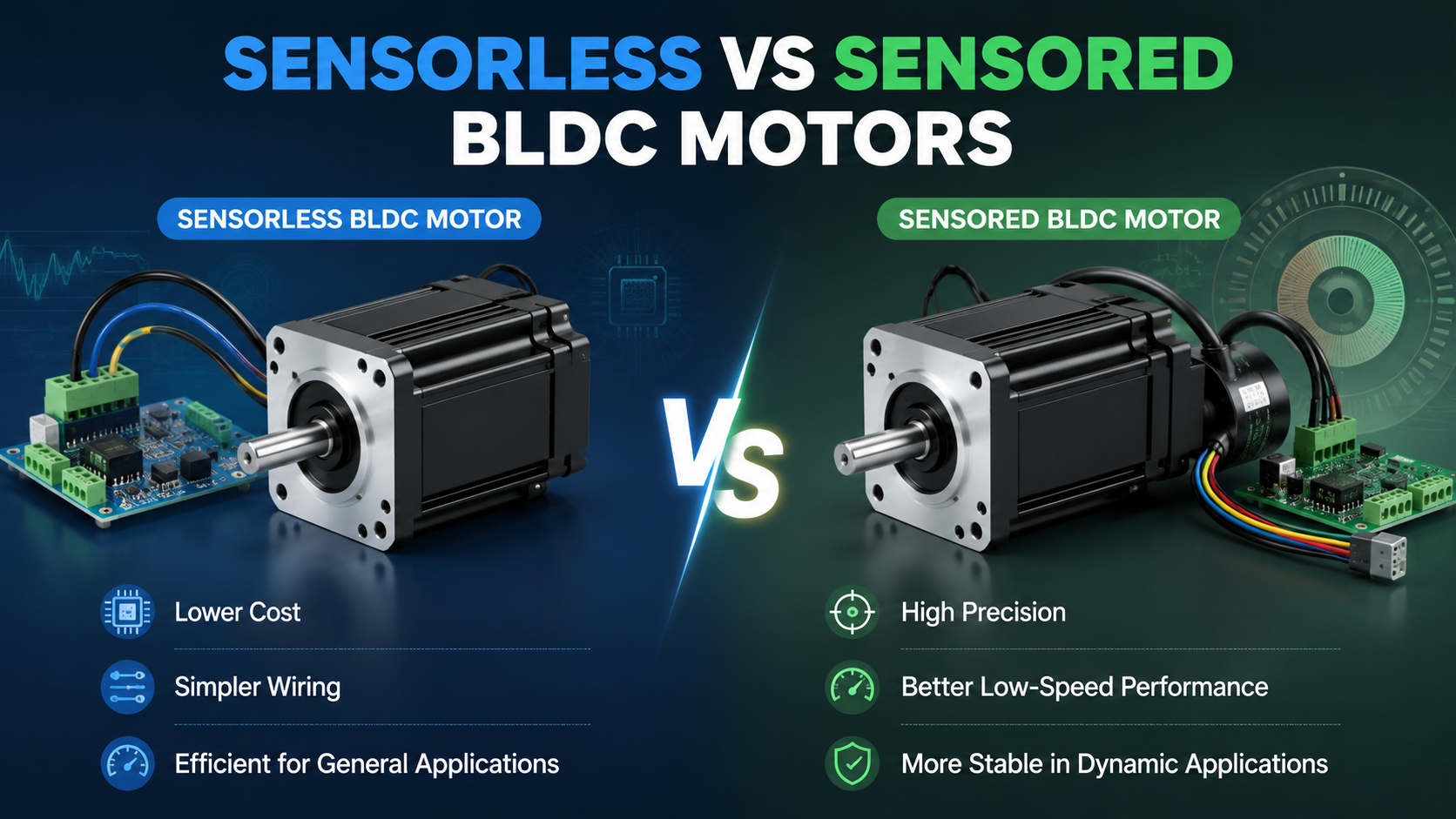
Choosing between Sensorless vs Sensored BLDC Motors depends primarily on startup requirements, low-speed performance, positioning accuracy, and overall system cost.
Sensorless BLDC motors estimate rotor position using back electromotive force, eliminating physical position sensors. They are simpler, lower in cost, highly reliable, and ideal for medium- to high-speed continuous operation.
Sensored BLDC motors use Hall effect sensors or encoders to directly detect rotor position, providing excellent starting torque, smooth low-speed operation, and precise motion control.
For applications such as industrial automation, AGVs, robotics, electric vehicles, medical equipment, and servo systems, sensored BLDC motors are generally preferred. For pumps, fans, blowers, compressors, and many consumer products operating at constant speed, sensorless BLDC motors are often the more economical solution.
Why Rotor Position Matters in BLDC Motors?
A Brushless DC motor requires the inverter to energize the correct stator windings at precisely the right electrical angle. Unlike brushed motors, electronic commutation replaces mechanical brushes.
Without accurate rotor position information, the controller cannot determine:
- Which phase should be energized
- When to switch phases
- How much torque is being produced
- Whether the motor is accelerating correctly
Rotor position can be obtained in two different ways:
- Direct measurement using sensors (Sensored BLDC)
- Mathematical estimation using motor voltage and current (Sensorless BLDC)
This single difference fundamentally affects startup behavior, efficiency, speed stability, controller complexity, and application suitability.
How Sensorless BLDC Motors Work?
A sensorless BLDC motor does not contain Hall sensors or rotary encoders.
Instead, the controller continuously measures:
- Phase voltage
- Phase current
- Back-EMF waveform
The controller estimates rotor position using algorithms such as:
- Zero-crossing detection
- Sliding Mode Observer (SMO)
- Extended Kalman Filter
- Flux Observer
- Model Reference Adaptive System (MRAS)
Once the rotor reaches sufficient speed, the generated back-EMF becomes large enough for accurate position estimation.
Because back-EMF is proportional to rotational speed:
Back-EMF = Ke × Angular Velocity
very low-speed operation presents a challenge, since little or no measurable voltage is generated.
Typical Operating Range
| Parameter | Typical Value |
| Startup | Open-loop |
| Low-speed performance | Fair |
| Medium/high-speed performance | Excellent |
| Speed range | 500–30,000 rpm |
| Position feedback | Estimated |
| Additional sensors | None |
How Sensored BLDC Motors Work?
Sensored BLDC motors incorporate physical rotor position sensors.
Common sensor types include:
- Hall effect sensors
- Incremental encoders
- Absolute encoders
- Magnetic rotary sensors
- Optical encoders
These sensors continuously report rotor position to the motor controller.
As a result, the controller immediately knows the correct commutation sequence—even when the rotor is stationary.
Advantages include:
- Instant startup
- High starting torque
- Stable operation below 100 rpm
- Accurate speed regulation
- Excellent positioning capability
Modern industrial servo systems typically combine high-resolution encoders with Field-Oriented Control (FOC) for maximum precision.
Sensorless vs Sensored BLDC Motors: Side-by-Side Comparison
| Feature | Sensorless BLDC | Sensored BLDC |
| Rotor position | Estimated | Measured directly |
| Hall sensors | No | Yes |
| Encoder | Optional | Often included |
| Startup torque | Moderate | Excellent |
| Low-speed control | Limited | Outstanding |
| High-speed efficiency | Excellent | Excellent |
| Controller complexity | Higher algorithm complexity | Simpler control logic |
| Hardware cost | Lower | Higher |
| Wiring | Simpler | More wiring |
| Reliability | Very high (fewer components) | High |
| Maintenance | Minimal | Sensor inspection occasionally required |
| Precision positioning | Limited | Excellent |
Startup Performance Comparison
Startup represents one of the largest differences between the two technologies.
Sensorless Startup
During startup:
No back-EMF exists.
Rotor position is unknown.
Controller performs open-loop commutation.
Rotor gradually synchronizes.
Potential issues include:
- Reverse rotation
- Startup hesitation
- Missed synchronization
- Reduced starting torque
Heavy-load applications may experience startup failure.
Sensored Startup
Hall sensors immediately indicate rotor position.
The controller:
- Energizes the optimal winding
- Produces maximum torque instantly
- Accelerates smoothly
- Maintains synchronization
This explains why electric vehicles, AGVs, elevators, and industrial robots almost always employ sensored motors.
Low-Speed Performance
Low-speed control is often the deciding factor in industrial applications.
| Speed Range | Sensorless | Sensored |
| 0 rpm | Not possible | Excellent |
| 20 rpm | Difficult | Stable |
| 50 rpm | Moderate | Excellent |
| 100 rpm | Good | Excellent |
| Above 1000 rpm | Excellent | Excellent |
Applications requiring continuous torque below approximately 100 rpm generally benefit from sensored BLDC motors.
Examples include:
- CNC equipment
- Medical devices
- Conveyor systems
- Collaborative robots
- Precision positioning systems
- High-Speed Performance
At higher speeds, back-EMF estimation becomes increasingly accurate.
Advantages of sensorless motors include:
- Lower hardware cost
- Reduced wiring
- No sensor failures
- Better thermal robustness
- Compact construction
Typical applications:
- Cooling fans
- Water pumps
- Compressors
- Vacuum blowers
- Centrifugal pumps
Once operating above roughly 20–30% of rated speed, many sensorless systems achieve efficiency comparable to sensored designs.
Cost Comparison
Cost considerations extend beyond the motor itself.
| Cost Factor | Sensorless | Sensored |
| Motor manufacturing | Lower | Higher |
| Sensors | None | Hall sensors or encoder |
| Cable harness | Simple | Additional signal wiring |
| Controller software | More advanced | Less estimation required |
| Installation | Easier | Slightly more complex |
Although sensored systems involve higher component costs, they often reduce commissioning time and improve machine performance in demanding applications.
Typical Industrial Applications
Best Applications for Sensorless BLDC Motors
Sensorless BLDC motors are widely used where high-speed efficiency, simplified hardware, and lower system cost are priorities.
Typical applications include:
- HVAC fans
- Air blowers
- Centrifugal pumps
- Compressors
- Home appliances
- Electric power tools
- Cooling systems
- Ventilation equipment
Best Applications for Sensored BLDC Motors
Sensored BLDC motors excel in applications requiring accurate speed regulation, rapid response, and reliable torque at low speed.
Common examples include:
- AGVs
- Autonomous mobile robots
- Industrial robots
- CNC machinery
- Medical equipment
- Electric wheelchairs
- Electric steering systems
- Electric vehicles
- Packaging machinery
- Semiconductor automation
Common Engineering Mistakes
Many motor selection issues arise from misunderstanding the strengths and limitations of each technology.
Mistake 1: Choosing Sensorless Motors for Heavy-Load Startup
If the motor must start under full load, sensorless control may struggle because there is no measurable back-EMF at standstill.
Recommendation: Select a sensored BLDC motor or use an advanced sensorless startup strategy with sufficient validation.
Mistake 2: Paying for Sensors in Constant-Speed Applications
For fans, pumps, or blowers running at steady speed, the additional cost of Hall sensors or encoders may provide little practical benefit.
Recommendation: Sensorless BLDC motors generally offer the best balance between cost and performance.
Mistake 3: Ignoring Environmental Conditions
Hall sensors and encoder assemblies may be exposed to heat, moisture, vibration, or electromagnetic interference.
Recommendation: Choose industrial-grade sensors with suitable IP protection and verify operating temperature ratings.
Mistake 4: Overlooking Controller Compatibility
Not all motor controllers support both sensorless and sensored operation.
Recommendation: Confirm that the controller firmware, commutation method, and communication interface match the selected motor.
Troubleshooting Guide
| Problem | Possible Cause | Recommended Solution |
| Motor fails to start | No rotor position estimation | Improve startup algorithm or use sensored motor |
| Low-speed vibration | Weak back-EMF signal | Switch to Hall sensor feedback |
| Torque ripple | Incorrect commutation timing | Recalibrate controller parameters |
| Speed instability | Poor observer tuning | Optimize FOC or observer gains |
| Hall sensor fault | Wiring or sensor damage | Inspect sensors and replace if necessary |
| Encoder communication errors | Electrical noise or cable issues | Improve shielding and verify encoder connections |
How to Choose Between Sensorless and Sensored BLDC Motors?
Before selecting a BLDC motor, engineers should evaluate several key operating requirements rather than focusing solely on motor cost.
Consider the following questions:
Will the motor start under heavy load?
Is smooth operation required below 100 rpm?
Does the application require precise positioning or speed regulation?
Is minimizing wiring and maintenance a priority?
What are the environmental conditions, such as temperature, vibration, or moisture?
Does the motor controller support sensorless algorithms, Hall sensors, or encoder feedback?
For industrial automation, robotics, medical equipment, and precision motion control, a sensored BLDC motor generally delivers the best overall performance.
For fans, pumps, compressors, and other constant-speed applications, a sensorless BLDC motor often provides an optimal balance of efficiency, reliability, and cost.
Conclusion
The debate over Sensorless vs Sensored BLDC Motors is not about determining which technology is universally better; rather, it is about selecting the most appropriate solution for a specific application. Sensorless BLDC motors reduce hardware complexity, eliminate position sensors, and deliver excellent efficiency during medium- and high-speed operation, making them well suited for pumps, fans, blowers, compressors, and many cost-sensitive systems. Sensored BLDC motors, by contrast, provide immediate rotor position feedback, superior starting torque, smooth low-speed performance, and accurate motion control, making them the preferred choice for robotics, AGVs, CNC machinery, electric vehicles, and other precision industrial equipment. At UNITED MOTION INC., engineers work closely with OEMs to evaluate load characteristics, speed requirements, control strategies, environmental conditions, and lifecycle costs, ensuring that every BLDC motor solution is optimized for long-term reliability, efficiency, and overall system performance.
Frequently Asked Questions (FAQ)
Is a sensorless BLDC motor more efficient?
At medium and high speeds, sensorless BLDC motors can achieve efficiencies comparable to sensored systems because there are no sensor-related losses and fewer components.
Why can’t sensorless BLDC motors start well under heavy load?
Back-EMF is nearly zero when the rotor is stationary, so the controller cannot accurately estimate rotor position during startup.
Are Hall sensors better than encoders?
Hall sensors are cost-effective and suitable for commutation, while encoders provide significantly higher resolution for precision positioning and servo applications.
Can a sensorless BLDC motor operate at zero speed?
No. Sensorless control relies on back-EMF, which is absent at standstill. Zero-speed holding generally requires physical position sensors or advanced observer techniques.
Which BLDC motor is best for robotics?
Most robotic systems use sensored BLDC motors with encoders because they require precise speed regulation, accurate positioning, and smooth low-speed torque.
What industries commonly use sensorless BLDC motors?
Sensorless BLDC motors are widely used in HVAC equipment, pumps, blowers, compressors, cooling systems, household appliances, and electric power tools.
Related blog: PMDC Motor vs BLDC Motor: Which Is Better for Industrial Automation?