Electric motors power nearly every industrial and commercial system, from HVAC units and pumps to conveyors, compressors, and manufacturing equipment. One of the most common engineering questions is:
Should I choose a single-phase motor or a three-phase motor?
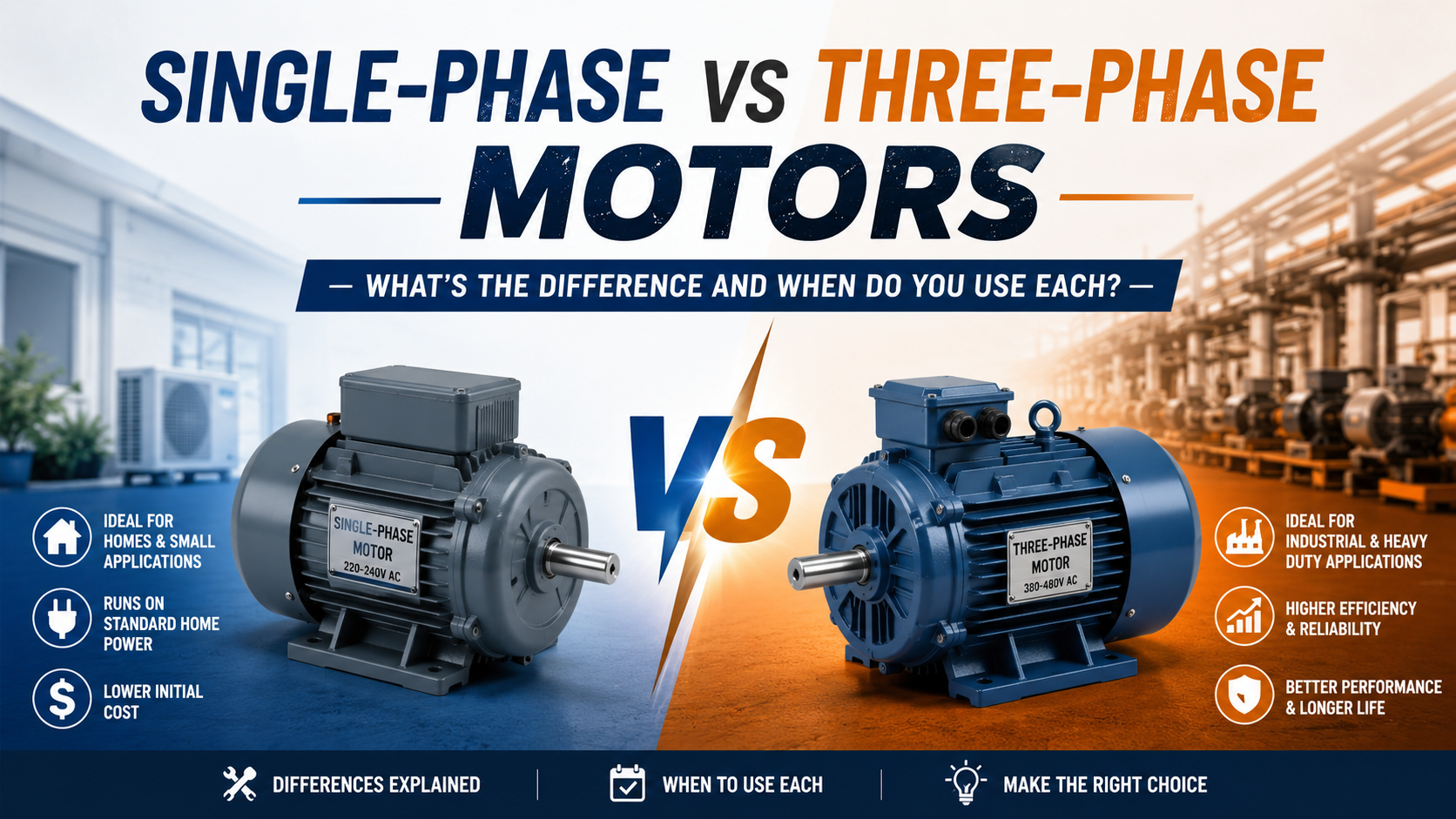
The answer depends on available power supply, load requirements, efficiency targets, startup characteristics, and long-term operating costs.
This guide explains the technical differences between single-phase and three-phase motors, helping engineers, OEM designers, maintenance teams, and purchasing managers make informed motor selection decisions.
Quick Answer
Single-phase motors are typically used for residential and light commercial applications where only single-phase AC power is available. They are simpler and less expensive but generally provide lower efficiency and starting torque.
Three-phase motors are preferred for industrial applications because they offer higher efficiency, smoother operation, greater power density, better starting performance, and lower operating costs over time.
At a Glance
| Factor | Single-Phase Motor | Three-Phase Motor |
| Power Supply | 120V / 230V AC | 208V / 380V / 400V / 460V AC |
| Typical Power Range | 1/20 HP – 10 HP | 1 HP – 500+ HP |
| Starting Torque | Moderate | High |
| Efficiency | Lower | Higher |
| Maintenance | Higher | Lower |
| Initial Cost | Lower | Higher |
| Industrial Use | Limited | Extensive |
| Power Delivery | Pulsating | Continuous |
What Is a Single-Phase Motor?
A single-phase motor operates using a single alternating current waveform supplied through one live conductor and one neutral conductor.
Because the power waveform crosses zero voltage twice per cycle, the motor cannot generate a naturally rotating magnetic field.
As a result, auxiliary components are required to start the motor.
Common starting methods include:
- Capacitor-start
- Capacitor-start capacitor-run
- Split-phase
- Shaded-pole designs
After startup, the motor continues running using the alternating magnetic field generated by the stator.
Typical Single-Phase Applications
- Residential HVAC systems
- Fans and blowers
- Small pumps
- Household appliances
- Garage door systems
- Small machine tools
What Is a Three-Phase Motor?
A three-phase motor receives power from three AC waveforms separated by 120 electrical degrees.
This configuration naturally creates a rotating magnetic field inside the stator.
The rotating magnetic field produces smooth and continuous torque without requiring additional starting mechanisms.
Most industrial motors are three-phase induction motors or permanent magnet synchronous motors.
Typical Three-Phase Applications
- Manufacturing equipment
- Conveyor systems
- Industrial pumps
- Compressors
- CNC machinery
- Robotics
- Material handling systems
- Process automation
How Single-Phase and Three-Phase Motors Generate Torque?
The primary difference lies in how the magnetic field is produced.
Single-Phase Motor Operation
The stator receives one AC waveform.
Without assistance, the magnetic field merely oscillates back and forth.
This creates:
- Zero starting torque
- Reduced efficiency
- Higher vibration
A start winding and capacitor create phase displacement to initiate rotation.
Three-Phase Motor Operation
Three sinusoidal currents create a naturally rotating magnetic field.
Benefits include:
- Self-starting capability
- Constant torque production
- Smooth rotation
- Higher power density
Research from the Massachusetts Institute of Technology (MIT) Electrical Engineering Department indicates that rotating magnetic field generation is the fundamental reason three-phase systems dominate industrial power applications. (MIT OpenCourseWare, Electrical Machines, Massachusetts Institute of Technology, updated educational materials)
Single-Phase vs Three-Phase Motors: Technical Comparison
1. Power Capability
Single-phase motors are generally limited in size.
Typical range:
50 W to 7.5 kW
Up to approximately 10 HP
Three-phase motors can easily exceed:
500 kW
670 HP
Industrial facilities commonly operate motors in the hundreds or thousands of horsepower range.
Source:
U.S. Department of Energy (DOE), Improving Motor and Drive System Performance Guide, Office of Energy Efficiency and Renewable Energy.
Winner: Three-Phase
2. Efficiency
Motor efficiency directly affects electricity consumption and operating costs.
Typical Efficiency Ranges
| Motor Type | Efficiency Range |
| Single-Phase | 60%–85% |
| Three-Phase | 85%–97% |
According to the U.S. Department of Energy, electric motor systems consume approximately 70% of industrial electricity usage, making efficiency a critical selection factor.
Source: U.S. Department of Energy, Energy Efficiency and Renewable Energy Program, Motor Systems Resource Facility, updated guidance.
Winner: Three-Phase
3. Starting Torque
Starting torque is important for:
- Compressors
- Pumps
- Conveyors
- Crushers
- Industrial automation
Typical Starting Torque
| Motor Type | Starting Torque |
| Split-Phase | 100–175% |
| Capacitor Start | 200–400% |
| Three-Phase Induction | 150–300% |
Three-phase motors achieve high starting torque without requiring capacitors or start switches.
Source: IEEE Industry Applications Society technical references on AC motor performance characteristics.
Winner: Three-Phase
4. Power Quality and Smoothness
Single-phase motors experience torque pulsations because power fluctuates during each AC cycle.
This may lead to:
- Vibration
- Noise
- Reduced bearing life
Three-phase motors maintain more uniform torque production.
Benefits include:
- Reduced vibration
- Longer service life
- Better process stability
Source: Electrical Machinery Fundamentals, Stephen J. Chapman, McGraw-Hill Education.
Winner: Three-Phase
5. Initial Investment Cost
Single-phase systems often have lower initial costs because:
- Simpler electrical infrastructure
- Lower installation expenses
- Fewer conductors required
However, the lower purchase price may be offset by higher energy consumption over time.
Winner: Single-Phase
Efficiency Impact on Operating Costs
Consider a motor operating:
- 8 hours/day
- 300 days/year
- Electricity cost: $0.12/kWh
- Example
Required output power:
5 kW
Single-phase motor efficiency:
80%
Input power:
6.25 kW
Three-phase motor efficiency:
92%
Input power:
5.43 kW
Annual energy consumption difference:
(6.25 − 5.43) × 2400 hours
= 1,968 kWh
Annual savings:
$236+
Over ten years:
More than $2,300 in energy savings.
Source: Calculation methodology based on DOE motor efficiency guidance and industrial electricity cost averages.
When Should You Use a Single-Phase Motor?
Single-phase motors are appropriate when:
Power Availability Is Limited
Many buildings only provide:
120V AC
230V AC
Installing three-phase service may be expensive.
Load Requirements Are Light
Examples include:
- Exhaust fans
- Water pumps
- Small air compressors
- Workshop equipment
Budget Is a Primary Concern
Lower acquisition cost may outweigh efficiency benefits for low-duty applications.
When Should You Use a Three-Phase Motor?
Three-phase motors should be selected when:
Continuous Operation Is Required
Examples:
- Manufacturing lines
- Packaging equipment
- Process plants
- High Power Is Needed
Applications exceeding:
- 5 HP
- Frequent starts
- Heavy loads
- Energy Efficiency Matters
Energy savings often justify the higher upfront cost.
Variable Speed Control Is Required
Modern VFD systems integrate seamlessly with three-phase motors.
Source: National Electrical Manufacturers Association (NEMA) motor application guidelines.
Common Engineering Mistakes
Mistake1: Choosing Based Only on Purchase Price
Many engineers focus on motor price rather than total ownership cost.
Energy costs often exceed motor purchase costs multiple times during the motor’s life.
Mistake2: Ignoring Starting Requirements
A motor that starts successfully under no-load conditions may fail under full-load startup.
Always evaluate:
- Breakaway torque
- Load inertia
- Acceleration requirements
Mistake3: Oversizing the Motor
Oversized motors often operate below peak efficiency.
The DOE recommends properly matching motor size to the actual load profile.
Mistake4: Overlooking Power Infrastructure
Verify available power supply before specifying the motor.
Retrofitting a facility for three-phase service can significantly increase project costs.
Troubleshooting Guide
| Symptom | Possible Cause | Recommended Action |
| Motor fails to start | Failed capacitor | Test and replace capacitor |
| Excessive vibration | Phase imbalance or bearing wear | Check supply and bearings |
| Overheating | Overload condition | Verify load and current draw |
| Low torque | Voltage drop | Measure supply voltage |
| Frequent tripping | Incorrect motor sizing | Recalculate load requirements |
| High noise level | Mechanical misalignment | Inspect mounting and coupling |
Single-Phase vs Three-Phase Motors for Modern Automation
Industrial automation increasingly favors:
- Three-phase induction motors
- Brushless DC motors (BLDC)
- Permanent magnet synchronous motors (PMSM)
- Servo motors
These technologies provide:
- Better efficiency
- Precise speed control
- Lower maintenance
- Improved reliability
For OEM equipment manufacturers, three-phase motor systems are generally the preferred choice when industrial power is available.
At UNITED MOTION INC., engineers frequently recommend three-phase BLDC and servo motor solutions for automation, robotics, material handling, medical devices, and industrial motion control systems requiring high efficiency and precise performance.
Conclusion
The difference between single-phase and three-phase motors extends beyond power supply configuration.
Single-phase motors offer a practical and economical solution for light-duty applications where only residential or commercial power is available.
Three-phase motors deliver superior efficiency, torque, reliability, and scalability, making them the standard choice for industrial systems.
For applications involving continuous operation, heavy loads, automation equipment, or long-term energy savings, a three-phase motor is usually the better engineering investment.
When selecting a motor, evaluate:
- Available power source
- Load characteristics
- Starting torque requirements
- Duty cycle
- Energy consumption
- Lifecycle cost
The correct choice can significantly improve system performance, reliability, and operating efficiency.
Frequently Asked Questions
Is a three-phase motor always more efficient than a single-phase motor?
In most industrial applications, yes. Three-phase motors typically achieve efficiencies between 85% and 97%, while single-phase motors generally operate between 60% and 85%.
Can a three-phase motor run on single-phase power?
Yes, but additional equipment such as a phase converter or variable frequency drive is typically required. Performance may be reduced.
Why do three-phase motors have higher starting torque?
Three-phase power naturally creates a rotating magnetic field, allowing the motor to generate torque immediately without auxiliary starting circuits.
Are single-phase motors cheaper?
The initial purchase price is usually lower. However, lifetime operating costs may be higher due to reduced efficiency.
What industries use three-phase motors most often?
Common industries include manufacturing, food processing, material handling, packaging, mining, HVAC, water treatment, and automation.